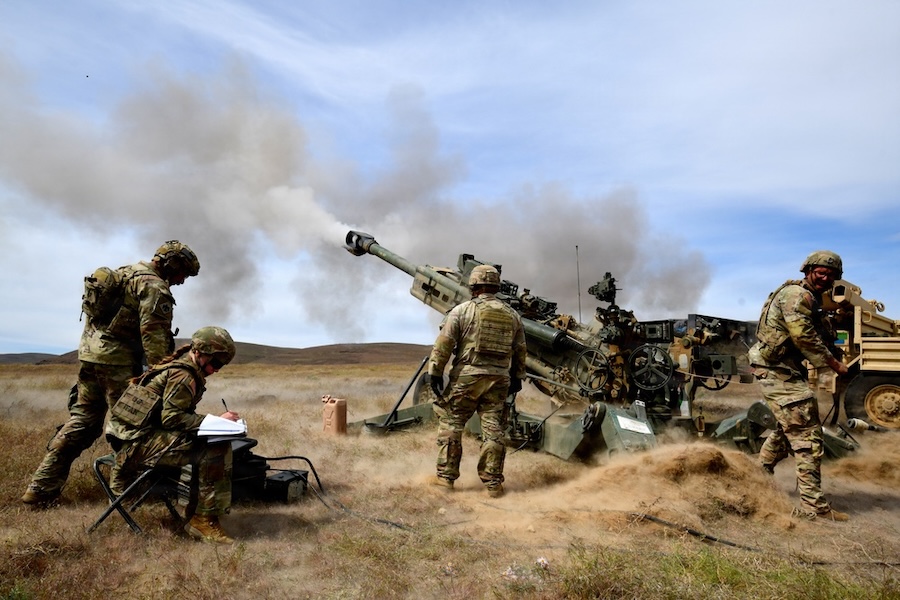
I Corps, headquartered at Joint Base Lewis-McChord in Washington, recently completed its first Operation Courage Lethality exercise. The exercise tested soldiers’ ability to conduct coordinated attacks across multiple domains while reducing their digital footprint.
Units in Washington, Hawaii, Alaska, Oregon, Australia and Idaho tested AI-enhanced capabilities across thousands of miles during the April exercise. Soldiers used live data to simulate a long-distance battle scenario across the South China Sea.
As part of wider Army transformation efforts, the 25th Infantry Division at Schofield Barracks in Hawaii and the 4th Infantry Division at Fort Carson in Colorado are working to improve data accessibility through next-generation command and control, known as NGC2. The system uses AI-enhanced technology and advanced applications to support commanders’ decisions rather than replace human judgement.
“Let’s be clear: artificial intelligence is not designed to replace the commander,” said retired Army Lt. Gen. Neil Thurgood, former director of the Army’s Rapid Capabilities and Critical Technologies Office.
“It is designed to assist the commander in making better decisions and more timely decisions, with more data and information available,” Thurgood added.
Thurgood said warfighters should focus on three major trends shaping future command and control. These include the shift from a linear kill chain to an AI-enabled network kill web linking sensors, shooters and command centres, the increasing importance of decision speed, and the move toward modular command systems that are continuously upgraded.
Army Maj. Gen. Denise McPhail, commander of the U.S. Army Network Enterprise Technology Command, said adversaries have already used AI to exploit civilian-sector vulnerabilities. She said the Army must be prepared to defend networks and operate quickly in contested digital environments.
“The future of AI is going to be to be able to secure at speed and to operate at speed,” McPhail said. “AI empowers commanders. … but it also allows us to do as humans, only what we can do, and that is critical thinking.”
“All we can do is train the AI, but we have the ability to do the critical thinking, not the AI, so we can’t be over-reliant on it,” McPhail added.
McPhail said the Army could benefit from using digital twins to simulate network conditions and help commanders identify outages or vulnerabilities. She said such tools could allow leaders to assess potential network problems in hours or days rather than months.
Army Maj. Gen. Matthew Cogbill, commander of the 11th Airborne Division and U.S. Army Alaska, said soldiers will need stronger data literacy as the battlefield becomes increasingly saturated with information. He said intelligence soldiers in particular should receive training that helps them understand and use data effectively.
“You have to train everybody; we need a data-literate workforce,” Cogbill said. “The younger generation is much easier to [train] because they’re digital natives and they’ve had computers in their pockets their entire lives.”
“They want to know about the data; they want access to everything because that’s how they’ve grown up,” Cogbill added. “So I think you’ve got to train them like you train anything else, through reps and sets.”