

The demonstration was sponsored by the Office of the Under Secretary of War for Acquisition & Sustainment and supported by the Operational Energy Capability Improvement Fund. It was conducted in partnership with Boeing and the DEVCOM Ground Vehicle Systems Center, with collaboration across Navy, Marine Corps and Army stakeholders.
The test showed how a fielded laser system could provide remote power delivery while retaining its original role as a directed-energy defense capability. Researchers used a trailer-mounted laser positioned across an airfield to transmit power from a standard military vehicle to specialized receivers at a remote location.
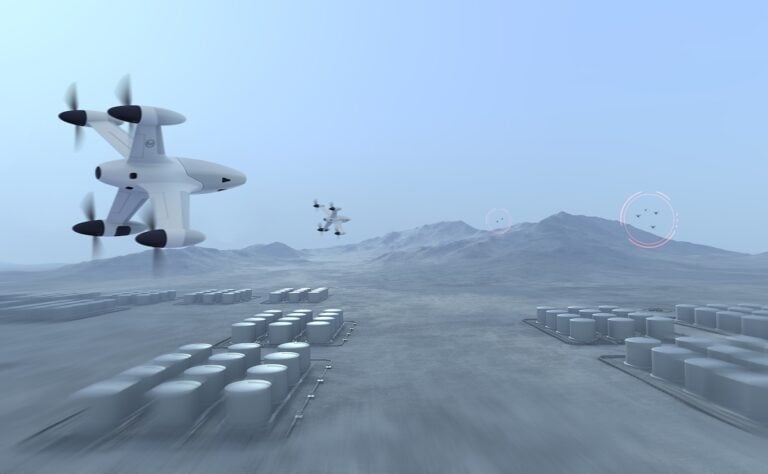
The same laser system then transitioned without delay to address a simulated aerial threat. NRL said this proved the system’s ability to perform both missions without interrupting operations.
“This was not just a laboratory exercise we were building the pieces for what this capability could actually look like on the battlefield,” said NRL Electrical Engineer Alex Grede, Ph.D. “We demonstrated that the same laser used to beam power remotely can immediately transition to counter a drone threat, giving Marines and soldiers greater flexibility without changing their operational footprint.”
Unlike previous record-setting power beaming demonstrations conducted in highly controlled desert conditions, this test focused on realistic field environments. NRL said the work also examined adverse atmospheric conditions to identify technical improvements needed for operational use.
The team continued testing through severe weather. That included snowfall approaching whiteout conditions until visibility nearly disappeared, while researchers collected data for future system refinement.
“We wanted to prove this could work where warfighters actually operate, not just in ideal conditions,” said NRL Research Physicist Justin Lorentzen. “Testing in wind, snow and real atmospheric interference gives us the data we need to improve the system and move it toward a true operational capability.”
The demonstration also highlighted joint-service collaboration. While NRL continues developing the technology for naval applications, U.S. Army operational requirements helped shape the field test.
Those requirements were especially relevant for expeditionary power scenarios. NRL said replacing fuel-dependent generators could improve logistics and survivability.
“The service most likely to field this kind of capability first may be the Army, and that’s exactly why this collaboration matters,” Grede said. “We can take the expertise we’ve built at NRL and help accelerate capability development across the joint force. That’s good for the services and good for the country.”
The laser system used in the demonstration was already fielded by the U.S. Marine Corps for directed-energy applications. The team paired that capability with high-efficiency solar receivers and mobile vehicle power generation.
NRL said the demonstration showed a practical pathway toward distributed and resilient energy delivery for forward operations. The test also validated rapid field maintenance and ease of operation.
During the event, researchers quickly repaired a key system component in the field. NRL said this demonstrated system resilience and maintainability in operational conditions.
“You can’t have a system that takes months to repair or months to train someone to use,” said NRL Radar Division Military Deputy Lt. Cmdr. Brian Di Salvo. “This system showed both repairability and simplicity of operation, qualities that matter when you’re talking about real deployment with young operators in the field.”
Researchers said the next phase will include additional demonstrations with Marines, Soldiers and Sailors. The work will gather direct user feedback and tailor the system for operational needs.
“Our next goal is putting this capability in front of warfighters and letting them tell us how they would use it,” Grede said. “That feedback is what will help shape the next generation of power beaming systems.”
The work supports NRL’s efforts to develop scalable directed-energy technologies. NRL said these technologies are intended to improve expeditionary logistics, strengthen battlefield resilience and expand the operational reach of U.S. forces.
The Operational Energy Capability Improvement Fund is the Department of War’s joint operational energy investment program. NRL said the fund supports pre-commercialization work through targeted science and technology investments that mature advanced operational energy technologies across warfighting platforms and domains.