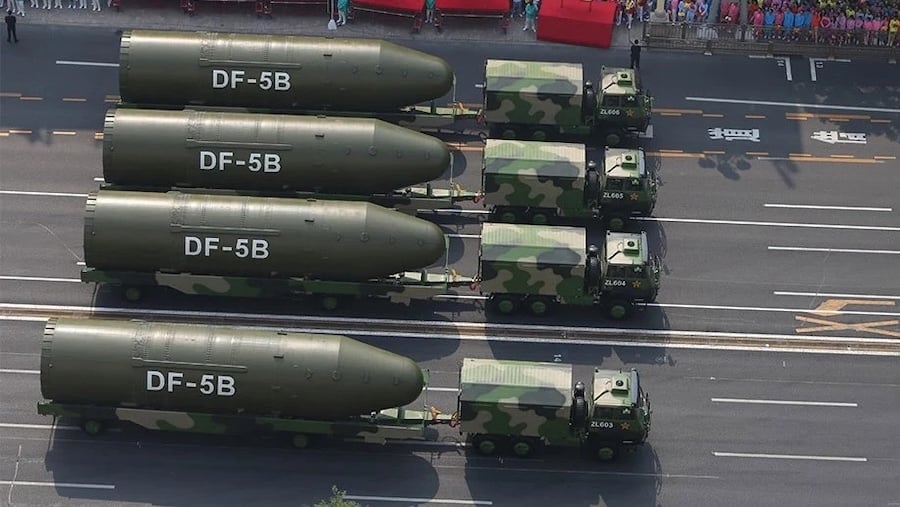
China already operates land-, air- and sea-based systems capable of delivering nuclear weapons. The Ministry of Defence linked that military expansion to a more assertive international posture, including activity in the South China Sea and the Taiwan Strait that it described as dangerous and destabilising.
The assessment presents China’s build-up as part of a wider deterioration in the security environment facing Britain and its NATO allies. Other nuclear-armed states are also modernising, expanding and diversifying their arsenals while investing in new weapons and delivery technologies.
Russia remains the most heavily armed country identified in the document, with more than 4,000 nuclear warheads available for use. It can deliver weapons over long ranges through its strategic nuclear triad and at shorter ranges from land-, sea- and air-based platforms.
Moscow is also expanding novel dual-capable systems that can carry conventional or nuclear warheads, according to the ministry. Britain said Russia had used such systems in Ukraine while accompanying its military modernisation with irresponsible nuclear rhetoric.
The document also identified Iran and North Korea as sources of growing concern. Iran’s programme has brought it closer to producing weapons-grade material, while North Korea continues to develop nuclear weapons and longer-range missiles.
The Ministry of Defence said the growing scale, complexity and diversity of these threats had driven a major renewal of Britain’s nuclear capabilities. The government is reprioritising the Defence Nuclear Enterprise on a scale not seen since the end of the Cold War.
Britain will invest £15 billion during the current Parliament in its sovereign warhead programme, supporting more than 9,000 jobs. The funding includes Astraea, which will replace the Mk4A warhead while retaining compatibility with the Trident II D5 ballistic missile.
The UK is also building four Dreadnought-class ballistic missile submarines to replace the Vanguard fleet from the early 2030s. Dreadnought will support more than 30,000 UK jobs at its peak and maintain Britain’s Continuous At Sea Deterrence.
The wider Defence Nuclear Enterprise currently supports an estimated 47,600 jobs, with workforce demand expected to reach around 65,000 by 2030. Its industrial network includes more than 6,000 British companies working across submarines, warheads, reactor technology, nuclear fuels and infrastructure.
Britain defines its policy as maintaining an independent, minimum and credible deterrent assigned to NATO’s defence. The government says it will retain only the destructive power required to deter the full range of state nuclear threats.
The UK maintains deliberate ambiguity over when, how and at what scale it might contemplate the use of nuclear weapons. It says they would be considered only in extreme circumstances of self-defence, including the defence of NATO allies.
The government said its modernisation plans remained consistent with Britain’s long-term commitment to nuclear disarmament. It argued, however, that UK reductions in recent decades had not been matched by other nuclear-armed states and that the deterrent would remain in place for as long as required.