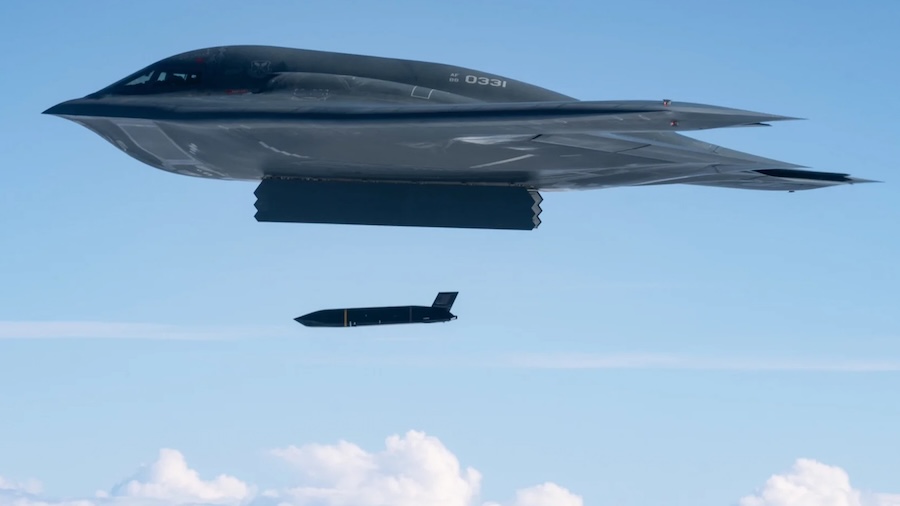
Pacific Air Forces said a B-2 assigned to the 509th Bomb Wing launched an LRASM during a live-fire sinking exercise north of the Mariana Islands on June 27. The service had not previously announced the missile’s integration with the bomber, leaving unclear how long the capability had been available.
The disclosure comes amid growing U.S. concern over China’s expanding naval power and the anti-access and area-denial systems intended to keep American forces away from the First Island Chain. Pairing a low-observable bomber with a long-range, autonomous anti-ship missile directly supports Pentagon efforts to strike naval targets without moving surface vessels or aircrews deep inside heavily defended areas.
The Pentagon’s fiscal 2027 budget request makes no reference to LRASM integration on the B-2. It lists only the Navy’s F/A-18E/F Super Hornet and the Air Force’s B-1B bomber as approved launch platforms, while efforts to add the weapon to the F-15E, F-15EX, F-16, selected F-35 variants and P-8A Poseidon have been discussed publicly.
Air Force Global Strike Command told reporters that details of the B-2 integration remain classified, including whether the June launch was the aircraft’s first. Pacific Air Forces also stopped short of describing the mission as a milestone, saying only that the exercise demonstrated an “enhanced ability to achieve strategic objectives within range of potential threats.”
The integration may have been simplified by the B-2’s existing ability to carry the AGM-158 Joint Air-to-Surface Standoff Missile family, from which LRASM was developed. The land-attack and anti-ship weapons use the same basic airframe, potentially reducing the engineering and testing required to add LRASM to the bomber.
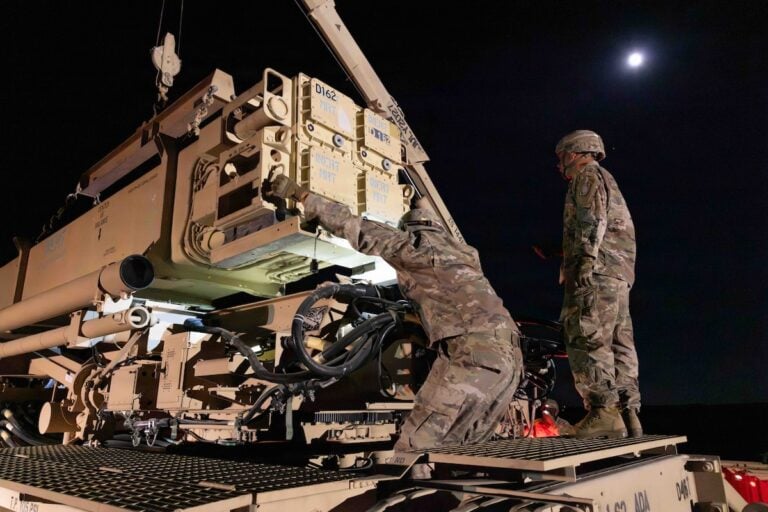
Air Force photographs showed personnel from the 393rd Bomber Generation Squadron loading a live missile onto a B-2 at Whiteman Air Force Base, Missouri, on June 22. Five days later, the aircraft conducted the maritime-strike mission over the Philippine Sea after operating from Andersen Air Force Base on Guam.
The Defense Advanced Research Projects Agency developed LRASM to attack well-defended surface vessels from beyond visual range, including in environments where satellite communications and supporting intelligence, surveillance and reconnaissance aircraft may be disrupted. The missile is designed to operate with limited external support after launch, reducing its dependence on communication links that an advanced adversary could jam or disable.
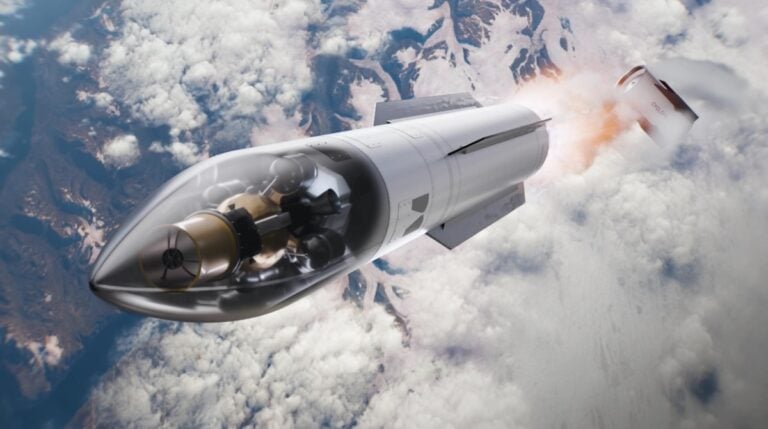
LRASM initially navigates using GPS before switching to a passive infrared seeker during its terminal approach. Because the seeker does not emit radar signals, the missile is more difficult for a target ship’s radar-warning systems to detect.
An onboard database helps the missile identify the class of its intended target and direct the attack towards a vulnerable area. Its sensors also allow it to detect and avoid air defences along its route, while multiple missiles can coordinate during a salvo.
The weapon carries a 1,000-pound warhead and has a publicly reported range of more than 200 nautical miles. The Navy is also developing the extended-range LRASM C-3 variant, with early operational capability targeted by the end of fiscal 2026.
The Air Force disclosed the B-2 mission shortly after opening market research into a new family of missiles capable of attacking land, air and maritime targets at distances of up to 1,000 nautical miles. That work forms part of the service’s Long-Range Kill Chain concept for operations against a heavily armed peer competitor.
The timing places the B-2 integration within a wider effort to expand U.S. strike options in the Indo-Pacific. A stealth bomber launching difficult-to-detect anti-ship missiles from hundreds of miles away would force an adversary to defend its fleet against attacks originating well beyond the immediate battlespace.
Pacific Air Forces Commander Gen. Kevin B. Schneider linked the capability to U.S. efforts to preserve a free and open Indo-Pacific. The combination of the B-2 and LRASM strengthens the Air Force’s ability to attack maritime targets while remaining outside the most concentrated layers of hostile air defence.
The B-2 launch formed part of a larger U.S.-led operation against the decommissioned amphibious warfare ship USS Juneau about 200 nautical miles from Guam. American and allied forces fired several types of weapons at the vessel, with a Japanese submarine appearing to deliver the final strike using a torpedo.
A Royal New Zealand Air Force P-8A Poseidon launched two Harpoon missiles, marking the service’s first live firing of the weapon. Japanese forces also attacked the ship with a helicopter-launched Hellfire missile, a destroyer-launched anti-ship missile and a fighter-launched cruise missile.
The coordinated operation reflected the growing importance of maritime strike capabilities in allied planning for the region. It also demonstrated how aircraft, surface ships and submarines from several countries could combine different weapons against a single naval target.
The new mission has implications beyond the B-2 fleet, which has only 19 aircraft in service and is due to be retired. The B-21 Raider is expected to inherit much of the Spirit’s mission portfolio, with industry observers now widely anticipating that the next-generation bomber will also carry LRASM.
Unlike the small B-2 fleet, the B-21 programme is intended to produce a substantially larger force of stealth bombers. LRASM integration would therefore give the Air Force more low-observable aircraft capable of threatening hostile warships from long range and from within contested airspace.