The investment is becoming a more significant part of Northrop Grumman’s capital-spending outlook. Chief Financial Officer John Greene said during the company’s second-quarter 2026 earnings call that capital expenditures are expected to reach $1.85 billion this year.
Northrop Grumman expects capital spending to remain at about 4.5% of sales in both 2027 and 2028. Greene specifically linked that investment profile to infrastructure required for the B-21 production ramp.
Higher B-21 activity is already feeding through to the company’s financial performance. Aeronautics Systems sales increased 13% in the second quarter, with higher Raider volumes among the main drivers, Greene said.
Northrop Grumman also raised its 2026 Aeronautics Systems sales outlook to about $14 billion. The revised forecast reflects higher B-21 sales as the program continues to ramp, alongside stronger volumes on mature production programs.
Chief Executive Officer Kathy Warden identified the B-21 among the programs where investments made over several years are beginning to support stronger growth. She said Northrop Grumman has invested both in new capabilities and in the production capacity needed to respond to higher customer demand.
“We also have been investing in capacity,” Warden said during the July 21 call. She said having manufacturing capacity available can allow Northrop Grumman to take on work it otherwise would not have been positioned to deliver and accelerate the resulting revenue.
The potential production requirement could become larger still. Asked whether the Air Force was considering increasing the B-21 program of record beyond 100 aircraft, Warden said an existing agreement gives the service scope to examine both faster production and a larger fleet.
“The agreement we reached with the Air Force does allow them to consider accelerating production into a larger program of record,” Warden said. Northrop Grumman is working with the service on the analysis, which she expects the Air Force to complete by the end of 2026.
Warden did not disclose the production rates under consideration or the potential size of an expanded B-21 fleet. The review nevertheless creates the prospect of a further increase in manufacturing requirements for a program already moving through a higher-output phase.
Execution on the bomber has also remained strong, according to management. Greene said B-21 performance during the year had helped keep overall program profitability moving in a positive direction.
Northrop Grumman provided additional context on the scale of its B-21 investment in a January 2026 company announcement. The company said it had invested more than $5 billion in digital engineering and manufacturing infrastructure supporting the Raider program.
“Northrop Grumman has invested more than $5 billion in digital engineering and manufacturing infrastructure, and we are ready to produce B-21 faster,” Warden said in the January statement. Northrop Grumman said the investment supports both digital development and the physical manufacturing capacity needed to scale production.
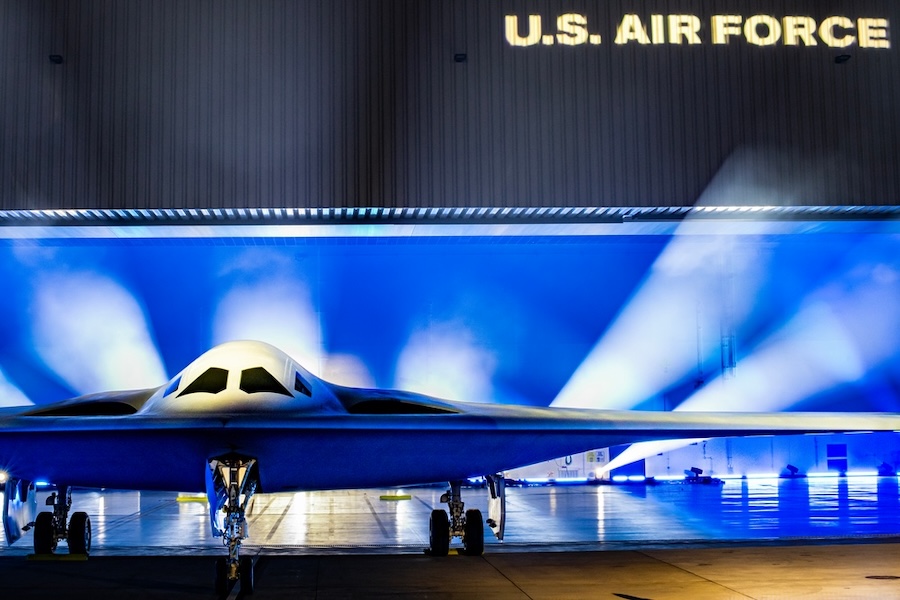
The company describes the B-21 as a sixth-generation stealth bomber incorporating next-generation low-observable technologies. Its digital and manufacturing architecture is also intended to support future software, mission-system and weapons upgrades as the aircraft evolves.
Final assembly is taking place at Northrop Grumman’s Palmdale, California, facility, with other manufacturing operations distributed across the United States. The company said in January that the first B-21 remained on track to arrive at Ellsworth Air Force Base in 2027.
The broader industrial network includes more than 400 suppliers across 40 states and more than 8,000 Northrop Grumman, supplier and Air Force personnel. Northrop Grumman has also invested in digital and augmented-reality manufacturing tools designed to link technicians more closely with engineering teams and improve production efficiency.
Its digital environment extends into testing and software development. Northrop Grumman said in January that software certification time had been reduced by 50%, while real-time analysis of flight-test data was helping increase test efficiency.
Those earlier investments provide context for the capital-spending trajectory management outlined in the second-quarter call. Northrop Grumman is now building on a multibillion-dollar digital and manufacturing base while B-21 volumes rise and the Air Force determines whether the sixth-generation bomber should move to an even larger and faster production profile.