The exercise involved about 2,000 U.S. service members and 2,000 multinational personnel. It was synchronized with NATO’s Steadfast Duel 26, which connected strategic and operational decision-makers across all 32 allies.
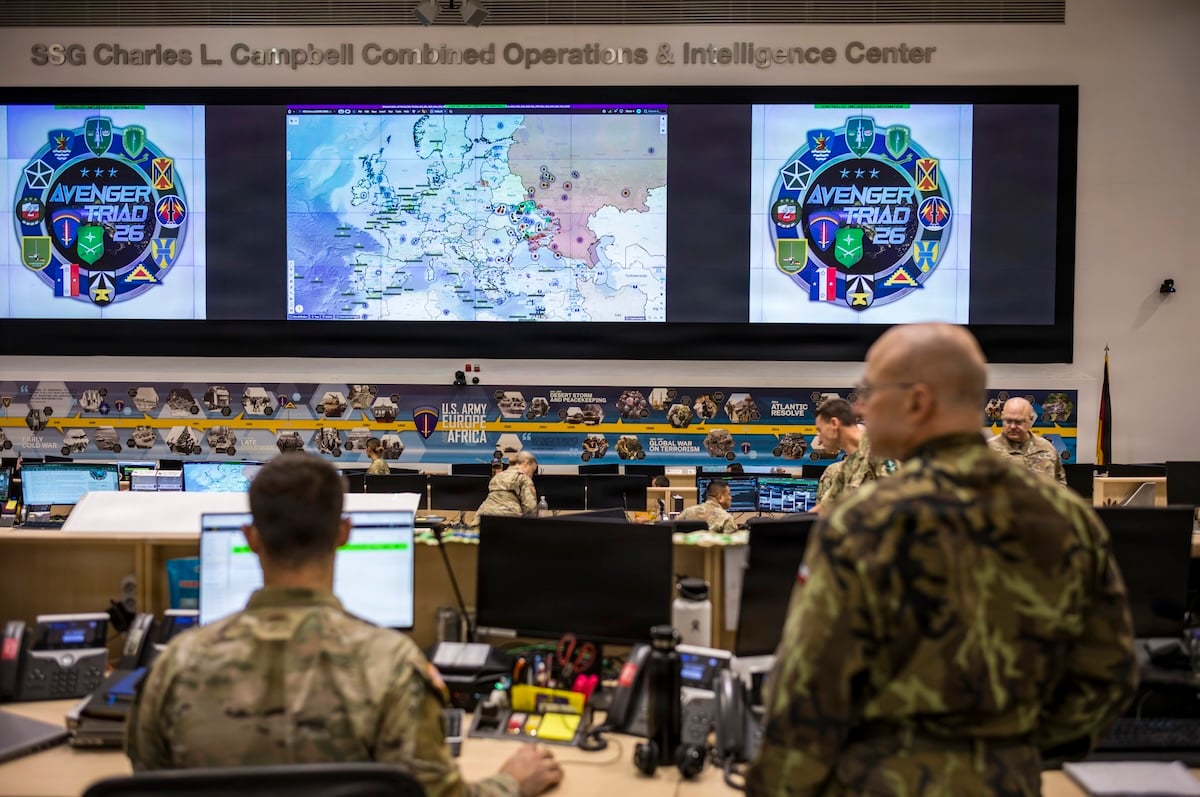
U.S. Army Europe and Africa and NATO’s Allied Land Command operated as an integrated headquarters, primarily from Clay Kaserne in Wiesbaden. Staffs worked under continuous pressure from a simulated opposing force, translating NATO’s regional defense plans into coordinated operations.
“Steadfast Duel and Avenger Triad demonstrated that our collective defense is not just an idea on paper; it is an active, trained reality,” said Lt. Gen. Jez Bennett, acting LANDCOM commander. “By deploying our LANDCOM staff to Wiesbaden to fight alongside our U.S. partners as a single, connected headquarters, we tested our people, validated our processes and refined our ability to deliver decisive action under pressure.”
Participating formations included the U.S. Army’s V Corps, 2nd Polish Corps, 1st French Corps and 1st German-Netherlands Corps. They were supported by theater commands responsible for sustainment, air and missile defense, and multi-domain operations.
One objective was to test NATO’s Eastern Flank Deterrence Initiative in an operational setting. The concept uses sensors, drones, cloud computing and shared data to shorten the time between detecting a threat and engaging it.
Headquarters used command-and-control software, including the Maven Smart System, to maintain a common operating picture. That network supported data processing, commander decisions and coordination of deep fires across land, air, sea, cyber and space.
“What we accomplished in Wiesbaden was a real test of how we will fight if called upon,” said Brig. Gen. Thomas Lowin, LANDCOM’s deputy chief of staff for operations. “Operating as one team, we proved that we can connect distributed sensors to effectors through a resilient digital backbone.”
“While artificial intelligence and modern data tools help us cut through noise and deliver information rapidly, warfare remains fundamentally human,” Lowin said. “Our staff analyzed those options and gave our commander the clarity required to act decisively.”
Avenger Triad and Steadfast Duel also rehearsed a greater European role in theater defense. National and multinational corps practiced operating within NATO’s command structure during an Article 5 collective defense scenario.
“Last year we finished at a high level, and this year we started at that level,” Lowin said. “The credibility of our deterrence rests on our capability.”
“When an adversary sees that 32 nations can share data seamlessly, command corps-level formations across thousands of kilometers and coordinate joint fires in minutes, it sends an unmistakable signal: attacking NATO will not succeed,” Lowin said. The procedures and digital workflows refined during the exercise will inform Steadfast Defender 2027, where they will be tested with live formations in the field.