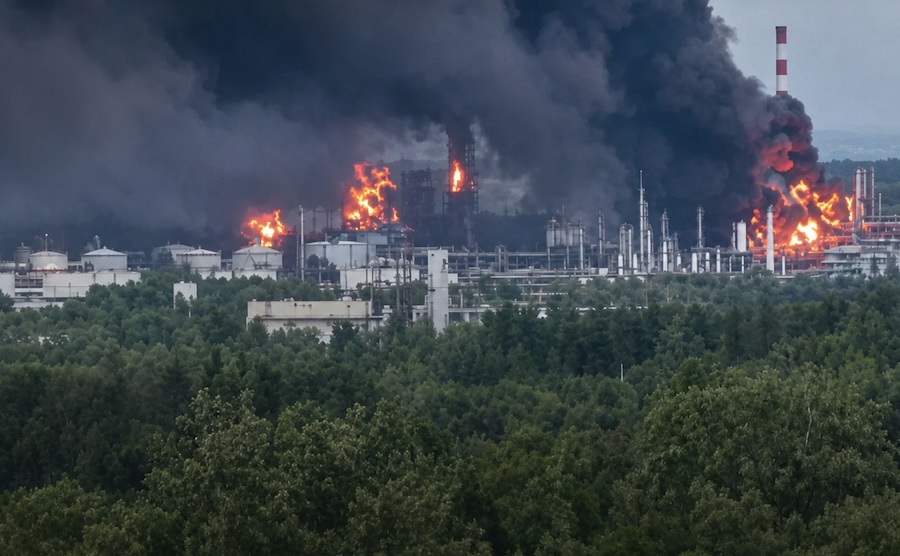
The Defence Forces of Ukraine struck 12 major oil refineries, two gas-processing and petrochemical enterprises, three major fuel terminals and oil depots, and two defence industry facilities, according to the ministry. Six workshops at the defence plants were destroyed or damaged, while several Russian military airfields and other logistics sites were also targeted.
The operations form part of a systematic campaign directed by Ukraine’s President and carried out by the defence ministry, the General Staff of the Armed Forces of Ukraine and other military units. Its stated purpose is to reduce Russia’s defence-industrial capacity and raise the economic and military cost of continuing the war.
The 12 refineries had a combined design capacity of about 100 million tonnes of petroleum products a year. Ukraine targeted processing units used for primary refining, secondary distillation, hydrocracking and catalytic reforming.
The targets included LUKOIL-Nizhegorodnefteorgsintez and the Syzran refinery, each about 800 kilometres from the border, as well as the Kirishi refinery at a distance of about 450 kilometres. The TANECO refinery was about 1,200 kilometres away, Slavneft-YANOS about 700 kilometres and LUKOIL-Permnefteorgsintez about 1,500 kilometres.
Ukraine also struck the Novokuibyshevsk refinery at a range of about 1,000 kilometres, the Saratov refinery at about 700 kilometres and Bashneft-Novoil at about 1,400 kilometres. The Ilsky and Afipsky refineries were each about 400 kilometres from the border, while the Orsknefteorgsintez refinery was about 1,500 kilometres away.
The most distant identified target was Tobolsk-Neftekhim, a petrochemical facility about 1,900 kilometres from the border whose central gas fractionation unit can process 6.6 million tonnes of feedstock annually. Ukraine also hit two U-272 gas-separation units at the Astrakhan Gas Processing Plant, approximately 1,200 kilometres away.
The two facilities produce materials used in rocket and aviation fuels, explosives, unmanned aerial vehicle components and composite materials, the ministry said. Ukraine presented the strikes as an effort to disrupt supplies of raw materials required by Russia’s weapons industry.
Fuel storage and distribution infrastructure was another focus of the August campaign. The targets included Tamanneftegaz, which can handle up to 19.9 million tonnes of petroleum products and liquefied gas annually, the Yeysk oil terminal complex and the Lyudinovskaya oil depot.
Tamanneftegaz and the Yeysk complex are both about 500 kilometres from the border, according to the ministry. The Yeysk facility has loaded more than 1 million tonnes of petroleum products onto maritime transport.
At the Kamensky Combine, also about 500 kilometres from the border, two workshops were destroyed and four sustained significant damage, the ministry said. The plant produces solid rocket propellant for Uragan, Smerch and Tornado-S multiple-launch rocket systems, as well as air-launched weapons.
The Progress Rocket Space Centre in Samara was also hit at a range of about 1,000 kilometres. The facility supports Russia’s military satellite constellation, and the ministry said the attack directly affected Russian intelligence capabilities.
Ukraine said it was striking not only military installations but the full supply chain behind Russia’s war effort, from fuel and raw-material production to weapons manufacturing, storage and delivery. “The aggressor must and will pay a high price for its actions,” the ministry said.