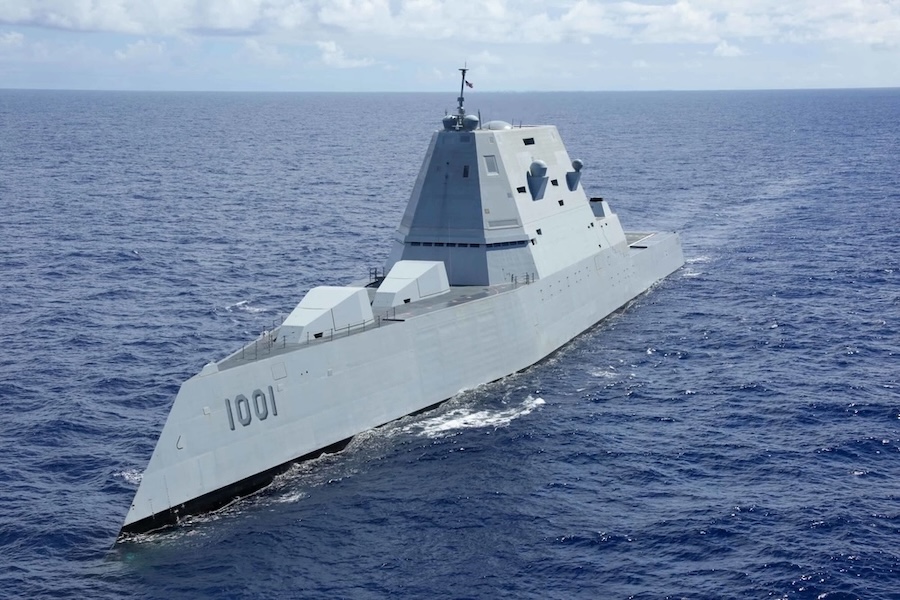
Shipbuilder Huntington Ingalls Industries announced on January 21 that sea trials of USS Zumwalt had been completed following a multi-year overhaul at Ingalls Shipbuilding in Pascagoula, Mississippi. The trials covered propulsion, hull stability, power systems and overall ship performance, forming a key step before the vessel proceeds to further work ahead of returning to operational service.
The modernization has fundamentally redefined the ship’s role, converting it into a platform for the Conventional Prompt Strike hypersonic missile system. This transformation marks a departure from its original concept as an advanced artillery destroyer designed for naval fire support.
On March 31, the U.S. Department of War announced a $1.356 billion contract modification with Lockheed Martin Space. The decision confirms that the hypersonic missile program is transitioning from development into industrial production and operational deployment.
The contract includes program management, engineering and integration work, procurement of long-lead materials, testing and specialized tooling. It reflects a broader investment in the industrial and logistical framework required to sustain and expand hypersonic capabilities over the long term.
The Zumwalt-class destroyers, with a displacement of around 16,000 tons and a unit cost of approximately $4 billion, were initially designed as highly advanced artillery platforms. Their intended role was undermined by the cancellation of the Long Range Land Attack Projectile program, which left their 155 mm Advanced Gun Systems without suitable ammunition.
As a result, the ships were unable to fulfill their original mission and were widely regarded as underutilized assets within the fleet. The current modernization program seeks to address these shortcomings by assigning them a new operational role centered on long-range precision strike.
Work on the upgrade began in 2023 and involved removing the two forward-mounted artillery systems. In their place, engineers installed launch modules for hypersonic weapons, marking a clear break from the original “naval super-artillery” concept.
The new configuration includes four large launch modules capable of carrying a total of 12 vertically launched missiles. The relatively small number reflects the size and complexity of hypersonic weapons compared with earlier missile systems, which previously allowed for a much higher number of launch cells.
The Conventional Prompt Strike system uses boost-glide technology, in which a two-stage rocket accelerates a glide body to hypersonic speeds exceeding Mach 5. The glide body then descends toward its target at high velocity, potentially evading missile defense systems.
The system’s estimated range exceeds 2,500 kilometers and may reach beyond 3,000 kilometers, with engagement times measured in minutes. Even with a limited warhead, the kinetic energy generated by its speed is considered sufficient to destroy hardened targets such as bunkers or command centers.
The program is being developed by Lockheed Martin in cooperation with Northrop Grumman. It is one of several major U.S. hypersonic initiatives, alongside land-based and air-launched systems.
The introduction of hypersonic weapons changes the operational geometry for commanders by compressing decision timelines and reducing the window for detection and interception. This represents a significant shift compared with traditional cruise missile operations.
In addition to hypersonic weapons, the Zumwalt-class has been designed with future integration of directed energy systems in mind. Its integrated power system generates up to 78 megawatts, providing sufficient capacity to support high-energy lasers.
Potential upgrades under consideration include laser systems with power levels of around 150 kilowatts, capable of countering drones, missiles and potentially damaging surface targets. Systems such as HELIOS have also been discussed, although it remains unclear whether they will be installed during the current phase of modernization.
The Pentagon’s investment in hypersonic capabilities extends beyond individual platforms to the broader industrial base. Production work is distributed across facilities in multiple states, including Colorado, California, Utah, Alabama, Connecticut, Massachusetts and New York, reducing supply chain risks and improving resilience.
The maritime hypersonic capability is expected to play a key role in U.S. power projection, particularly in regions such as the Indo-Pacific. Surface ships equipped with such weapons can threaten high-value targets, including command centers and air defense systems, from long distances and at speeds that complicate defensive responses.
At the same time, the United States is expanding its undersea strike capabilities. The recent commissioning of USS Massachusetts, a Virginia-class Block IV submarine, highlights parallel efforts to strengthen the submarine component, with future variants expected to incorporate additional payload capacity and potentially hypersonic systems.
In this context, Zumwalt-class destroyers and future Virginia-class submarines are expected to form complementary elements of a layered hypersonic deterrence architecture. Surface ships provide visible presence and signaling, while submarines offer stealth and survivability.
USS Zumwalt has now moved from shipyard trials to acceptance testing, with full operational capability expected between 2028 and 2029. The same modernization is planned for USS Michael Monsoor and USS Lyndon B. Johnson, which together will form the core of the Navy’s initial maritime hypersonic force.
The program reflects both a reassessment of the Zumwalt-class and a broader shift in naval doctrine. While originally seen as a costly and underutilized concept, the class may now become a key element in the future U.S. conventional deterrence architecture built around hypersonic weapons