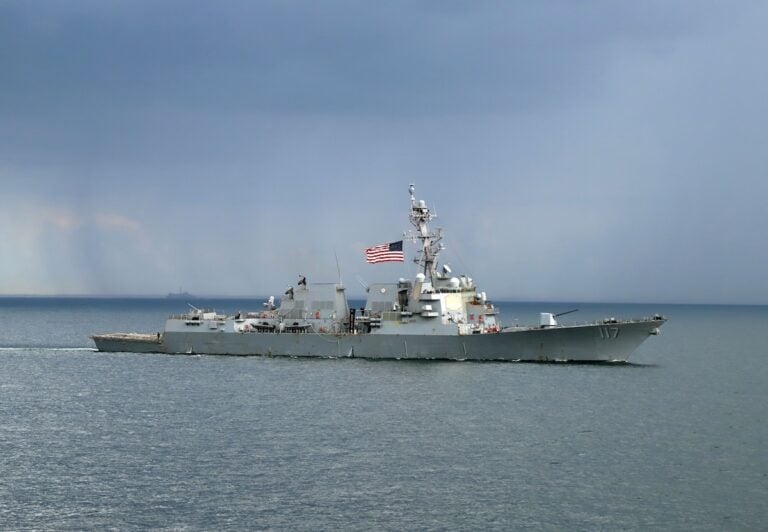

The Juneau was launched in 1966 and saw action during the Vietnam War and Operation Desert Storm. It was decommissioned in 2008 before being used as the target vessel for the exercise.
The live-fire event brought together air, surface and subsurface assets in coordinated strikes. The Department of War said the exercise allowed crews to sharpen weapons employment and target engagement skills under realistic conditions that no simulator can fully replicate.
Navy Rear Adm. Eric Anduze, commander of Carrier Strike Group 5 and Task Force 70, said the event helped the joint team integrate capabilities across multiple domains. “This [exercise] provided an outstanding opportunity for our joint team to integrate capabilities across domains, honing the lethal precision and coordination essential for high-end maritime operations in the Pacific theater,” said Navy Rear Adm. Eric Anduze, commander of Carrier Strike Group 5 and Task Force 70.
The coordinated strike included a long-range anti-ship missile launched by an Air Force B-2 Spirit bomber. The LRASM is designed to detect and destroy enemy ships at long ranges and is described as a key component in the military’s counter-maritime strike operations.
“The B-2’s impressive performance underscores the U.S. military’s commitment to adaptability and flexibility in the face of emerging security challenges,” said Air Force Gen. Kevin B. Schneider, commander of Pacific Air Forces. “By prioritizing counter-maritime strike operations, we can maintain a decisive edge over adversaries, protect our national interests and ensure the free and open Pacific that underpin our global security.”
The Department of War said the deployment of LRASM from the B-2 Spirit gives Pacific Air Forces another tool for countering maritime threats. It described the milestone as a demonstration of high-end innovation supporting the department’s commitment to safeguarding national interests and maintaining global security.
Before the exercise, the target vessel underwent extensive preparation, including the complete removal of hazardous materials in line with Environmental Protection Agency guidelines. The selected site was surveyed to ensure the safety of marine life, vessels and personnel.
The exercise was conducted in compliance with the National Environmental Policy Act, the Marine Mammal Protection Act and other key statutes. The release said these measures were part of the preparation before the live-fire event.
Valiant Shield is a biennial, multilateral field training exercise conducted by the United States and partner nations in the Western Pacific. The exercise focuses on joint, cross-combatant integration across sea, air, land and cyberspace.