The decision responds to the growing threat from systems such as the Iranian Shahed family of drones. These weapons have played an important role in recent armed conflicts and are also seen as a threat to Gulf states allied with France.
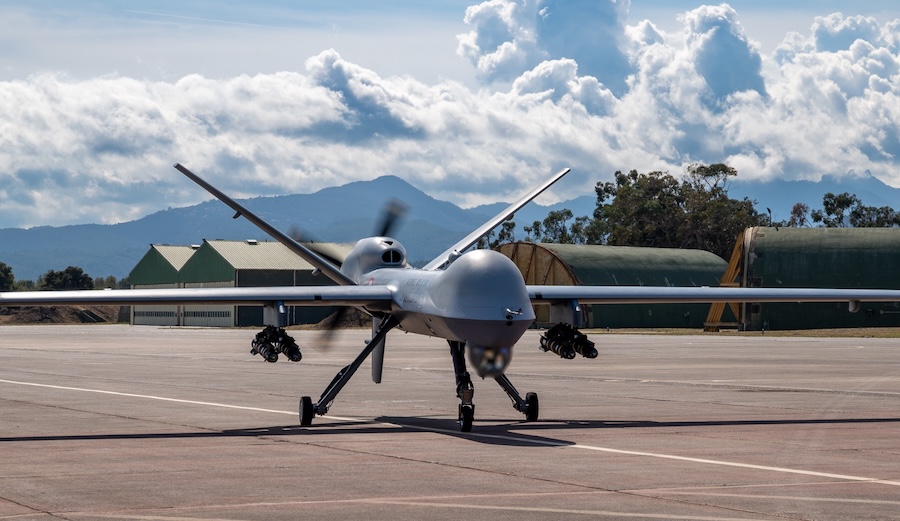
French Reapers, purchased from the United States, had previously been used mainly for reconnaissance and strikes against ground targets. They proved effective during operations against jihadist groups in the Sahel region.
The aircraft have now been given a new task: intercepting and destroying enemy uncrewed aerial vehicles. The new role reflects efforts to make maximum use of systems already in service as the character of modern conflict changes quickly.
The new configuration was first tested in early April 2026 off the coast of Levant island in the Var department. It was then presented to media representatives on 12 June at Cognac 709 Air Base, where France’s 12 MQ-9 Reapers are stationed.
The system is based on an unusual use of existing weapons. The AGM-114 Hellfire anti-tank guided missile, originally designed to strike ground targets, was used as a weapon against aerial targets.
According to the French military, developing the new configuration took only three months. Both the Reaper and the Hellfire missile were designed for ground-attack missions, but their rapid adaptation shows the pressure to respond quickly to emerging threats.
French air forces say the Reaper is intended to complement ground-based systems, fighter aircraft and helicopters in countering drones at low and medium altitudes. Its advantages include powerful sensors for detecting threats on the ground and in the air, as well as very long endurance for patrols over designated areas.
The aircraft is controlled from the ground by a four-person crew. The crew consists of a pilot, a sensor operator, an intelligence officer and an imagery analyst.
France has also tested helicopters in the counter-drone role. On 2 June 2026, the French Air and Space Force conducted its first experiments involving Fennec and Caracal helicopters operating from Cazaux 120 Air Base.
During those trials, different weapons and associated observation systems were tested on both helicopter types. The Caracal was fitted with a 7.62 mm MAG58 machine gun, which has been carried on the aircraft for more than 20 years, as well as the more recently used 12.7 mm M3M heavy machine gun.
After detecting the target with thermal imaging through an EOS camera, the Caracal crew intercepted and neutralised two Shahed-class target drones. The targets were engaged using door-mounted small arms.
The Fennec light helicopter used a combination of a Trakka electro-optical observation head and a fixed 20 mm cannon mounted on a fuselage pylon. The tests showed how existing helicopter weapons and sensors can be adapted for counter-drone missions.
Experience from the war in Ukraine and recent fighting in the Middle East, including clashes involving Iran, has confirmed the impact of mass attacks using cheap strike drones. Such attacks can overload traditional air defence systems.
France’s initiative is part of a wider search for relatively low-cost and rapidly deployable methods to counter this threat. The solutions are being treated as interim measures until sufficient numbers of specialised counter-drone effectors enter service.