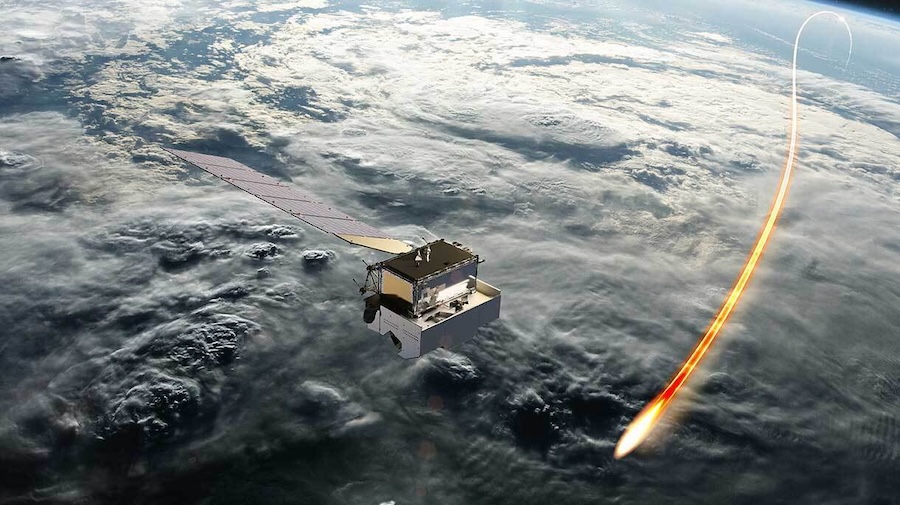


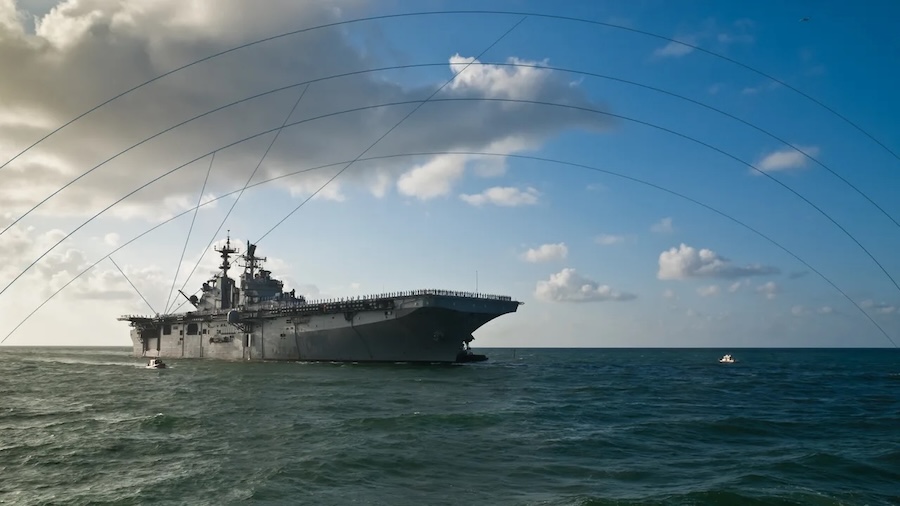
The technology was first demonstrated in April 2025 and has since been presented to multiple U.S. Department of Defense organizations. The Office of Naval Research is supporting its development as part of efforts to enhance connectivity and information exchange for distributed naval and joint operations.
The contract aligns with the Navy’s Information Warfare objectives, focusing on improving end-to-end connectivity and quality of service in mission-critical environments. High-performance antenna systems are seen as key enablers for Distributed Maritime Operations, particularly for platforms with constraints on size, weight and power.
In parallel, Bascom Hunter has issued a purchase order to Kymeta for the first prototype terminal incorporating the KuKa technology. The prototype, known as the Kymeta KuKa 8 Series, is scheduled for delivery for testing and evaluation beginning in the second quarter of 2026 under an existing U.S. Navy relationship.
The terminal is designed as a next-generation electronically steered flat-panel system capable of operating across Ku and Ka frequency bands simultaneously. It supports connectivity across multiple satellite orbits, including GEO, MEO, LEO and HEO, while maintaining a compact and low-profile form factor.
Kymeta said its shared aperture architecture allows the antenna to operate across multiple frequency bands without dividing the surface into separate panels. This approach is intended to improve efficiency, reduce power consumption and lower heat output for use in maritime, unmanned and other defense applications.
The prototype will be evaluated across commercial and government satellite networks to support resilient, multi-orbit and multi-band operations. Integration with Bascom Hunter’s software-defined modem and associated modules is expected to enhance survivability and performance in contested environments.
“True SATCOM resilience is provided by network diversity rather than dependence on a single network. ONR recognizes the need for capabilities that allow seamless switching between networks and frequency bands, ensuring resilient and uninterrupted connectivity. This capability is essential, because being disconnected, even momentarily, is not an option. Reliable access to critical data can determine mission success or failure, enable clear real-time decision-making, and ultimately influence whether fleets return home safely,” said Matthew Sieber.
“When we made our KuKa breakthrough last year, we knew it would have a transformational effect on military SATCOM capabilities,” Sieber said. “I’ve had conversations with stakeholders across U.S. Defense about their requirements from satellite connectivity, and the answer is always the same: resilience through path diversity. A resilient and robust comms capability that never fails and supports responsive and agile operations while on the move. Kymeta’s new terminal will deliver on that need.”
Craig Gendron, Vice President of SATCOM at Bascom Hunter, said, “Our responsibility is to deliver resilient, mission-ready SATCOM capabilities that directly address the Navy’s operational requirements in contested environments. Kymeta KuKa technology introduces a powerful new dimension of multi-band, multi-orbit flexibility that complements our multi-waveform, software-defined modem architecture. Together, this integration enables a scalable, survivable communications solution designed to ensure connectivity for the warfighter.”
Kymeta said the development builds on its broader role in multi-orbit satellite communications for the U.S. Department of Defense, including its selection for the U.S. Army’s Next Generation Command and Control pilot program in 2025. The company said it plans to expand deployment of KuKa terminals for defense and commercial applications beginning in 2026.