
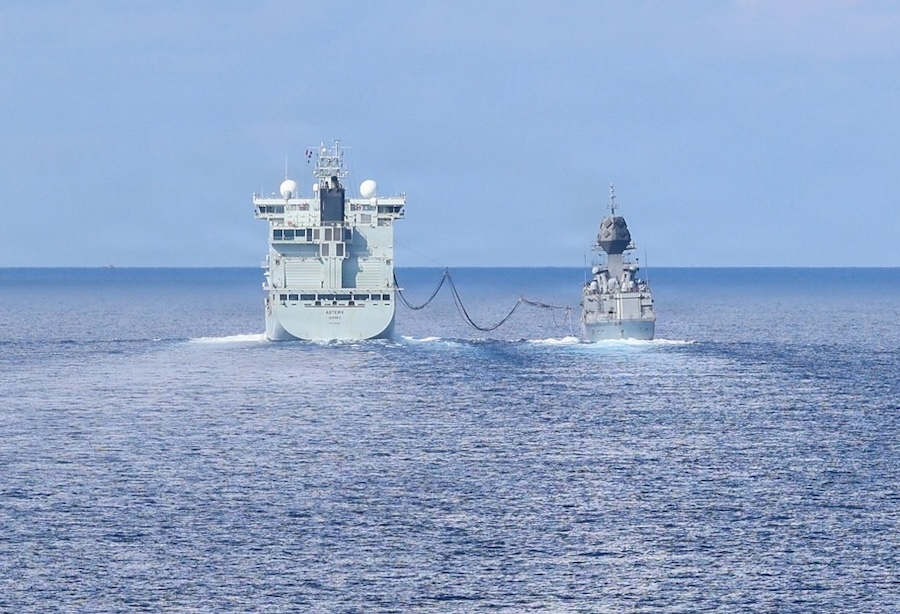
Participating units included the Royal Australian Navy Anzac-class frigate HMAS Toowoomba, a Royal Canadian Air Force Super Puma helicopter, the Royal Canadian Navy Halifax-class frigate HMCS Charlottetown, and the U.S. Navy Whidbey Island-class amphibious dock landing ship USS Ashland with embarked Marines from Task Force Ashland. The combined force conducted tactical maneuvers, helicopter cross-deck operations and personnel exchanges during a joint transit through the South China Sea.
Commander Adam Peeples, commanding officer of USS Ashland, highlighted the value of allied engagement in the region. “We embrace any chance to engage with our allies and friends in the region to learn from each other and build upon our strong relationships,” he said.
Peeples also underscored the broader strategic purpose of such exercises. “These exercises provide an opportunity to increase interoperability, information-sharing, and access with our allies and partners across the globe. The Sailors and Marines of Task Force Ashland are dedicated to supporting regional security and committed to ensuring a free and open Indo-Pacific,” he added.
The operation builds on a series of prior multilateral engagements, including Exercise Rim of the Pacific (RIMPAC) 2024, in which all three nations participated alongside 29 countries in exercises designed to foster cooperative relationships and ensure the safety of sea lanes. Such multilateral activities are described by the U.S. Navy as providing valuable opportunities to improve combined readiness and promote peace and stability across the Indo-Pacific.
USS Ashland and Task Force Ashland are forward-deployed to U.S. 7th Fleet as a flexible crisis response force, purpose-built to integrate with allies and partners in the region. U.S. 7th Fleet, the largest forward-deployed numbered fleet in the U.S. Navy, routinely conducts operations with allied and partner nations in support of a free and open Indo-Pacific.