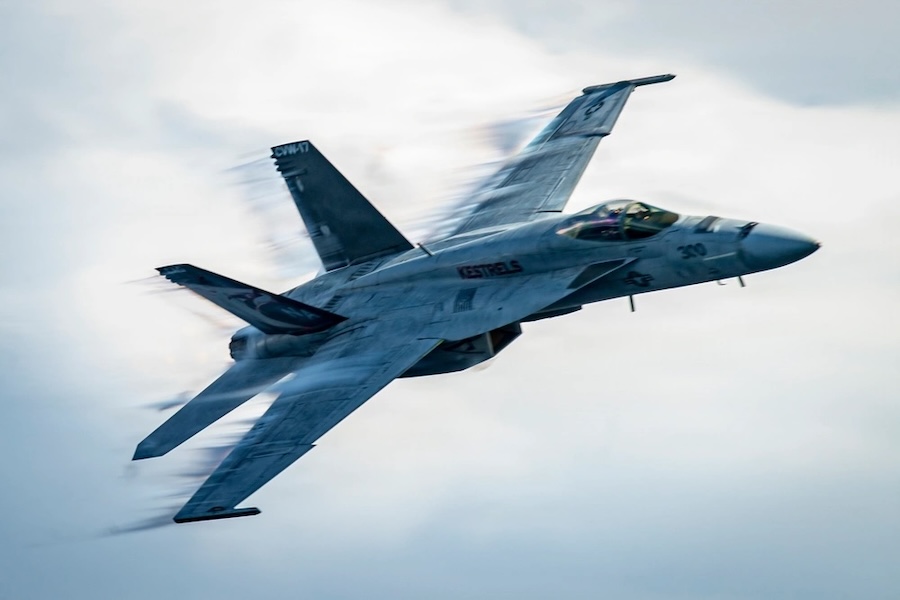
“I think you’re going to see a downselect on this in August. I think that’s the month that they have committed to making the decision on the program,” Caudle told reporters at the Sea Air Space 2026 conference. The F/A-XX is intended to eventually replace the Boeing F/A-18E/F Super Hornet aboard U.S. Navy aircraft carriers in the 2030s.
Boeing and Northrop Grumman are the two aviation contractors considered to be in contention for the F/A-XX programme. Boeing was selected last year to build the F-47 air superiority fighter for the U.S. Air Force, while Northrop Grumman is currently producing the B-21 Raider bomber, also for the Air Force.
Without identifying the company by name, Caudle indicated that one of the two contractors was unable to meet the Navy’s required delivery timeline. “One of the contractors who would make this plane for us is in a place where they really can’t deliver in the timeframe we need it. So there was a ‘check twice, cut once’ kind of mentality here on this decision,” he said.
Caudle outlined the broader strategic drivers behind the requirement for a next-generation fighter, pointing to advances by peer competitors as well as the proliferation of low-cost, capable weapons systems. “One of the challenges we’re seeing is not only is our peer competitors improving their capability for anti-air, air-to-air, surface-to-air, but the lower cost of entry of very capable weapons are also making more players on the field in which that level of stealth and technology is required,” he said.
The F/A-XX has been in development for decades as the Navy has assessed how to sustain the viability of aircraft carriers against the growing range of adversary guided weapons. The rise of low-cost, lethal drones has further complicated the operational environment by extending long-range strike capability to less sophisticated forces.
Caudle linked the F/A-XX to the Navy’s broader air wing of the future concept, which also incorporates the MQ-25A Stingray unmanned tanker. “It ties to our MQ-25 for stealth refueling. It ties to our reach. It ties to the work we’re doing for making the carrier something that remains very effective into the future based on the range in which it can operate safely,” he said.
In addition to the F/A-XX, the Navy has contracted five companies to develop naval collaborative combat aircraft (CCA). Caudle described the CCA effort as integral to the service’s sixth-generation concept, noting that the Navy is working closely with the Air Force on questions of command and control, optimal numbers and the role of artificial intelligence in managing such systems.
“The CCA concept is all part of our sixth generation concept. It’s tied with the overall air wing of the future concept,” Caudle said. “It is a program that we’re working very hard trying to do that in learning with the Air Force on what CCAs look like in the future and the way we’re going to command and control those, how many, what’s the number that a pilot can reasonably control and task, and AI is part of that,” he added.
Source: USNI News.