

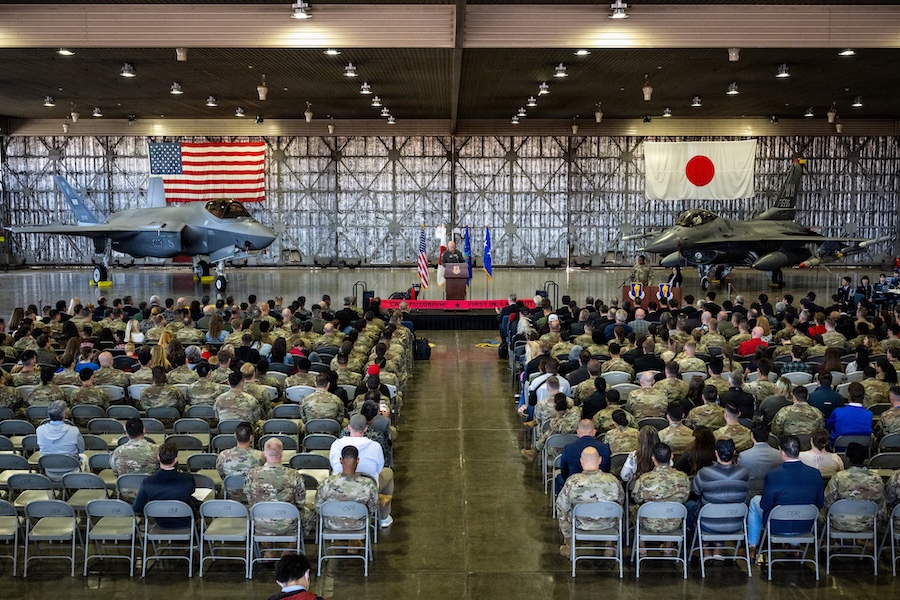
The 35th Fighter Wing held a ribbon-cutting ceremony to formally induct the aircraft into the Fifth Air Force fleet. Officials said the move represents the first phase of the Department of the Air Force’s plan to permanently assign fifth-generation fighter squadrons to the region.
The 35th Operations Group first received the aircraft on March 28 as part of a force posture adjustment that has been under development for a decade. Under the transition, the 13th and 14th Fighter Squadrons will replace their F-16 Fighting Falcon fleets and infrastructure with systems needed to support F-35 operations.
Col. Paul Davidson said the transition reflects the growing strength of the U.S.-Japan alliance.
“From the flight line to the community, Misawa’s strength has always been rooted in the bonds between our nations,” Davidson said. “Despite the new, advanced platforms, the core purpose will remain unchanged: to strengthen the U.S.–Japan alliance, protect the force, and safeguard a free and open Indo-Pacific.”
The Air Force said Misawa is now the first Pacific Air Forces base in the Western Pacific to host permanently assigned F-35A aircraft. Officials described the platform as a critical capability for operations across the first island chain due to its stealth features, advanced sensors and multi-role mission capabilities.
Christopher Allison highlighted Japan’s own F-35 acquisition programme, noting that Tokyo has committed to purchasing 147 aircraft.
“Misawa is now the only location in the world where U.S. Air Force and Japan Air Self-Defense Force F-35As operate side by side — a powerful symbol of interoperability and shared purpose,” Allison said. “These fifth-generation aircraft provide capabilities previous generations could never match — combining stealth technology, advanced sensors, and seamless integration with allied forces.”
The Air Force said the F-35 joins more than 30 aircraft types that have served with the Fifth Air Force since its establishment in 1941. The service highlighted historic platforms including the B-17 Flying Fortress, B-24 Liberator, P-38 Lightning, F-86 Sabre, F-4 Phantom II and F-15 Eagle.
Lt. Gen. Joel Carey said the aircraft significantly strengthens allied military capabilities in the region.
“The arrival of the F-35A Lighting II marks an exponential leap in our warfighting capabilities,” Carey said. “It’s sensor fusion, stealth capability, and network-centric design provide, situational awareness, lethality, and survivability as a critical force multiplier.”
“For our pilots and allies flying the same platform, training on the same systems, developing tactics together, we create a seamless and formidable defensive shield [and] our shared F-35s send a powerful message of unity and of resolve,” he added.
Carey said joint F-35 operations with the Japan Air Self-Defense Force are turning interoperability into daily operational reality through shared mission planning, sustainment and combined operations.
Davidson said the arrival of the aircraft demonstrates the United States’ long-term commitment to Japan’s defense and regional deterrence. “This aircraft represents the future of airpower, but more importantly, it represents the strength of our alliance and our shared commitment to defend it,” he said.