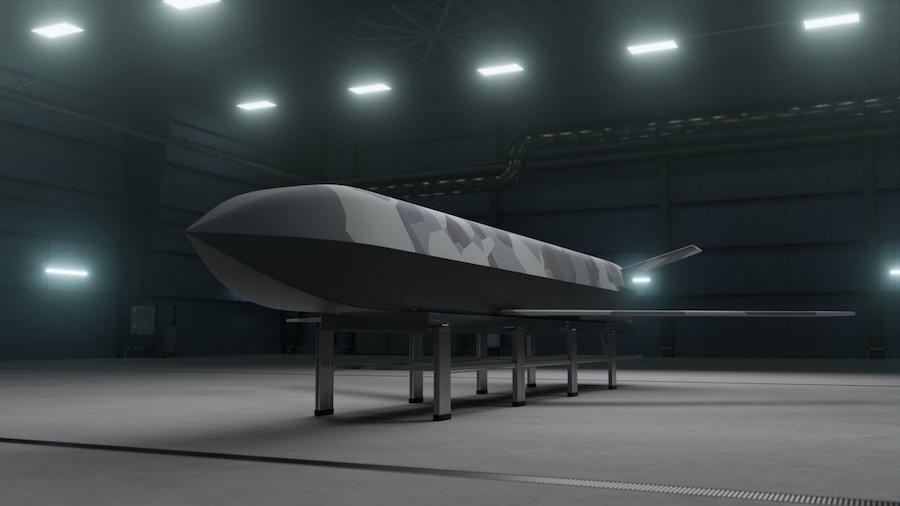
Blizzard is being developed by BAE Systems’ FalconWorks and Lockheed Martin Skunk Works. The roughly 400-pound unmanned aircraft has already completed captive-carry trials.
The subsonic vehicle has a boxy, cruise-missile-like airframe with some low-observability features. It is designed for electronic warfare, attack, decoy and air-defense suppression missions.
BAE Systems sees Blizzard as part of its expanding portfolio of uncrewed combat aircraft. FalconWorks is developing systems that can operate alongside current and future frontline platforms.
Two of defence’s most secretive labs rarely work together ? This time, they did.
Meet Blizzard: a modular, multi-mission uncrewed air system from BAE Systems FalconWorks and @LockheedMartin Skunk Works®. Multiple launch options. One purpose.
? https://t.co/CBWXKOQ7De pic.twitter.com/H1LWBWl2ki
— BAE Systems (@BAESystemsplc) July 20, 2026
A key proposed mission would place Blizzard alongside crewed combat aircraft. The vehicle could carry electronic warfare payloads for stand-in jamming against hostile air defenses.
“Blizzard will complement end effects in the battlespace,” Anthony Gregory, BAE Systems FalconWorks business development and strategy director, said at the Farnborough International Airshow. “It will enable other systems to do the job they need to do by decoying, suppressing very hostile threats.”
Blizzard can also operate independently or as part of a larger group. BAE Systems says multiple vehicles could deliver coordinated effects against the same target.
The aircraft is designed around a modular and adaptable configuration. Planned payloads include electronic warfare and attack capabilities for different mission requirements.
An open systems architecture is intended to support faster integration of new payloads and software. BAE Systems has not disclosed the technical interfaces or standards behind that architecture.
The companies are also developing several launch options for Blizzard. These include air, ground and maritime launch configurations.
BAE Systems and Lockheed Martin are examining palletized deployment from transport aircraft. Potential platforms include the Airbus A400M and Lockheed Martin C-130 Hercules.
Blizzard is also intended for operations without reliable GPS or GNSS signals. The aircraft is designed to operate in electromagnetically contested environments.
BAE Systems said Blizzard could complement other uncrewed electronic warfare systems. Gregory cited the Royal Air Force’s Tekever AR3-based Storm Shroud as an example.
Blizzard could provide electronic warfare effects at greater range or speed than some other systems. It could also coordinate missions with fast-jet aircraft.
The program stems from a strategic partnership announced in September 2025. That partnership covers cooperation between BAE Systems and Lockheed Martin on uncrewed autonomous air systems.
FalconWorks contributes more than 25 years of BAE Systems experience in uncrewed and autonomous systems. Lockheed Martin Skunk Works contributes nearly 90 years of advanced aircraft design and development experience.
Blizzard also has links to the Skunk Works Common Multi-Mission Truck air vehicle family. Gregory, however, described Blizzard as “truly a joint design effort.”
The aircraft includes components originating from both the United Kingdom and United States. The program combines technologies and investments made by both companies over several decades.
“Through our collaboration with Lockheed Martin, we’re delivering disruptive capabilities that can make a real difference to our military customers at pace, enabling them to confront the operational requirements of today’s battlefield,” said David Holmes, Managing Director of BAE Systems’ FalconWorks business. Blizzard remains under development and has no publicly confirmed customer or production contract.
Flight testing is planned for 2027 following the completed captive-carry trials. BAE Systems and Lockheed Martin are aiming to bring Blizzard to market in 2028.