
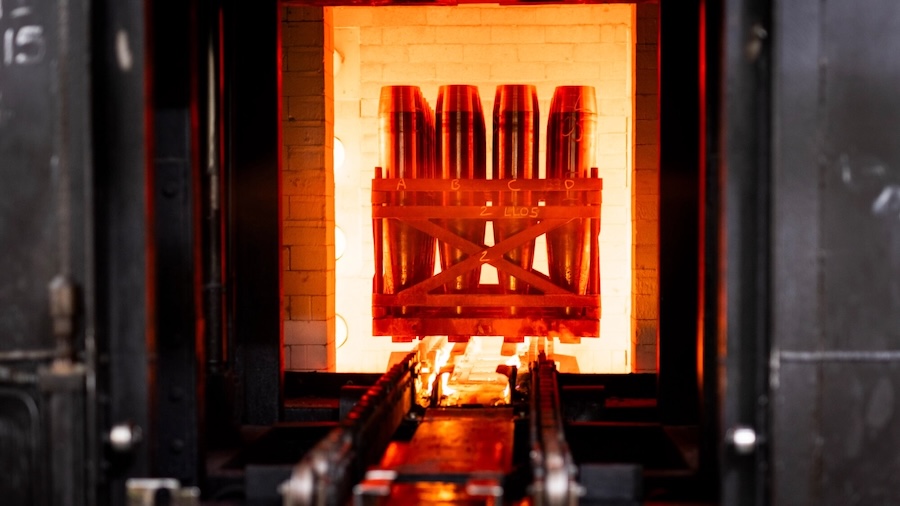
The government has committed £1.5 billion to the factory programme, which forms part of £11.1 billion in planned spending on weapons and munitions over the next four financial years. The investment is intended to expand production capacity, strengthen national stockpiles and make military supply chains more resilient.
Potential locations have been identified in England, Scotland and Wales, although the government has not disclosed the individual sites. The programme is expected to create at least 1,000 jobs across the country.
The factories will focus on energetics, including the explosives, propellants and pyrotechnics required to manufacture ammunition and weapons. They will restore industrial capabilities that largely disappeared from Britain after domestic facilities closed over almost two decades.
The programme therefore represents more than an increase in manufacturing space. It is an attempt to rebuild control over a part of the ammunition supply chain that directly determines how quickly weapons can be produced and stockpiles replenished.
Feasibility studies for the plants were funded under the “factories of the future” initiative announced in November 2025. The government is now moving towards construction, although it has not published the planned capacity or role of each facility.
The investment supports Britain’s shift towards an “always-on” approach to ammunition production. Instead of allowing manufacturing lines to operate intermittently, the government wants a permanent production base capable of expanding rapidly when military demand rises.
Britain also plans to maintain continuous production of CAMM, Lightweight Multirole Missile, ASRAAM and NLAW. The Defence Investment Plan does not specify which of those weapons will use materials produced by the new factories.
The wider strategy is intended to provide the foundations for sustained production during high-tempo warfare. It also gives manufacturers a clearer long-term demand signal as the government seeks to increase both ammunition output and industrial readiness.
The plan does not name the companies that will construct or operate the facilities. It also provides no breakdown of investment by factory, expected production volumes or detailed schedules beyond the first construction start and the 2030 target.
Delivering the plants would restore a strategically important layer of Britain’s defence-industrial base. Their output will determine how effectively the country can convert its wider weapons investment into a reliable domestic supply of ammunition.