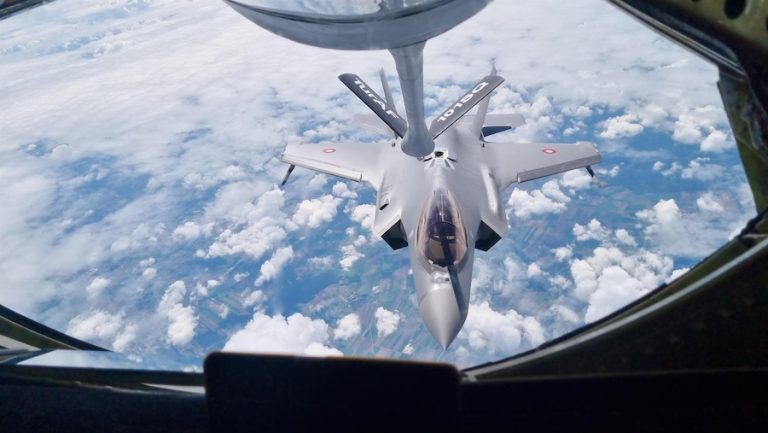

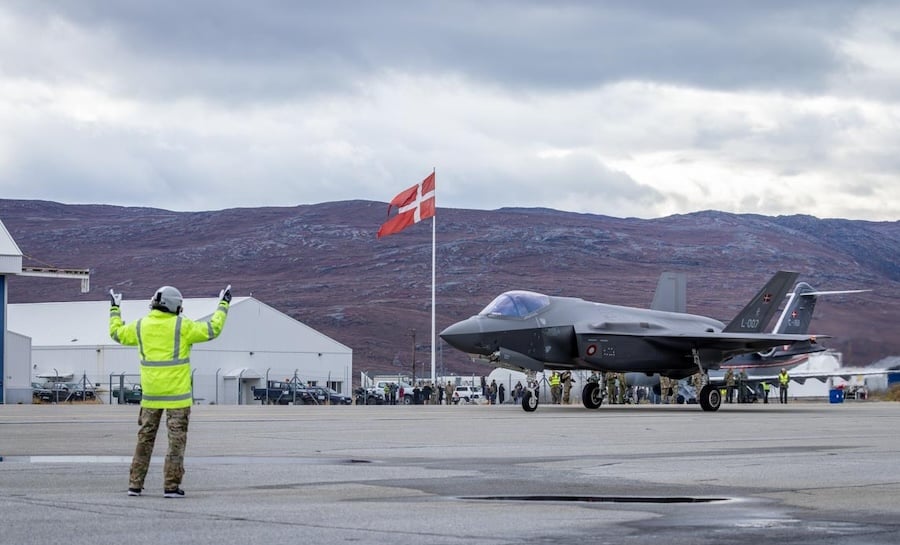
Two Danish F-35s landed at Kangerlussuaq Airport on Wednesday after flying from Keflavik Air Base in Iceland. They trained over Greenland with US F-16s and Canadian F-18s operating from Goose Bay in Canada.
The aircraft flew hundreds of kilometres from bases on opposite sides of Greenland before joining for the mission. The operation tested their ability to coordinate combat air activity across long distances and from separate locations.
“We are essentially training our ability to synchronise the efforts of many aircraft from different nations and bases spread over great distances,” said the F-35 pilot with the call sign PLA, who took part in Wednesday’s mission. “There are many moving parts required for an operation like this to be carried out safely and according to plan.”
A French MRTT tanker refuelled the Danish fighters during their journey from Iceland. A NATO AWACS aircraft handled surveillance and airspace coordination, while a Danish Challenger surveillance aircraft provided search-and-rescue cover.
Arctic operations place added demands on aircrews and mission planners because weather conditions can shift quickly and suitable landing sites are far apart. The Danish Armed Forces said much of the work required for the mission was completed before the aircraft took off.
“The Arctic region imposes some very particular requirements,” PLA said. “The weather can be harsh and changeable, and there are long distances between places where we can land.”
“That is why we spend a great deal of time planning the missions and managing the risks associated with operating up here,” PLA said. The planning covered the operational risks created by the region’s weather, distances and limited landing options.
Wednesday’s arrival was the first by Danish F-35s at an airport in Greenland, but Danish fighter aircraft have previously operated from Kangerlussuaq. Danish F-16s were deployed there for earlier training and operations in the Arctic.
Danish F-35s have also flown patrols along Greenland’s east coast from their base at Keflavik. The latest operation added a Greenland landing to those previous missions.
NATO established Arctic Sentry to reinforce the alliance’s presence and surveillance across the region. The initiative is also intended to improve NATO’s ability to conduct operations in Arctic conditions.