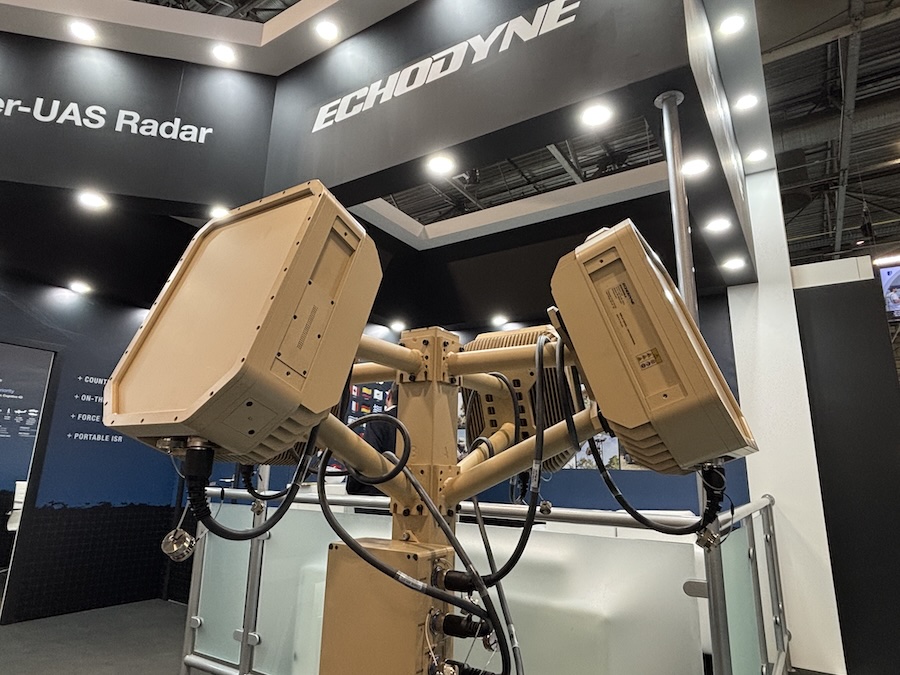
The 86,350-square-foot facility has begun end-to-end manufacturing operations and is expected to be able to produce more than 30,000 radars annually. Echodyne said that level of production would be equivalent to more than 2,500 radars per month.
The company said the new site is intended to prepare supply for several large global markets. It will gradually take over all manufacturing operations from Echodyne’s headquarters and become a dedicated manufacturing and operations hub for the company’s radar portfolio.
Echodyne said its $40 million investment in the facility is supported by more than 100 new jobs. The company said employment at the site could rise to as many as 200 positions when the facility reaches full production capacity.
“Our global customer base is demanding more radar to be delivered as fast as possible,” said Eben Frankenberg, CEO of Echodyne. “Drones are driving significant change in both enabling a drone economy and in defending against nefarious drone use.”
“While radar performance will always be the dominant consideration, product availability both now and in a predictable and consistent manner over time is quickly becoming a requirement for any global supplier. The only way to defend against mass is with mass. That requires not just high-performance economical radars, but the ability to manufacture them at scale.”
The company said demand for high-performance radar is growing across applications including counter-UAS, force protection, border security, intelligence, surveillance and reconnaissance, critical infrastructure protection, and beyond visual line of sight operations for autonomous systems. It said the wider use of drones, including in the Russian war in Ukraine, is increasing the need for safety and security sensors.
Echodyne said its patented Metamaterials Electronically Scanned Array, or MESA, architecture uses a simpler design than conventional electronically scanned array radars that rely on thousands of phase shifters. The company said the technology delivers high-fidelity radar performance while reducing size, weight, power, complexity and cost.
The new facility includes about 74,350 square feet of manufacturing space and 12,000 square feet of warehousing. Echodyne said this will allow production to shift across multiple radar product lines and support future product introductions.
The company said its manufacturing approach combines its radar architecture with commercially scalable production techniques rather than traditional low-volume defense production. It said the modular approach is designed to let capacity flex across product lines, support rapid introduction of new capabilities and respond to changing customer demand.
Echodyne said recent program awards and growing international demand underline the need for expanded manufacturing capacity. Its radar technology is integrated into hundreds of defense and security systems worldwide and supports platforms from companies including Anduril, Axon, Moog and Northrop Grumman Corporation.
The company was recently selected as the primary radar provider for Trust Automation’s Small UAS Detection System platform. That system is being delivered to the U.S. Air Force under a $490 million indefinite-delivery, indefinite-quantity contract.
Echodyne said it expects to continue expanding its workforce as manufacturing operations scale. The company said the new facility strengthens the U.S. defense industrial base by increasing domestic capacity for advanced radar production.