
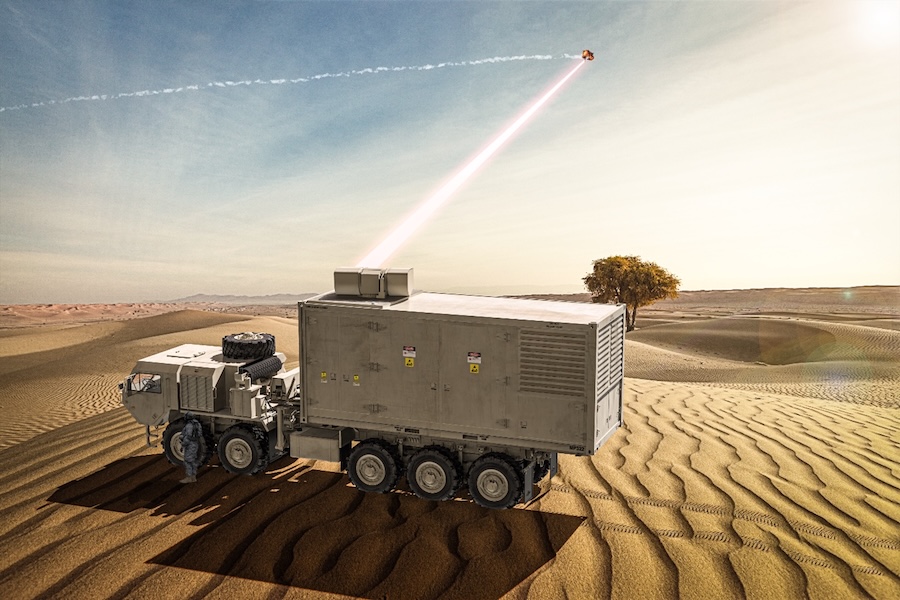
The company said the system will provide combatant commanders with scalable and cost-effective intercept options. The contract also acknowledges Lockheed Martin’s collaboration with SCALED Directed Energy, one of the Department of War’s six Critical Technology Areas under the Office of the Under Secretary of War for Research and Engineering.
“We are honored to field this operational tactical prototype — the highest power laser ever packaged in a transportable container,” said Paul Lemmo, vice president and general manager of Lockheed Martin Sensors, Effectors, and Mission Systems. “By applying our expertise in lowering size, weight, and power along with rugged system design, we can rapidly build containerized laser weapons in the near term.”
“We must actively defend the homeland against emerging threats,” said Emil Michael, Under Secretary of War for Research and Engineering. “We are partnering with industry to rapidly deliver deep magazine directed energy capabilities to the Joint Force that can be seamlessly deployed across multiple domains.”
Lockheed Martin said the award builds on more than 15 years of company investment and expertise in designing and fielding tactically relevant laser weapons. The company said its laser systems offer speed-of-light engagement, virtually unlimited magazines and a much lower cost per intercept compared with conventional kinetic systems.
Those capabilities are intended to support defense against high-volume unmanned aerial system swarms and advanced cruise missile threats. Lockheed Martin said these features are central to providing an operational edge in future air and missile defense missions.
The company said it will continue working with the Department of War and industry partners to accelerate the fielding of directed energy capabilities. Lockheed Martin said the effort is focused on supporting warfighters with these capabilities when they are needed most.