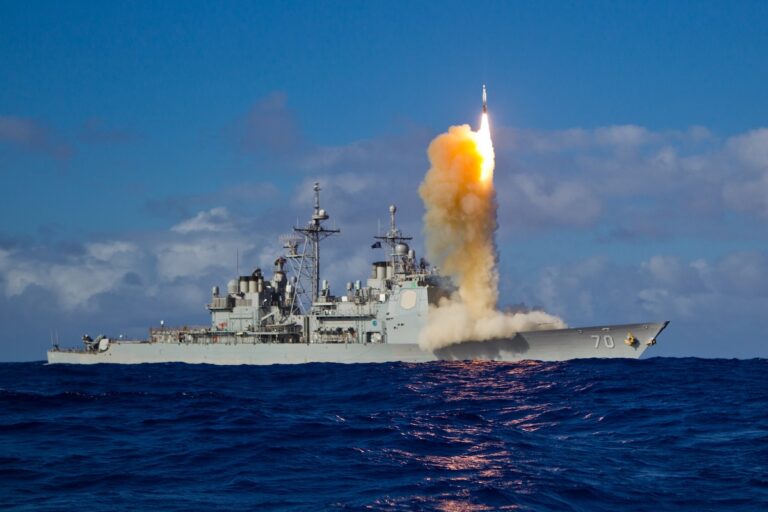


“We have also agreed with the US government on the sidelines of the NATO meeting in Ankara that we will acquire American Tomahawk missiles and station them in Germany,” Merz said. “In doing so, we are closing an important strategic gap in our defence.”
Merz said Germany would also “work to develop our own European systems and station them in Europe.” The remarks point to Berlin’s effort to combine an immediate purchase from the United States with longer-term European weapons development.
U.S. President Donald Trump had previously rejected a plan agreed in 2024 under his predecessor Joe Biden to station Tomahawk missiles in Germany by 2026. Berlin had since sought to persuade Washington to allow Germany to buy the missiles, which have a range of up to 2,500 kilometers.
In 2024, the German Defense Ministry said it wanted to use Tomahawk missiles to counter the threat from Moscow. The ministry noted at the time that Russia had stationed nuclear-capable Iskander missiles and fighter jets equipped with hypersonic missiles in the Kaliningrad exclave bordering Lithuania and Poland.
The ministry also said Russia planned to station nuclear weapons in Belarus. Moscow is 1,600 kilometers from Berlin as the crow flies, meaning Tomahawk missiles stationed in Germany could reach deep into Russian territory.
European NATO countries do not currently have their own medium-range weapons. Several allies plan to procure long-range precision strike systems through the European Long-Range Strike Approach, or ELSA, project launched at the NATO summit in Washington in 2024.
Under that framework, some European NATO allies intend to develop their own cruise missile with a range of more than 2,000 kilometers. The German Defense Ministry said last year that work on this new long-range weapons capability had begun.
Land-based ballistic missiles and cruise missiles with ranges between 500 and 5,500 kilometers were banned under the 1987 Intermediate-Range Nuclear Forces Treaty between the United States and the Soviet Union. The United States withdrew from the treaty in 2019 after Washington and European NATO members accused Russia of breaching it by developing a new land-based, nuclear-capable medium-range cruise missile of the 9M729 type.