The system continuously monitors spectral energy, including underwater acoustic data collected through networks of sonobuoys. It uses artificial intelligence and machine learning to help aircrews detect and identify potential undersea threats.
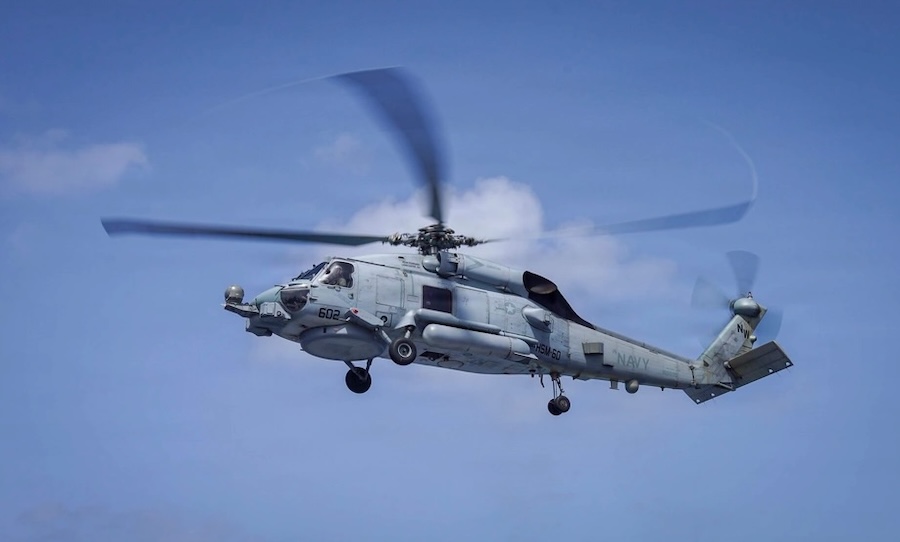
During the demonstration, the helicopters deployed sonobuoys that operated as underwater microphones. Their acoustic data was transmitted to SensorMAX for analysis and target identification.
The system allowed each aircrew to manage as many as eight simultaneous sonobuoy surveillance feeds. Lockheed Martin said this doubled the capacity available through legacy capabilities.
SensorMAX also transmitted data to operators at a ground station. When a new target was detected, operators labelled its acoustic signature and used the information to retrain the model.
The revised model was returned to the aircraft through an encrypted over-the-air software update. Each retraining cycle took less than five minutes, according to Lockheed Martin.
The closed-loop process covers data capture, labelling, model retraining and operational deployment. It is intended to improve situational awareness throughout a mission without interrupting aircraft operations.
Lockheed Martin worked with FUSE Inc. to provide secure and resilient software delivery to the deployed helicopters. The arrangement allows SensorMAX models and mission software to be updated while operations continue.
“Today’s battlespace requires the defense industry to accelerate capability delivery and seamlessly integrate commercial technology; at RIMPAC 2026 our mission focused engineers demonstrated exactly how we are meeting that challenge,” said Devon Rodgers, vice president and general manager, Undersea Mission Systems. “Lockheed Martin is investing its own resources to mature AI capabilities, blending commercial innovation with our engineering expertise so the Navy has the technology it needs for tomorrow’s battles.”
The company said the demonstration showed that MH-60R helicopters and AI-enabled acoustic systems could detect and track underwater threats faster than traditional methods. The work supports the Navy’s plans for wider crew-uncrewed teaming across the fleet.
SensorMAX can process information from different sensors supporting military and commercial applications. Its lightweight and portable design also allows the same processing capability to operate in the air, at sea or on land.
The system’s platform-independent design could allow future naval forces to use data from a wider range of acoustic sensors. Lockheed Martin said this could expand protection around high-value assets and shorten the antisubmarine warfare detection-to-engagement cycle.