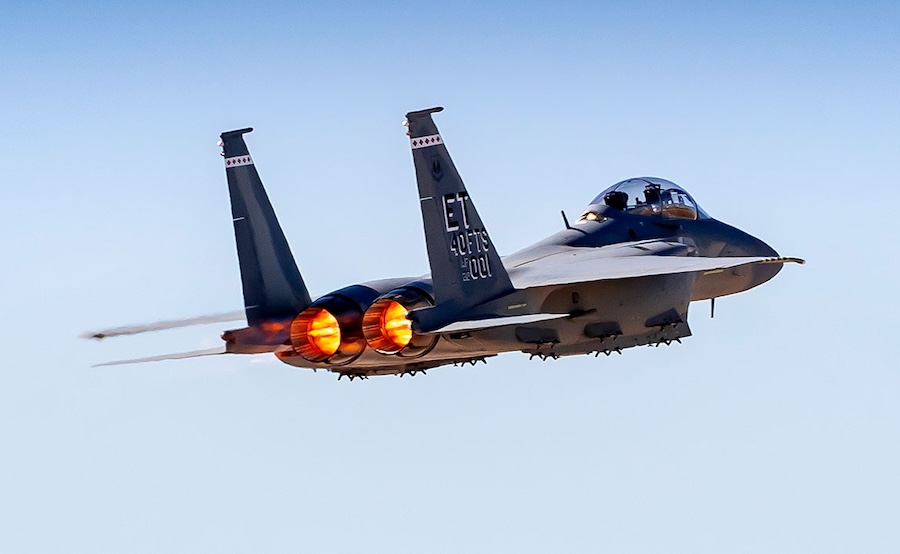
The F-15EX is the most advanced version of the F-15 family, a combat aircraft whose reputation was built over decades of air-superiority operations. Unlike fifth-generation stealth fighters such as the F-22 Raptor and F-35 Lightning II, the Eagle II is not designed primarily to penetrate the densest air-defense networks on the first night of a war. Its value lies elsewhere: carrying large numbers of weapons, operating at long range, integrating rapidly with new systems, and adding mass to a force that must be ready for sustained operations.
The original F-15 Eagle entered U.S. Air Force service in the 1970s as a dedicated air-superiority fighter. Its design emphasized speed, altitude, maneuverability, radar power, and weapons capacity. Over time, the F-15 family evolved into one of the most successful fighter lines in modern aviation, with the F-15E Strike Eagle adding deep-strike capability to the aircraft’s air-to-air heritage.
The F-15EX represents the next major step in that evolution. Developed for the U.S. Air Force by Boeing, the Eagle II incorporates digital fly-by-wire flight controls, modern mission computers, advanced cockpit displays, the APG-82 active electronically scanned array radar, and the AN/ALQ-250 Eagle Passive/Active Warning Survivability System, or EPAWSS.
The aircraft’s large weapons payload remains one of its defining advantages. With the ability to carry far more external ordnance than stealth fighters operating in low-observable configurations, the F-15EX can serve as a high-capacity weapons platform for air-defense missions, standoff strike, homeland defense, and integrated operations with stealth aircraft and other sensors.
Just as important, the F-15EX was designed with open mission systems architecture, allowing the Air Force to integrate new weapons, sensors, and software more quickly than would be possible on many older platforms. In an era when electronic warfare, unmanned systems, hypersonic weapons, and long-range missiles are reshaping air combat, that adaptability is not a luxury. It is a requirement.
The Iran campaign highlighted the importance of force depth. Public reporting has focused heavily on aircraft already embedded in U.S. operational planning, including F-15E Strike Eagles, F-35s, F-22s, bombers, tankers, surveillance aircraft, and support assets. Those operations demonstrated that airpower in a contested theater is not defined by one platform alone, but by the ability to combine stealth, strike capacity, logistics, refueling, intelligence, electronic warfare, and command and control.
That is where the F-15EX matters.
The Eagle II is not a direct substitute for stealth aircraft in the opening phase of a high-end fight. Instead, it is a complementary platform that can bring volume and persistence once conditions allow. In a layered air campaign, stealth fighters may locate and identify targets while high-payload aircraft launch large numbers of weapons from farther away. The result is a broader and more resilient force structure.
The campaign also reinforced a procurement lesson that is easy to overlook in peacetime: numbers matter. Aircraft losses, maintenance demands, high sortie rates, and munitions consumption can quickly strain even the most advanced air force. A fighter fleet built only around small numbers of exquisite platforms may be powerful, but it can also be fragile. The F-15EX gives the Air Force another way to add combat capacity without waiting for an entirely new generation of aircraft to arrive.
Critics of the F-15EX often describe it as an updated version of an old airplane. That description is technically incomplete and strategically misleading. The airframe has a long lineage, but the systems inside the Eagle II are new, and its role is shaped by current operational needs.
The Air Force does not need every fighter to be stealthy. It needs a balanced mix of aircraft that can perform different missions across different phases of a conflict. The F-35 and F-22 bring low observability and advanced sensing. The future F-47 is expected to push air dominance into a new generation. The F-15EX brings payload, range, speed, and magazine depth.
That combination may prove especially important in the Indo-Pacific, where vast distances and the growing threat from cruise missiles, drones, and advanced aircraft place a premium on fighters that can carry more weapons and remain relevant through upgrades.
The F-15EX also carries industrial significance. Built by Boeing in St. Louis, Missouri, the aircraft supports a production line with decades of fighter-manufacturing experience. Its major systems involve a wider defense-industrial network, including electronic warfare and radar suppliers that are central to U.S. airpower modernization.
For allied air forces that already operate F-15 variants, the Eagle II offers a familiar but substantially modernized path forward. It does not require abandoning the F-15 concept. It updates that concept for a combat environment defined by sensors, electronic attack, long-range missiles, and joint-networked operations.
The aircraft’s future will depend on budgets, production rates, and the Air Force’s broader force-structure plans. But the Iran campaign has strengthened the argument that the service needs more than a small fleet of stealth aircraft. It needs mass, resilience, and fighters that can be upgraded quickly as threats evolve.
The F-15EX Eagle II is not a relic. It is a bridge between the proven airpower of the past and the networked, high-capacity warfare of the future.
Its role will not be to replace fifth- or sixth-generation fighters. Its role will be to fight alongside them, carrying the weapons, sensors, and electronic warfare tools needed to sustain air superiority after the first wave of a conflict. In that sense, the Eagle II’s significance is not measured by hype, but by utility.
For the U.S. Air Force, the lesson is clear: winning future wars will require stealth, but it will also require capacity. The F-15EX was built for that mission.