Armed Forces and Veterans Minister Catherine Vautrin presided over the ceremony alongside Patrick Pailloux, head of France’s Directorate General of Armaments, or DGA. The agency leads the six-submarine programme to replace the navy’s earlier Rubis-class attack boats.
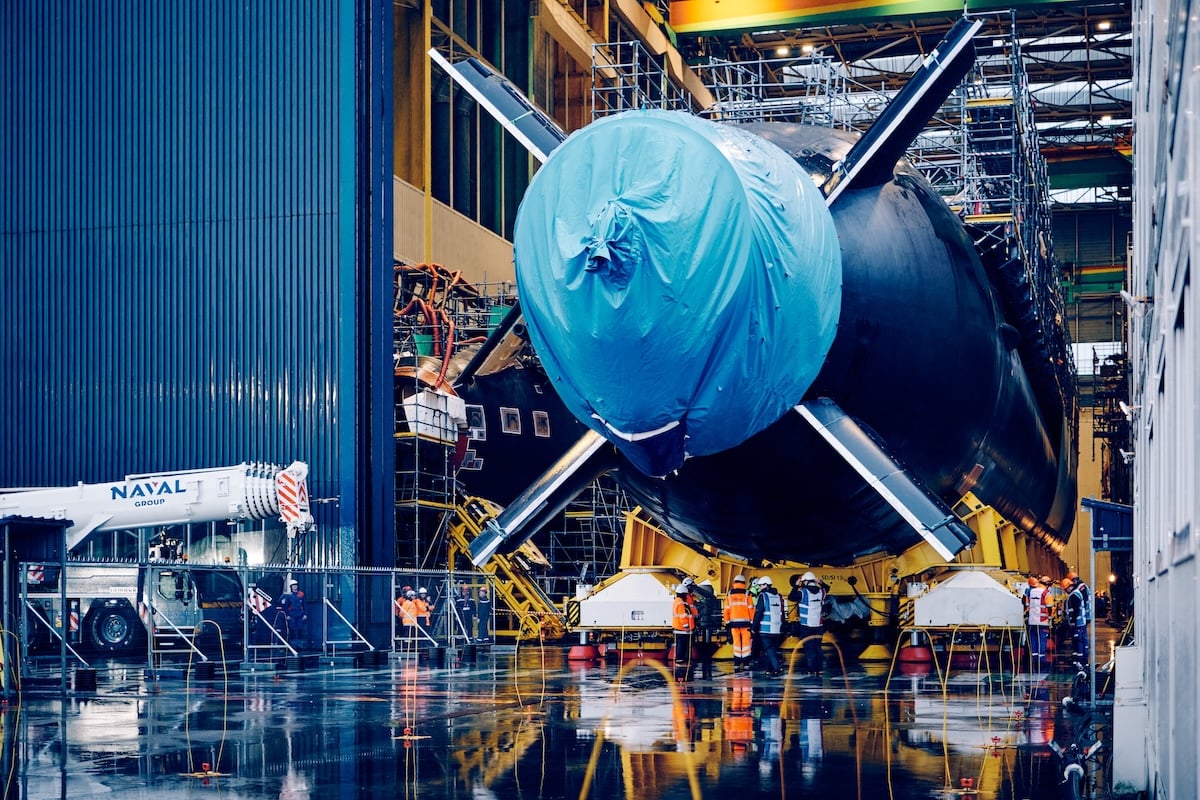
The submarine is moving to the hydraulic launch system in the Cachin basin using supports known as *marcheurs*. The transfer proceeds at approximately 30 metres per hour and precedes the vessel’s first entry into the water.
State and industry teams will conduct dockside tests followed by sea trials before handing Rubis over to the navy. The DGA did not give a delivery date in its announcement.
“Rubis is a French success,” Vautrin said. “It embodies the work of the Cotentin, the excellence of our industry and the ambition of an entire nation.”
The French Navy has received the first four boats in the programme. Suffren entered active service in 2022, followed by Duguay-Trouin in 2024 and Tourville in 2025.
De Grasse was delivered in June 2026 and is expected to enter active service shortly. The sixth submarine, Casabianca, is under construction, with delivery expected by 2030 under France’s 2024–2030 military programming law.
The new boats replace the Rubis class, which began entering service in the 1980s. Améthyste, commissioned in March 1992, is the last submarine of that class still in service.
The DGA said the new submarines offer greater speed, endurance and versatility, including capabilities for deploying special forces and striking land targets with naval cruise missiles. Nuclear propulsion supports their endurance and stealth.
Rubis will displace 5,300 tonnes submerged at full load and measures 99.5 metres long and 8.8 metres wide. Its predecessor of the same name displaced 2,600 tonnes and measured 73.6 metres long.
Four bow-mounted 533.4 mm tubes will launch F21 Artemis heavyweight torpedoes, MdCN land-attack cruise missiles and SM39 Exocet B2 Mod 2 anti-ship missiles. The SM40 Block 4 is planned as a future anti-ship weapon.
The submarine can also lay FG29 mines, with two mines carried in place of one torpedo. Its weapons capacity is equivalent to 20 torpedoes.
More than 10,000 people and 800 companies across France have contributed to Barracuda, according to the DGA. The programme currently mobilises 3,000 direct jobs each day, including 800 in subcontracting.
Rubis inherits the traditions of the Free French minelaying submarine Q145 Rubis, which completed 28 combat missions and laid 683 mines during the Second World War. That vessel received the Croix de la Libération from General de Gaulle and the Croix de Guerre 1939–1945.