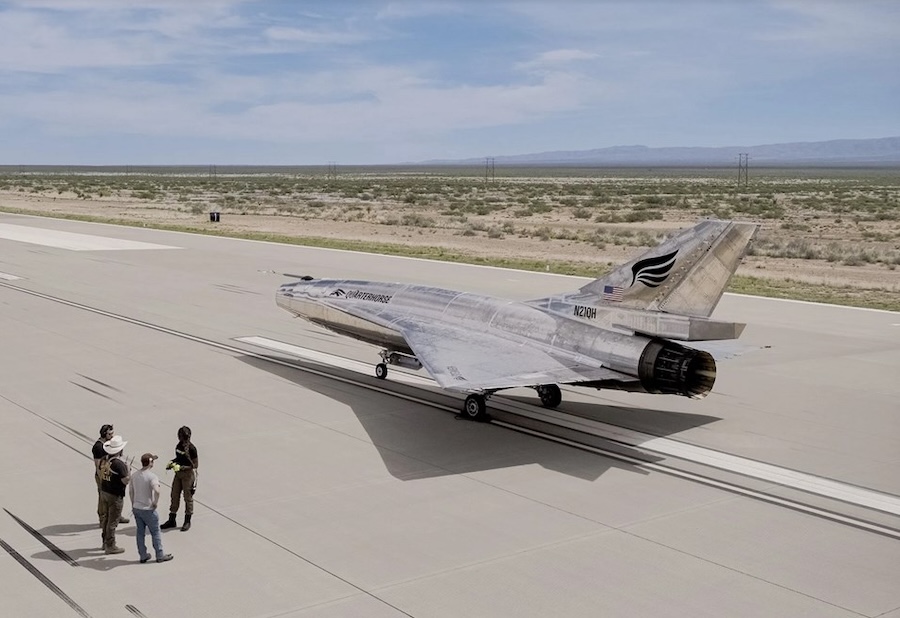
The company said the milestone highlights its pace of iterative aviation development. Quarterhorse Mk 2.1 flew supersonic less than three months after its first flight and 364 days after the maiden flight of Hermeus’ first aircraft, Mk 1.
“Our customers at the Department of War are paying close attention to how fast this program is moving,” said AJ Piplica, CEO and Co-founder of Hermeus.
“This flight demonstrates a pace of execution that is extremely rare in modern aviation,” Piplica said. “Our country’s ability to deliver new asymmetric military capability at scale depends on teams that can solve hard technical challenges quickly.”
“That’s exactly what we’re proving with each test flight we conduct and each new aircraft we build at Hermeus,” Piplica said.
Quarterhorse Mk 2.1 is the first of three F-16-scale supersonic aircraft in Hermeus’ development roadmap. The aircraft is powered by the Pratt & Whitney F100 engine, with Pratt & Whitney operating as an RTX business.
Hermeus said its development approach is based on rapid iteration. The company designs, builds and flies aircraft in quick succession, using flight test data to improve performance and reduce risk across the program.
The company said this model is intended to unlock and scale new capabilities in years rather than decades. Hermeus is already building and testing its next aircraft, Quarterhorse Mk 2.2, with Mk 2.3 expected to follow.
Each aircraft in the roadmap is designed to push performance further. Hermeus said the program is moving toward sustained high-Mach flight.
The milestone comes as the Pentagon increases its focus on high-speed capability amid growing competition from near-peer adversaries such as China. Hermeus said faster unmanned aircraft could shorten response times and bring affordable mass to highly contested environments.
Hermeus said it will continue the Quarterhorse Mk 2.1 flight test campaign. The company will also continue building later aircraft intended to add capabilities and reach higher-speed regimes.