President and Chief Executive Officer Eric DeMarco said during the company’s second-quarter 2026 earnings call that Kratos had already committed its supply chain to the first production increase. The company is buying components before the broader missile market reaches the volumes management expects later this decade.
“We have leaned forward,” DeMarco said. “We have placed the orders now for the components for 3,000 engines to be built in 2027. At least 3,000 for customers.”
Kratos plans to order components for another 5,000 engines for 2028. Production could rise again in 2029 if the missile programs now moving through U.S. defense procurement advance on schedule.
“We’re going to do a minimum of 3,000 next year, a minimum of 5,000 in 2028,” DeMarco said later in the call. “It could be 8,000, 10,000 in 2029 if things come together.”
The production plan centers on Kratos’ Spartan family of turbojets, which cover engines with roughly 250 pounds of thrust or less. They are built at the company’s new manufacturing facility in Michigan and have an average selling price of about $50,000, according to DeMarco.
“These are not PowerPoints — these are all engines that work, that are flying today,” DeMarco said. He described turbojets as the main driver of the expected increase in Kratos’ engine business during 2027 and 2028.
Management tied the scale-up to a broader Pentagon shift toward producing affordable missiles in much larger quantities. DeMarco said the Defense Department had sought multiyear procurement authority for several missile and munition programs that Kratos supports or is positioning to support.
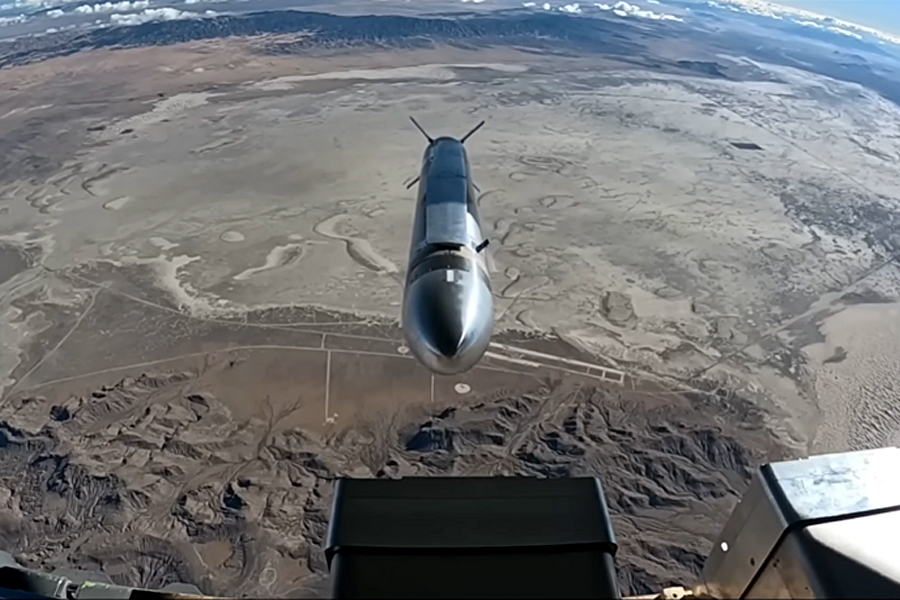
One of the largest opportunities cited by management is the Family of Affordable Mass Missiles program. DeMarco said the Air Force’s future-years plan calls for 27,000 low-cost cruise missiles, while a separate low-cost containerized munitions program could involve another 10,000 cruise missiles.
“The family of affordable mass missiles, the FAM program, for example, which the Air Force’s Future Years Defense Plan calls for 27,000 low-cost cruise missiles, has been a top strategic priority of Kratos’ jet engine initiative, and it’s now happening,” DeMarco said. He said the containerized-missile requirement represented another market Kratos had been targeting for its engines.
Kratos is also supporting or positioning itself for ERAM, ETV, Ground Launched Cruise Missile and JDAM-LR. DeMarco said those programs together represent potential demand for “tens of thousands” of small Kratos turbojets.
JDAM-LR could become one of the company’s largest individual opportunities. “We believe that JDAM-LR alone, which includes a Kratos engine, could be one of the largest single opportunities for our company, with the potential for tens of thousands of systems by itself,” DeMarco said.
DeMarco also named CMMT, or COMET, Speed Racer, Carrera, Silver Fox, Gray Wolf and Lumberjack among publicly discussable platforms involving Kratos engines. He said Kratos was designed into additional programs that he could not identify because of confidentiality restrictions.
The planned volumes are also forcing Kratos to build redundancy into a supply chain designed for production rates far above its current output. Management said the company is qualifying primary suppliers and backup sources while adding personnel with experience from the automotive industry, the Defense Department and major defense contractors.
“We got to make sure every one of our vendors and every one of our suppliers, including their backup and the backup to the backup, is qualified,” DeMarco said. He said the effort covers production lines, quality control, delivery schedules and supplier redundancy.
Kratos is separately preparing to expand into larger turbofan engines through its partnership with GE Aerospace. That effort is aimed at higher-thrust applications including JASSM and LRASM, with the companies’ new Oklahoma production facility expected to become operational in summer 2027.
For the nearer-term production ramp, however, DeMarco said turbojets will account for the biggest increase. “The forecasted big jump for 2027 over 2026 on the engines is the turbojets,” he said, linking the expansion directly to the emerging U.S. market for high-volume, low-cost cruise missiles.