The blockade applies to vessels that were in Iranian ports before 10 a.m. Eastern Time on April 13 and covers traffic along Iran’s coastline. U.S. Central Command is overseeing the operation as part of broader efforts to pressure Iran over its nuclear programme and access to the Strait of Hormuz.
“U.S. forces have completely halted economic trade going into and out of Iran by sea,” said Brad Cooper. The measure follows an initial round of talks between the United States and Iran in Pakistan, which ended without agreement but may resume.
The blockade is being enforced by more than a dozen warships alongside extensive air support. Aircraft involved include fighters, surveillance platforms, drones and tankers operating from regional bases, an aircraft carrier and an amphibious assault ship.
U.S. Air Force A-10 Thunderbolt II aircraft have been tasked with patrols over the Persian Gulf and Strait of Hormuz. Other aircraft, including KC-46 Pegasus tankers and U.S. Navy P-8 Poseidon and MQ-4 Triton surveillance platforms, have been observed operating in the region.
“This is a joint effort,” said Kenneth F. McKenzie Jr.. “The secret to a blockade is broad-area ocean surveillance, and you gain that through a variety of airborne platforms—some launched from the sea, some launched from the land, all completely integrated into a single command and control architecture.”
U.S. forces have directed vessels leaving Iranian ports to return, with several complying. Officials said seizure of ships remains a last resort to avoid complications involving vessels from other nations.
That approach avoids “impounding vessels that might belong to another nation and have oil on board for yet another nation,” said Bryan Clark. However, U.S. forces retain the capability to interdict ships if required.
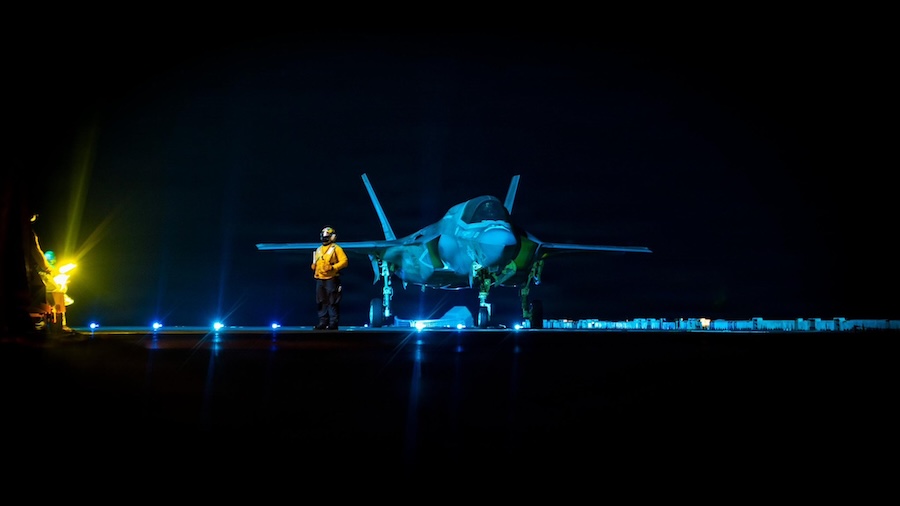
Additional assets in the region include the 31st Marine Expeditionary Unit and aircraft such as F-35s operating from the USS Tripoli amphibious assault ship. Amphibious ships provide additional helicopter capacity to support boarding and interdiction operations.
“The amphibious ships end up being useful players in a blockade, because they have a lot of helicopters,” Clark said. “Amphibious ships’ additional capacity gives them the ability to board, or at least interdict, more ships simultaneously.”
Unmanned aerial systems are also playing a role in monitoring maritime activity. MQ-9 Reaper drones are being used for targeting and surveillance, supported by advanced radar and sensor systems.
“It’s got a synthetic aperture radar that can scan hundreds of square miles at a time,” said Houston Cantwell. “It’s a very useful platform for situational awareness of where surface vessels are.”
“The Reaper can play a critical role in defending our naval assets, because the Reaper carries Hellfire missiles” in addition to its ISR equipment, Cantwell added. “We’re not worried about the Iranian Navy sailing a cruiser out to come take on our destroyers. We’re worried about these small, fast attack boats, and that’s exactly the type of threat that the MQ-9 can be on the lookout for.”
Officials said some vessels attempting to evade detection may operate without transmitting identification data. Analysts noted that the presence of U.S. forces is likely to deter ships associated with so-called “shadow fleet” operations.
“These shadow fleet captains, they’re criminals, but they’re not idiots,” said Mark Montgomery. “If they try to break the blockade and get boarded and detained, we’re going to find a lot of things wrong with that ship.”
Source: Air & Space Forces Magazine.