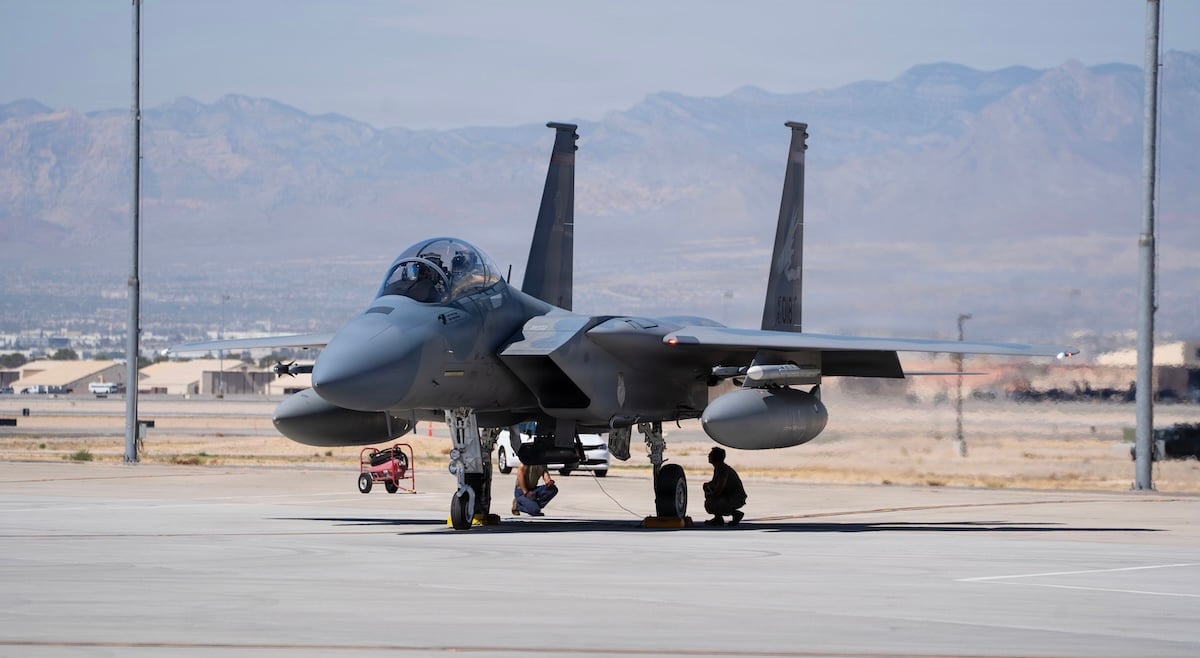
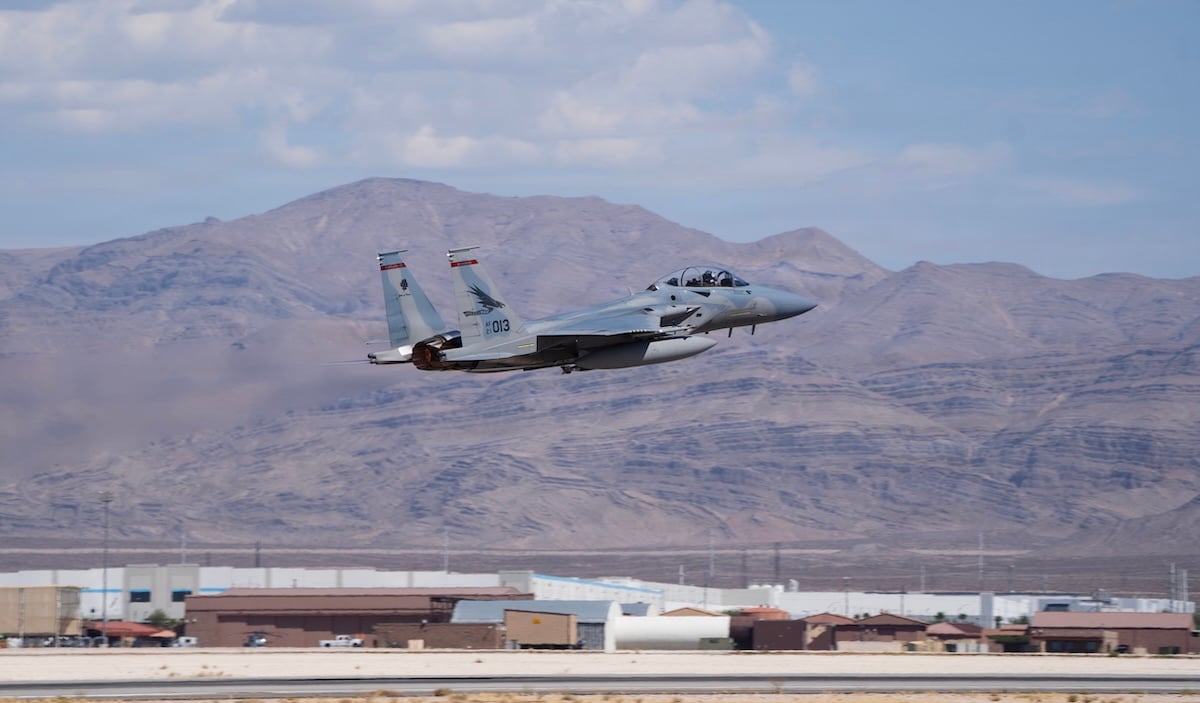
“The 142nd Wing’s fleet of F-15EXs operated at Nellis AFB for three weeks in late August and early September in support of the U.S. Air Force’s Weapons Instructor Course (WIC),” the Air National Guard said. “During this time, the unit hit a historical milestone, dropping live bombs from operational F-15EXs for the first time.”
The deployment followed training with BDU-50 and BDU-56 practice bombs in July. Successful completion of those flights cleared the way for live JDAM employment by the Oregon Air National Guard unit.
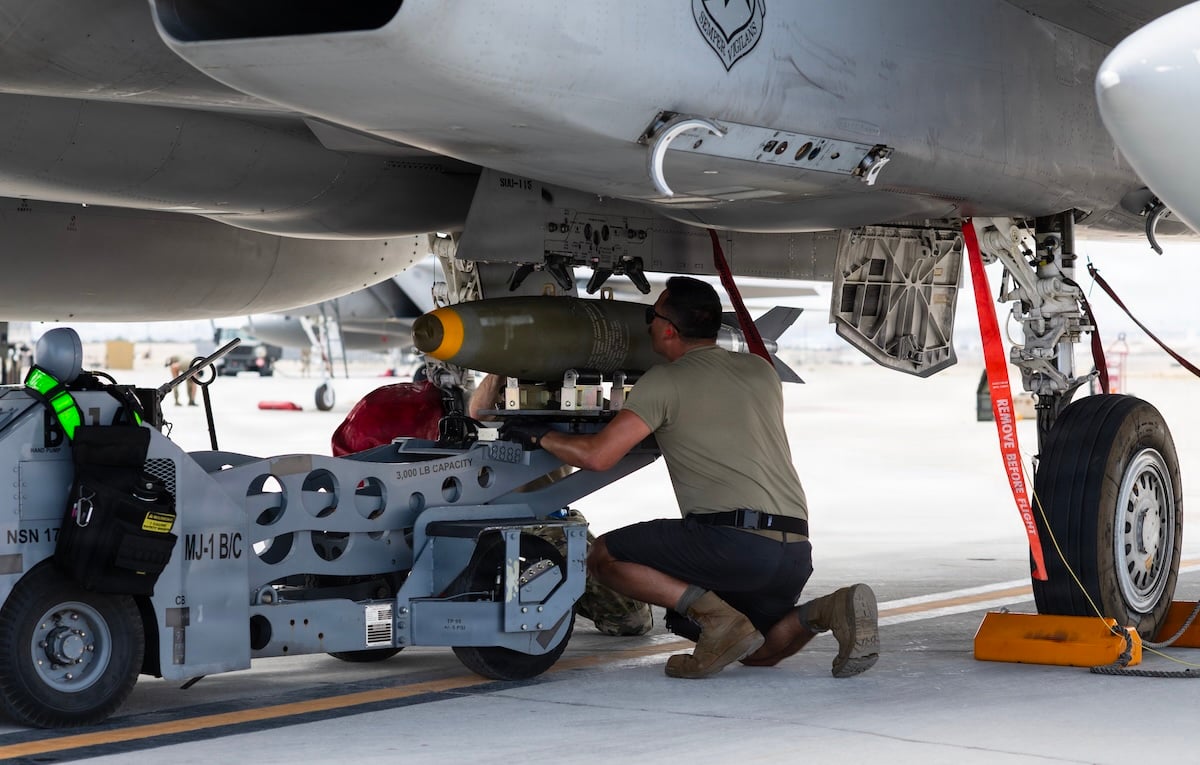
Photographs released by the U.S. Department of War show a JDAM carried on the centerline station beneath the fuselage. Earlier bomb configurations had used underwing stations.
A second F-15EX observed the release while carrying a Lockheed Martin AN/AAQ-33 Sniper targeting pod. The pod was also mounted on the centerline station.
The missions advance the F-15EX’s strike role alongside its air-to-air mission. Plans envisage the aircraft replacing F-15C/D Eagles and enabling the replacement of F-15E Strike Eagles.
The Joint Direct Attack Munition (JDAM) is a tail-mounted guidance kit that converts an unguided free-fall bomb into a guided air-to-surface weapon. Developed through a joint U.S. Air Force and Department of the Navy program, it combines inertial navigation with GPS guidance.
JDAM kits equip bombs in the 500-, 1,000- and 2,000-pound classes. After release, the weapon navigates autonomously toward designated target coordinates.
Crews can load coordinates before takeoff, change them before release or obtain them through onboard targeting sensors. JDAM supports attacks against fixed and relocatable targets, including multiple targets during a single pass.
The U.S. Air Force lists a circular error probable of five meters or less when GPS data is available. Without GPS, the stated figure is 30 meters or less for flight times up to 100 seconds, provided the aircraft supplies a GPS-quality navigation handoff.
The weapon can be released from different altitudes during level flight, dives and loft deliveries. Boeing’s published specifications describe a release envelope extending more than 15 miles from a target.
In August 2026, Boeing received a $75 million contract to begin initial production of JDAM Long Range. The powered variant is designed to strike targets beyond 300 nautical miles, or approximately 555 kilometers.
JDAM LR combines an existing bomb design with guidance and propulsion to extend its reach. It is intended to provide a lower-cost option for some long-range strikes while allowing aircraft to launch farther from enemy air defenses.
An F/A-18 conducted the first flight test off California on April 1, 2026. A second successful test followed on April 3, with the trials verifying weapon separation and long-range guidance performance.
The operational F-15EX milestone involved JDAM-family weapons, without identification of the specific variant. The JDAM LR flight tests were conducted separately using the F/A-18.