The SPY-6(V)3 provides continuous 360-degree surveillance and supports both air traffic control and ship self-defense. It is designed to operate against cruise missiles, anti-surface and anti-ship threats, as well as in electronic warfare environments.
“SPY-6(V)3 provides continuous 360-degree situational awareness while supporting air traffic control and ship self-defense against cruise missiles, anti-surface and anti-ship threats, and challenging electronic warfare environments,” Raytheon said. The radar is also known as the fixed variant of the Enterprise Air Surveillance Radar.
The V3 configuration uses three fixed array faces, each containing nine radar modular assemblies. That architecture is designed to provide uninterrupted coverage around the ship while supporting the carrier’s aviation and self-defense missions.
SPY-6(V)3 is part of the wider SPY-6 family being introduced across seven classes of U.S. Navy ships. Raytheon says the radar family can simultaneously defend against ballistic missiles, cruise missiles, hypersonic missiles, hostile aircraft and surface ships.
The radar also provides targeting data for Navy weapons, including Standard Missile variants. Raytheon says SPY-6 offers greater detection range, higher sensitivity and more accurate discrimination than legacy radars.
SPY-6 variants use common hardware and software and are built around standardized radar modular assemblies. The modular design allows the Navy to scale the radar for different ship classes while simplifying maintenance and future upgrades.
The Navy is integrating SPY-6 onto DDG 51 Flight III destroyers, frigates, aircraft carriers and amphibious warships. The system is also being backfitted onto existing DDG 51 Flight IIA destroyers and legacy aircraft carriers.
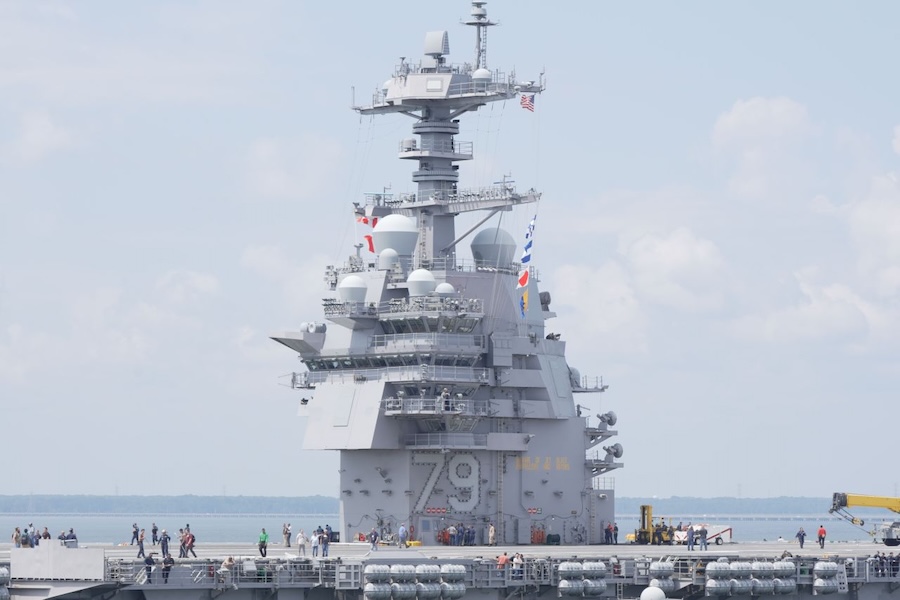
“Raytheon-built SPY-6(V)3 successfully completed acceptance trials aboard USS John F. Kennedy (CVN 79), the second Gerald R. Ford-class nuclear-powered aircraft carrier,” the company said. The completed trials mark another step in validating the radar aboard one of the Navy’s newest carriers.
“With acceptance trials complete, CVN 79 moves closer to preliminary acceptance — enabling the U.S. Navy to begin underway testing and evaluation of the carrier’s unique systems,” Raytheon said. Preliminary acceptance will open the next phase of Navy evaluation as John F. Kennedy moves toward completion.