
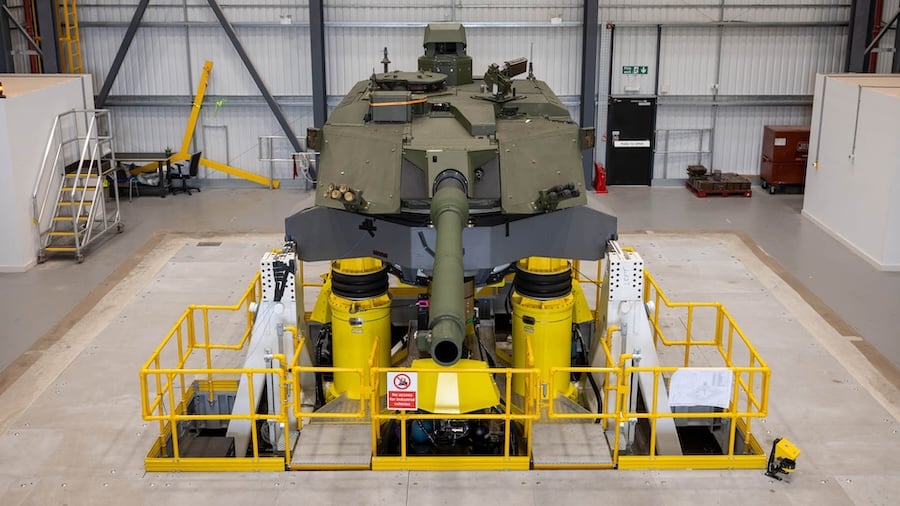
The facility is already supporting development of Challenger 3, the British Army’s next-generation main battle tank. It gives engineers another source of evidence on vehicle reliability and performance alongside physical trials, modelling and other forms of technical analysis.
Rheinmetall said the investment would reduce reliance on lengthy physical testing and allow engineering decisions to be made using detailed data produced in a controlled environment. Engineers can use information collected during real-world operations to reproduce demanding vibration and movement profiles.
The equipment can generate vertical motion, pitch and roll in complex combinations. This allows Rheinmetall to conduct accelerated durability and reliability testing on complete structures, assemblies and onboard systems.
For Challenger 3, the facility will help assess how the vehicle and its components respond to demanding operating conditions over extended periods. The results are intended to identify potential issues and support decisions during the tank’s development and assurance process.
“The VTF gives our engineers a powerful new way to understand complex platforms,” said Rob Hunter, vibration test manager. “We can recreate demanding operational conditions, measure how equipment responds and use that evidence to make better-informed engineering decisions.”
“Challenger 3 is an important application, but this is a capability we have deliberately designed with the future in mind,” Hunter said. “Its flexibility means we can adapt it to different engineering challenges, supporting future programmes and technologies while retaining critical engineering knowledge and skills here in the UK.”
The facility was designed as a long-term national engineering capability rather than infrastructure tied to a single contract. Its scale and flexibility may allow it to support future defence platforms and technologies, as well as work in aerospace, automotive, rail, energy and civil engineering.
Rheinmetall is bringing together testing infrastructure and specialists in mechanical and electrical engineering, instrumentation, software and data analysis at the Telford site. The facility will also provide opportunities for apprentices and other early-career British engineers and technicians to develop transferable technical skills.
The investment forms part of Rheinmetall UK’s effort to expand sovereign defence engineering capacity in Britain. The company said the facility would provide the skills and infrastructure needed to develop, test and support increasingly complex military equipment.