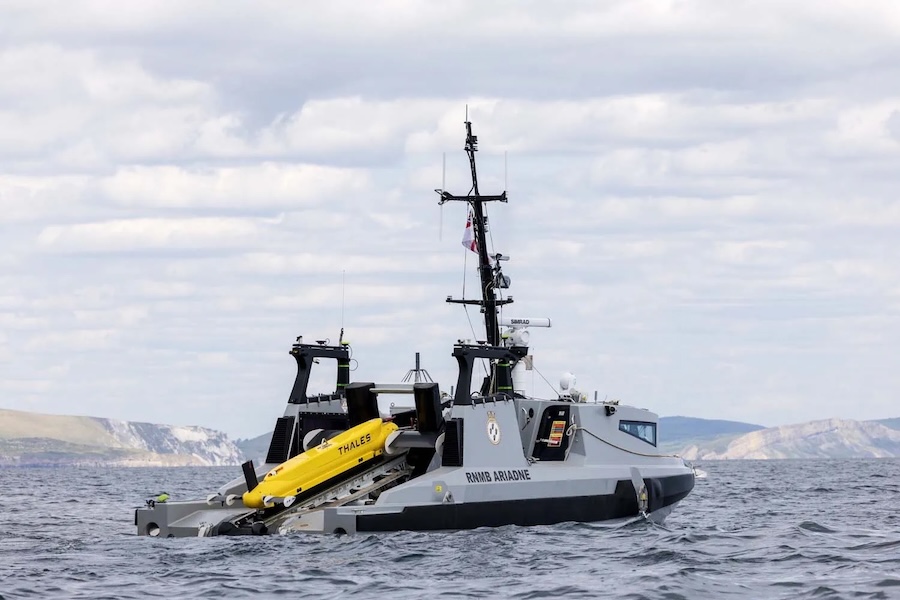
The 12-metre uncrewed surface vessel RNMB Ariadne was manoeuvred into the floodable dock of RFA Lyme Bay in waters off Gibraltar. RFA Lyme Bay is intended to act as the mothership for mine-hunting technology for the proposed Gulf mission.
The docking followed operational testing of Ariadne in waters off Portland in Dorset. The trials were carried out by specialist assessors and mine warfare experts.
Lieutenant Commander Craig Wadley, operations officer with Commander UK Mine Counter Measures Force, said: “This was a successful first day of operations and great to see the integration of Ariadne with Lyme Bay.”
Ariadne was designed and manufactured in the UK and is intended to detect and destroy sea mines without personnel entering dangerous minefields. The vessel uses the Thales TSAM system, described by the Royal Navy as one of the world’s most sophisticated towed sonars, to search for mines on the seabed.
The Royal Navy’s Maritime Capabilities, Trials and Assessment team conducted an accuracy analysis trial to check that Ariadne’s on-board technology was working correctly. The trial also gathered evidence of the vessel’s capabilities, which could support a future multinational mission in the Strait of Hormuz to secure the waterway and safeguard freedom of navigation.
Ariadne’s powerful towed sonar was tested against a seabed target that had recently been surveyed by HMS Magpie. Personnel were embarked during the trial as a safety measure, although Ariadne is designed to operate without a crew.
The vessel can be controlled locally and from a Portable Operating Centre. It can send operational and sensor data directly from the vessel to support command decision-making.
Members of the Mine Threat Exploitation Group’s Yankee Squadron operated Ariadne alongside the Maritime Capabilities, Trials and Assessment team. The squadron includes mine warfare operators supported by a hybrid team of marine and weapons engineers to enable deployment of next-generation autonomous systems.
“Having conducted intensive trials, the opportunity to develop the capabilities further is exciting alongside the prospect of contributing to multinational operations with autonomous mine hunting equipment,” said Lieutenant Ryan Sweet, officer in charge of Yankee Squadron’s unit 1.
“These trials have drawn to a close an extensive period of operating the Maritime Mine Counter Measures system in Portland with the opportunities for a greater contribution exciting and challenging,” Sweet said.
“As modern warfare continues to evolve at pace, it is essential that the Royal Navy advances alongside it,” said Lieutenant Tommy Walters, from the Maritime Capabilities, Trials and Assessment team.
“Supporting these trials and helping to ensure autonomous capabilities can be effectively deployed in an operational environment has been a privilege for both myself and the MCTA team,” Walters said.
“The work conducted here is a vital step in delivering credible, future-ready mine countermeasure capability,” Walters added.
After the trials were completed, Ariadne was loaded onto HMS Stirling Castle for transport to Gibraltar and docking with RFA Lyme Bay. Members of Yankee Squadron guided the vessel into the dock before the water was drained and Ariadne was placed on a cradle in the hull.
The Royal Navy’s Gibraltar Squadron provided additional safety and protection during the operation. The docking took place shortly after RFA Lyme Bay sailed from Gibraltar.
Leading Hand Matt Savage said: “It all went a lot smoother that I expected, thought it was going to be tighter, but we nailed it first time.”
Petty Officer Hayley Garnett said: “I have to confess I was a little nervous. I am responsible for Ariadne’s hull and was worried she might hit the cradle, but it all went really well.”
“This has been a very successful week for RFA Lyme Bay which has seen the embarkation of cutting-edge mine-hunting equipment and specialist personnel,” said Captain Simon Herbert RFA, commanding officer of RFA Lyme Bay.
“This, together with the considerable work conducted whilst in Gibraltar has seen RFA Lyme Bay re-role as an Afloat Forward Support Base mother ship for mine-hunting operations,” Herbert said.
“She and the ship’s company have again proven the versatility and flexibility of the Bay class and the RFA to be able to depart from Gibraltar ready to deliver an effective modern capability,” Herbert added.
The Royal Navy said the work is part of its transition to a hybrid navy combining traditional crewed warships with uncrewed and autonomous vessels. The service said this approach is intended to create a force prepared for modern conflict.
The Royal Navy is taking steps to prepare for a potential multinational mission in the Strait of Hormuz. The UK and France plan strictly defensive operations when conditions allow, aimed at restoring confidence for commercial shipping along the critical trade route.
Type 45 destroyer HMS Dragon is expected to play a key role in the effort. The destroyer arrived east of the Suez Canal earlier this month.