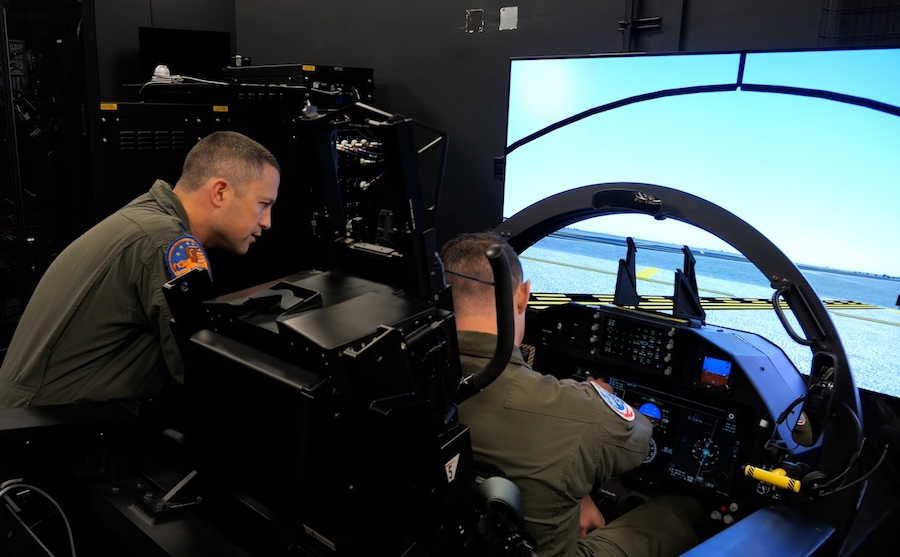
The accepted systems are highly advanced aircraft simulators designed to support the future training pipeline for T-7A pilots. They are the first eight devices from a planned fleet of 46 GBTS units and associated support equipment.
The systems began arriving at Joint Base San Antonio-Randolph in October 2025. After delivery, engineers and program personnel from Boeing and the T-7 Program Office completed assembly and carried out extensive integration testing.
The acceptance followed several months of performance testing by teams from Boeing and the Air Force Life Cycle Management Center’s T-7 Red Hawk Division. Those evaluations were conducted to ensure the simulator systems met Air Force training and safety standards.
“The official transfer of the devices to AETC leads into the start of Type 1 Maintenance and Aircrew Training,” said Michael Casey, Training Systems Branch Chief for the T-7 Red Hawk Division. “This training is the next step in preparations to support Initial Operational Test & Evaluation and the eventual start of advanced pilot training.”
The Air Force said the T-7 training system represents a shift in military aviation training. It is the first combined aircraft and simulator designed from the start with Embedded Training and Integrated Live, Virtual, and Constructive capabilities.
Through Embedded Training, student pilots can use high-fidelity simulated weapon and sensor scenarios on their displays. The approach exposes them to complex real-world systems while removing the operational and logistical challenges of using actual radar or ordnance.
The Integrated Live, Virtual, and Constructive capability allows live aircraft and ground-based simulators to operate together in a shared virtual environment. This enables both types of training assets to participate at the same time in complex scenarios within the AETC curriculum.
The system also uses a “one-push” software architecture linking the physical T-7 aircraft and the GBTS. Both use the same operational flight software, allowing students on the ground to train with the same pilot-vehicle interfaces and aircraft capabilities they will encounter in live T-7A flight.
The remaining GBTS devices are scheduled for delivery to T-7 pilot training bases at Columbus, Laughlin, Vance and Sheppard Air Force Bases from 2027 to 2035. Once fully deployed, the systems are expected to increase pilot training efficiency and help AETC meet the Air Force’s future pilot production goals.