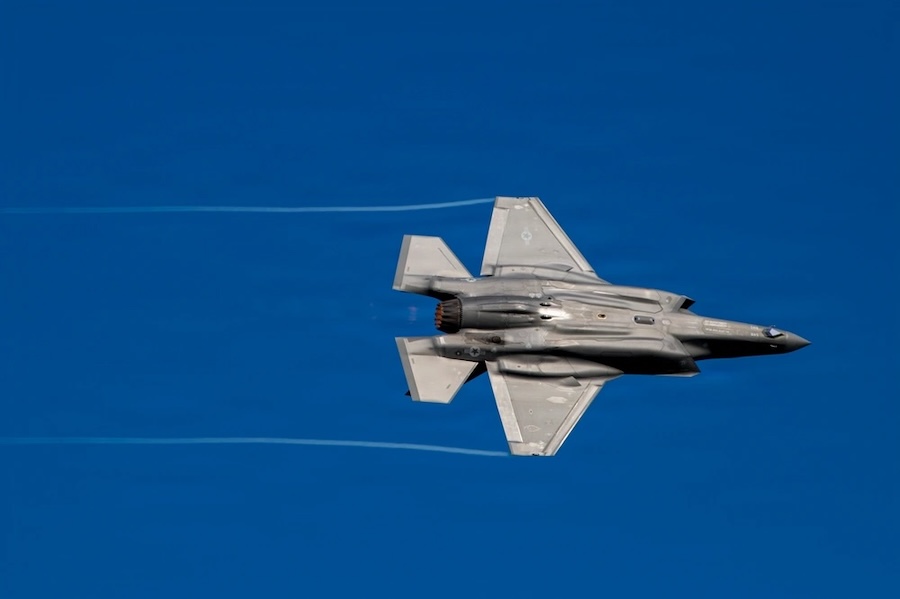
The governors’ letters call for maintaining a strong F-35 production rate to support fleet readiness, meet warfighter requirements and preserve industrial capacity. They also support multiyear procurement authority to produce cost savings and provide a clearer long-term demand signal to suppliers.
The letters include appeals from Greg Abbott, Kelly Ayotte, Mike DeWine, Maura T. Healey, Katie Hobbs, Kay Ivey, Brian P. Kemp, Tina Kotek, Joe Lombardo, Henry Dargan McMaster, Tate Reeves, Sarah Huckabee Sanders, Philip B. Scott, Mikie Sherrill and Josh Stein. The recipients included senior lawmakers on defense authorization and appropriations committees in the House and Senate, as well as congressional delegations in several states.
Texas Gov. Greg Abbott wrote: “The F-35, manufactured in Fort Worth, Texas, is the only fifth-generation stealth fighter in production in the United States. It utilizes cutting-edge technologies to deter our geopolitical foes, while also creating top-tier manufacturing and engineering positions nationwide.”
Abbott said the F-35 program supports 49,000 direct and indirect jobs in Texas, with more than 141 suppliers and an annual economic impact of over $10 billion. He also highlighted Fort Worth’s U.S. Air Force Plant 4 as the home of the F-35 production line and described it as a symbol of Texas innovation and national strength.
Ohio Gov. Mike DeWine wrote: “As you know, the F-35 is an essential component of the Air Force, Navy and Marine Corps fighter fleets. It is critical that the Department of Defense (DoD) restore production of the F-35 to ensure we maintain air superiority — and industrial superiority — well into the future.”
DeWine said the F-35 program supports more than 391 companies in Ohio and more than 15,300 direct and indirect estimated jobs. He also cited an annual economic impact of more than $2.9 billion across the state and noted Ohio’s role in F-35 bulkhead supply and global fleet sustainment support.
Several governors tied the request to local production, sustainment and training roles in their states. Georgia Gov. Brian Kemp wrote that at Lockheed Martin’s Marietta facility, “more than one-quarter of every F-35 aircraft takes shape,” while Arizona Gov. Katie Hobbs said the program supports nearly 14,000 jobs and 41 small and medium suppliers in Arizona.
Oregon Gov. Tina Kotek wrote: “Here at home, Oregon plays a vital, direct role in sustaining and deploying this capability. We are not just contributing to the aircraft’s supply chain; we are forging the aviators who will fly it.”
Kotek cited the selection of Kingsley Field in Klamath Falls to host the Air Force’s third formal training unit for the F-35A. She said the F-35 program supports 4,800 jobs and 18 small and medium-sized suppliers in Oregon, generating $670 million in annual economic impact.
South Carolina Gov. Henry Dargan McMaster highlighted Marine Corps Air Station Beaufort as the premier East Coast training and operational hub for the F-35B Lightning II. North Carolina Gov. Josh Stein pointed to operational F-35B and F-35C squadrons at Marine Corps Air Station Cherry Point and depot-level maintenance work at Fleet Readiness Center East.
Stein wrote: “The strength of the F-35 program is not defined by a single platform but by the integrated system that sustains it—from operational squadrons to depot maintenance to the suppliers that keep the fleet mission-ready. North Carolina sits at the center of this system.”
The recurring request in several letters said: “I respectfully request your support for procurement of 85 F-35 aircraft in the 2027 National Defense Authorization Act to maintain fleet readiness and cost stability. The F-35 program delivered 191 aircraft last year, demonstrating production maturity, stability, and sustained demand.”
The same language urged Congress to “consider multiyear procurement authority to achieve meaningful cost savings through production optimization, economic order quantity purchasing, and predictable demand signals for the defense industrial base.” It also said: “This production level is essential to meet the warfighter’s requirements and ensure the F-35 remains a vital component of U.S. and allied airpower.”
The comment accompanying the letters said the governors are pressing Congress to fully fund the Pentagon’s request for 85 additional F-35s. Together, the letters present the program as both a military priority and an industrial base issue for states that host production sites, training units, sustainment facilities and supply chain partners.