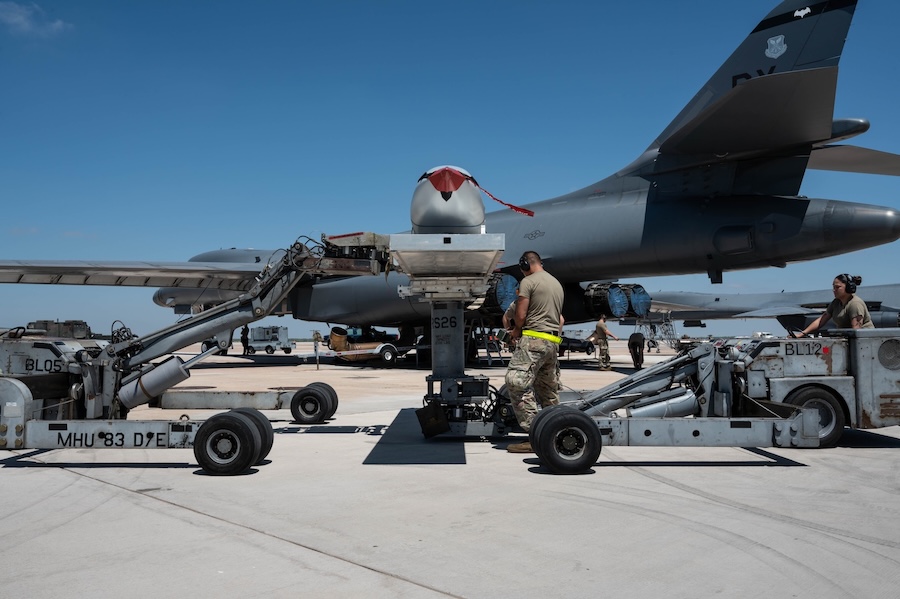
Conducted as an Air Force Global Strike Command Capabilities Exercise, Trident Fury was built around combat production techniques, operational planning and interoperability. The training placed munitions crews in a realistic, hands-on environment designed to replicate the pace and uncertainty of high-demand combat support.
The exercise opened with an initial air tasking order drop that forced 7th MUNS personnel to assess available stocks, select lots and move assets to production pads. Crews then shifted into continuous 24-hour operations, building munitions and delivering them to the flightline for in-check and grading across the four-day event.
“This exercise tested our ability to take a massive ATO, break it down into a supportable plan and execute it under extreme pressure,” said U.S. Air Force Master Sgt. Chris Kirby, 7th MUNS Munitions Accountable Systems Officer. “With evaluators throwing unexpected daily FRAG [Fragmentary Order] changes at us, our Airmen had to rapidly pivot and adapt our production on the fly. It validated our ability to surge and sustain operations in a highly dynamic environment.”
The Weapons Armament section focused on Multi-Role Pylon Loads, described by the Air Force as a major training milestone. Using the launcher load frame inside the armament building, technicians carried out a rapid magazine-reload type operation that required heavy weapons to be loaded directly onto racks within the facility.
The work included conventional bombs and Joint Air-to-Surface Standoff Missiles, or JASSM. The Air Force said the process sharpened a critical backshop skill set by challenging crews to handle complex weapons safely and quickly under compressed timelines.
In the munitions storage area, the exercise placed particular emphasis on joint and international cooperation. Production was divided into specialized areas for JASSM operations and conventional bomb builds, bringing together Airmen from multiple Major Commands, the Guard and Reserves, along with Marines and RAAF personnel.
“Having our Marine Corps and Royal Australian Air Force counterparts here allowed us to show them exactly how AMMO does it, while also learning from their unique perspectives,” said U.S. Air Force Chief Master Sgt. Jason Buzzard, 7th MUNS senior enlisted leader. “These joint partnerships are absolutely vital. When we can seamlessly integrate our teams on the pad, it ensures we can deliver combat power together in any theater.”
Trident Fury culminated with Agile Combat Employment techniques on the production pads. The final phase tested whether the teams could prepare weapons under simulated austere conditions, including limited tooling, limited base resources and limited facilities.
“We are executing an agile combat operations weapons preparation activity, which essentially means we are working with limited tooling, limited base resources and limited facilities to see how we can collaborate to prepare munitions,” said Royal Australian Air Force, No. 6 Squadron armaments technician, CPL Shannon Upton. “In the RAAF, we are jacks-of-all-trades—we handle everything from prepping the weapon to loading it and maintaining the aircraft systems. Integrating our procedures here with the Marines and the USAF has been a great opportunity to see how easily we can cross over our roles to achieve the mission in a realistic, high-tempo environment.”
That integration was most visible on the final day, when RAAF personnel led a major conventional bomb build. Working shoulder to shoulder with U.S. Airmen and Marines, the Australian team directed the physical assembly of the weapons under short-notice conditions.
“I had the opportunity to lead a shift involving short-notice bomb builds alongside U.S. forces and seeing how well everyone integrated was incredible,” said RAAF CPL. Lachlan McFarlane, 77 Squadron non-commissioned officer supervisor. “It is vital we do this now for real-world operations. If a crisis arises, we need to hit the ground running on day one. Seeing us achieve our mission objectives together under a tight timeframe proves we can operate seamlessly in a joint environment.”
The Air Force said the successful execution of Death Strike: Trident Fury reinforced Dyess’ ability to rapidly scale munitions operations with international and sister-service partners. By integrating teams and pushing tactical boundaries, the 7th MUNS said the exercise helped prepare the joint force to deliver synchronized combat power anywhere in the world.