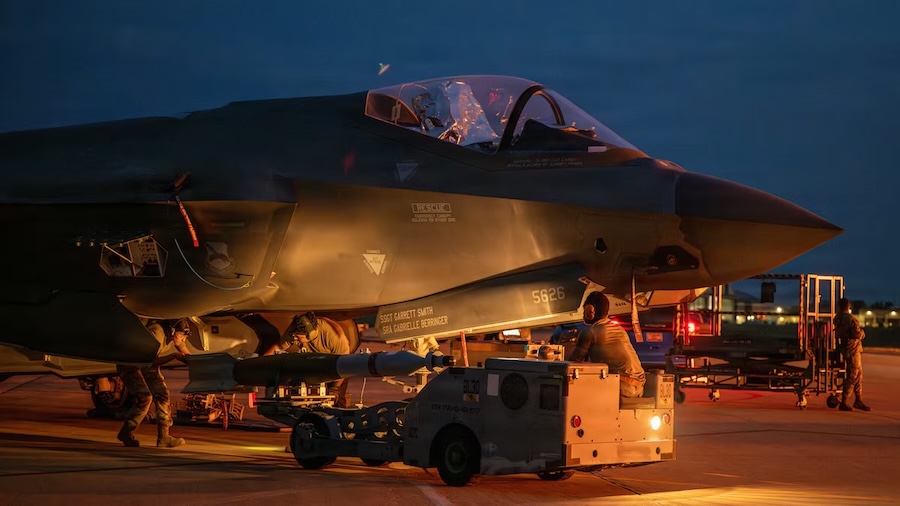
The 325th Fighter Wing joined the 86th Fighter Weapons Squadron for the Weapon System Evaluation Program event. The evaluation covered precision-guided munitions and related F-35A weapon systems.
The training required Airmen to generate combat power away from their normal operating environment. It supported Air Combat Command priorities for readiness, lethality and Agile Combat Employment.
“Combat Hammer allowed us to have hands-on exposure, specifically to air-to-ground weapons that the F-35 can carry,” said Capt. Simon Little, a 95th Fighter Squadron pilot. “We’re able to have those weapons on the aircraft, for the first time for some pilots.”
The Utah Test and Training Range gave F-35A pilots access to mountainous terrain. That environment differed from the mainly overwater training conducted at Tyndall Air Force Base.
“At Tyndall, we don’t get a ton of exposure to our air-to-ground mission set, just because we primarily train in the Gulf of America,” Little said. “So being here allows us exposure on different terrain — we get experience flying low level around the mountains and using terrain masking, different techniques and to target specific things on the ground.”
Live ordnance increased the responsibility placed on pilots and ground crews. It also added realism that routine training cannot fully reproduce.
“Anytime you have a live munition on the aircraft, the stress level is naturally a little higher,” Little said. “We train for this every day, but there is a distinct realism that comes with the ability to employ catastrophic ordnance … it’s a sobering reminder of what we do in the F-35.”
Maintenance and munitions personnel supported the same F-35A missions. The 325th Maintenance and Munitions Squadrons worked with Hill’s WSEP team to support the 95th Fighter Squadron.
The munitions unit arrived one week early for a dedicated “bomb week.” It assembled the required ordnance from the ground up before shifting to a 24-hour preparation cycle.
“We get 24 hours’ notice of what [munitions] are expected for the next day, what needs to be getting greened up, finished and out to the line, so it’s very quick,” said Staff Sgt. John Neer, a 325th Munitions Squadron precision-guided munitions inspector. “Here, we’re doing it as a 14-man team, as opposed to a 50-man team.”
Three members of Neer’s team had not previously assembled live munitions. The training gave them experience with live components and a faster operating tempo.
“It takes an entire team to execute the fundamentals of ‘fly, fight, and win’ and achieve our objectives,” Little said. “Being here allows us to see how every single role contributes directly to the team’s success or failure.”
Combat Hammer connected F-35A weapons employment with the maintenance and munitions support required to sustain combat operations. The Air Force said the training strengthened Tyndall’s ability to generate combat airpower and move from home-station preparation to operational execution.