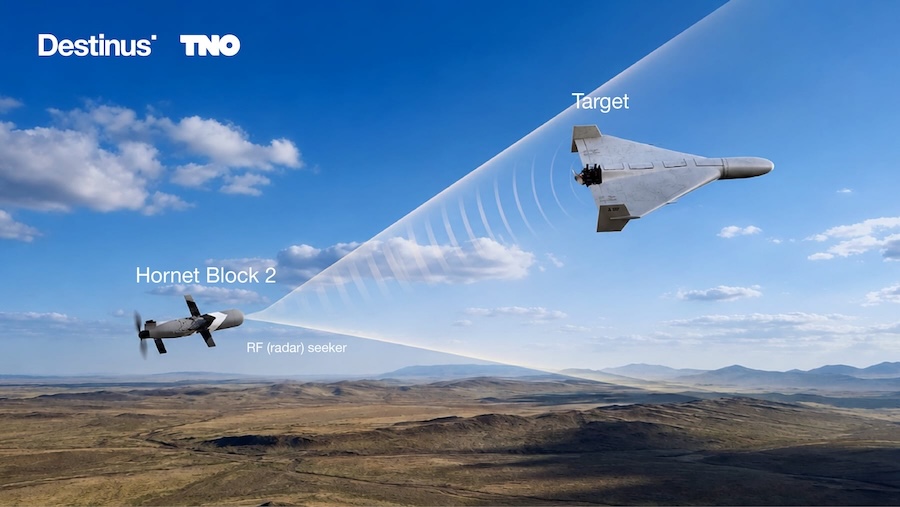
The joint venture is planned to be established in 2026, subject to relevant approvals, including from regulatory authorities. TNO and Destinus said the initiative marks an important step in strengthening integrated air defence capabilities in Europe.
The companies are developing, testing and industrialising advanced radar technology, also known as RF seekers, for interceptor systems. The active RF seeker is roughly the size of an ice hockey puck and acts as the “eyes” of a modern precision interceptor.
The technology is designed to help distinguish targets from countermeasures such as decoys. It is also intended to operate reliably under changing conditions, including at night, in poor weather and in more complex target environments.
TNO and Destinus said the seeker will enhance the final phase of target acquisition for interceptor systems. Decisions on deployment and engagement will remain under human control and within applicable doctrines and legal frameworks.
Under the joint venture, TNO will focus on developing and validating technological concepts, architectures and knowledge. Destinus will be responsible for system design, engineering, integration, industrialisation and market introduction of the developed solutions in deployable air defence systems.
The first demonstration products are expected early next year. The companies said the model brings technology development and industrialisation closer together from the outset.
“The geopolitical situation requires Europe to strengthen its defence technological and industrial base,” said Tjark Tjin-A-Tsoi, CEO of TNO. “Success will not only be determined by who can build the most platforms, but by who controls the critical technologies that make those platforms effective, robust, and reliable.”
“By making technology available earlier and at scale, this joint venture creates important opportunities for Dutch high-tech companies to produce, integrate, and scale technologies that are vital to European defence capability.” TNO said the cooperation supports a wider need to reduce European dependence on other regions for critical defence technologies.
“Advanced seekers are among the most critical guidance technologies in modern air defence,” says Tim Moser, Group CTO of Destinus. “Radar seekers are essential because they enhance performance in conditions where purely optical systems have limitations, such as low visibility, weather effects, and more complex target environments.”
“Together with TNO, we can integrate deep radar expertise into a system architecture that Destinus can design, industrialise, and scale for European air defence.” Destinus said the joint venture will support the scaling of radar seeker technology into deployable systems.
The announcement follows a recently signed letter of intent between the Dutch Ministry of Defence and TNO. That agreement aims to translate research and development more rapidly into concrete applications and build strategic positions in international defence and dual-use value chains.
State Secretary Derk Boswijk said: “Current geopolitical developments underline the need for rapid innovation and scaling of our defence industry. Now is the time to move forward: less talk, more action.”
“This requires close cooperation between knowledge institutions, industry, and Defence, with concrete products and results as the goal. This collaboration between TNO and Destinus aligns perfectly with Defence policy, and we therefore fully support it.”
TNO and Destinus said Europe faces a need to develop, validate and deploy new systems more quickly. The planned joint venture is intended to answer that challenge by linking research, industrial design and scalable production for critical air defence technology.