The Counter-UAS Integration and Planning Conference brought together sensor manufacturers, command-and-control developers, communications providers and companies developing common operating pictures. The Army tested how individual technologies perform and how they can work together as part of a broader defensive fires architecture.
“What we wanted to look for is their capability to perform individually, as well as with each other between all of the industry partners, to provide us this capability in the future, not only for the base, but also in tactical situations,” said Maj. Anne Pham, deputy director for XVIII Airborne Corps G34 Fires and Effects. Pham is a Royal Canadian Artillery officer, reflecting allied participation in the Corps’ approach to future combat operations.
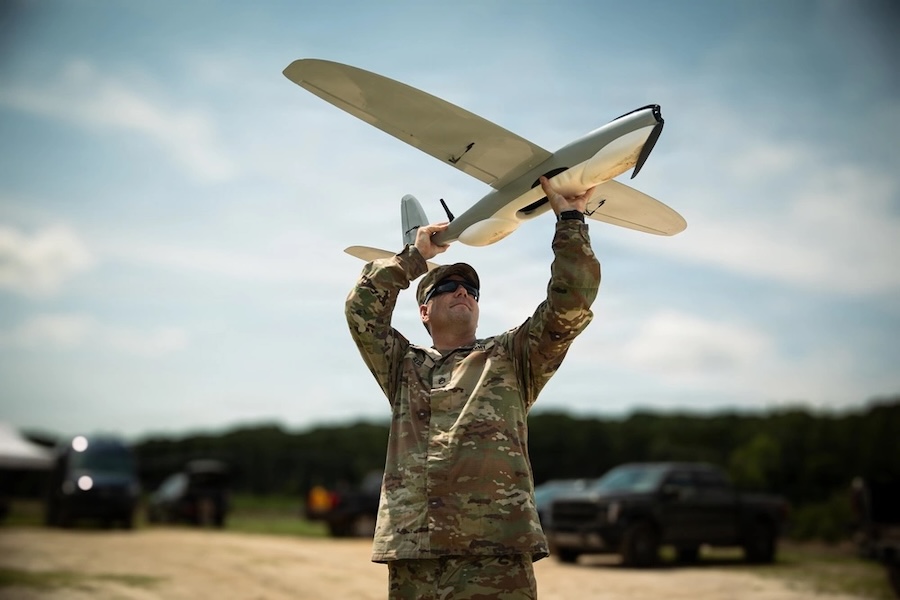
Industry teams also conducted individual sensor evaluations in the Fayetteville area against representative unmanned aircraft threats. The tests examined each system’s ability to detect, track and characterize drones before integration into a wider counter-UAS network.
“The goal isn’t to find one system that does everything,” said Staff Sgt. Jacob Schmall, assigned to G34 Fires, XVIII Airborne Corps. “It’s to understand how different capabilities work together and integrate the best technologies into a more complete counter-UAS architecture.”
The Army said no single sensor can address the full range of unmanned aircraft threats. The evaluation therefore focuses on combining systems with different strengths into a more complete picture for commanders and operators.
“This evaluation helps us understand what each sensor contributes and how these capabilities complement one another,” Schmall said. “Ultimately, the goal is to combine that information into a more accurate, timely and usable airspace picture for both commanders and operators.”
The results will inform the counter-UAS portion of Scarlet Dragon in September. XVIII Airborne Corps will use the exercise to continue testing how new technologies can be integrated across the force and applied to operational missions.