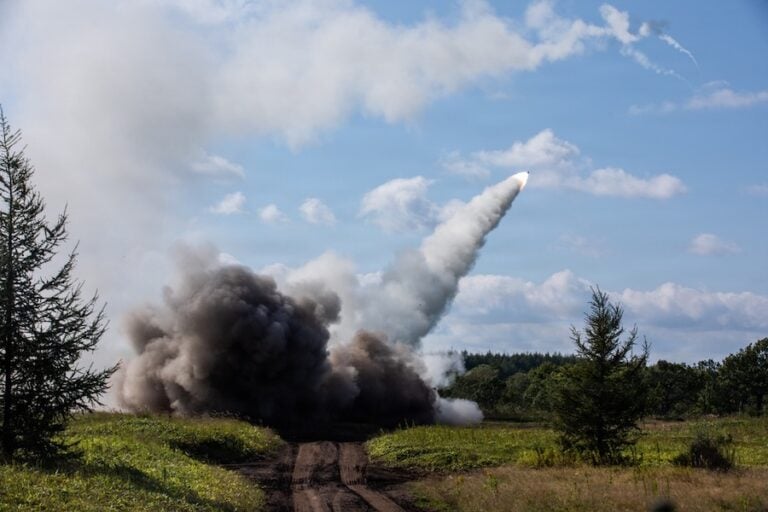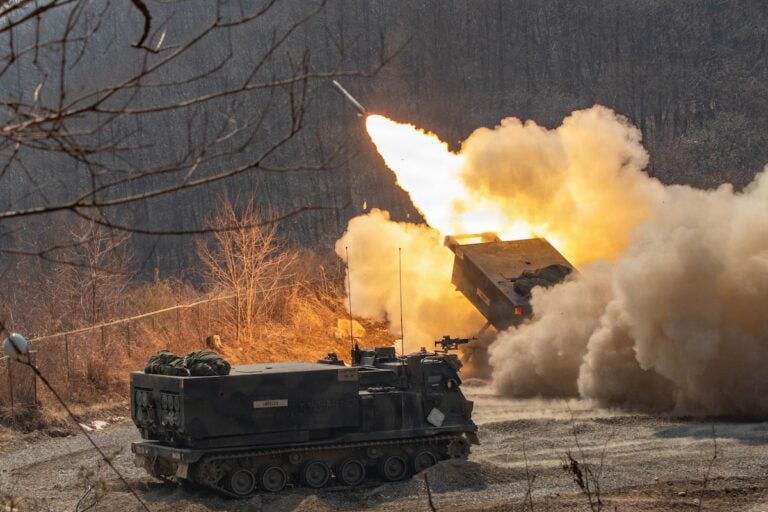
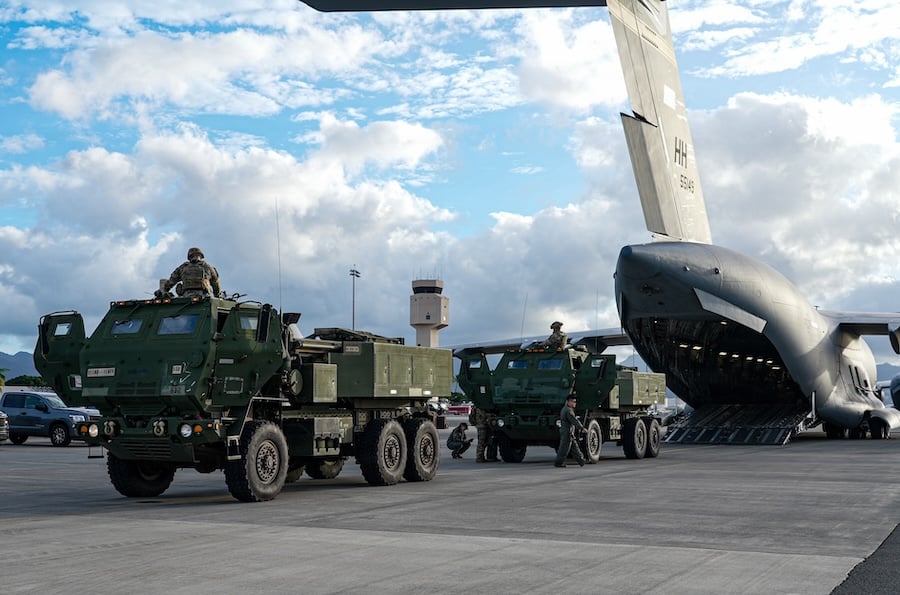
The U.S. Air Force’s 15th Wing provided airlift for launchers from the 2nd Battalion, 11th Field Artillery Regiment during Joint Pacific Multinational Readiness Center Rotation 27-01. Once the simulated fire mission was complete, crews secured the launchers for further maneuvers.
The tactic, which the Army calls HIMARS Rapid Infiltration, is designed to get launchers into areas with limited infrastructure, carry out a fire mission and fly them out quickly to reduce the risk of counterfire. Army crews worked with Air Force loadmasters to secure the launchers for flight and get them ready to move as soon as the aircraft landed, said 1st Lt. Cameron Richardson, a Bravo Battery platoon leader.
“For us, a strike means being quick, so making sure that we’re up on all communications, and it means being accurate,” Richardson said. “We want to make sure that we’re hitting the right thing at the right time.”
Col. Kyle Clinton, the 15th Wing commander, said the wing’s C-17 aircraft could quickly move equipment into remote or contested areas. “Missions such as this demonstrate the full extent of our continued teamwork and interoperability with our joint and allied partners,” he said.
The HIMARS crews on Kauai were hundreds of miles from ground operations on the islands of Hawaii and Oahu. Commanders used encrypted networks, Super-Intelligence decision aids and command-and-control software to process sensor data, confirm targets and coordinate the simulated mission with those operations.
The exercise gave the division a chance to rehearse short-notice deployments across islands. “Training here in Hawaii is exactly what prepares us to fight anywhere in the Pacific by rehearsing these short-notice deployments into contested terrain,” said Col. Bryan Fanning, commander of the 25th Division Artillery Brigade.