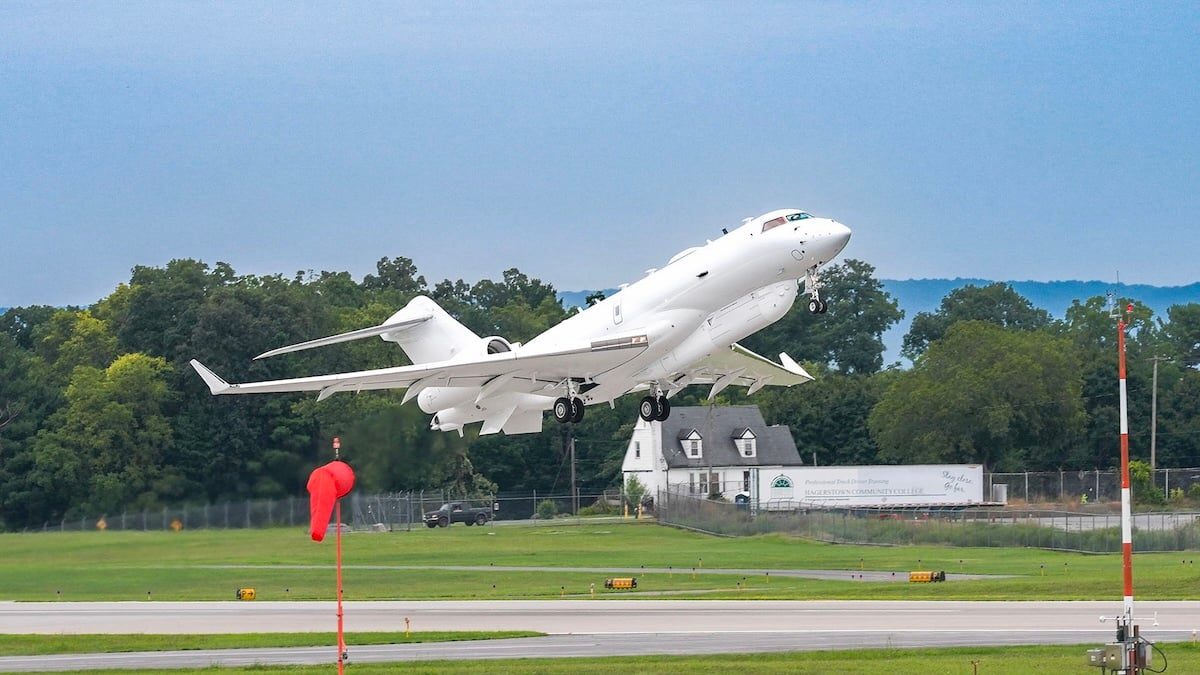
HADES, short for High Accuracy Detection and Exploitation System, uses a commercial jet airframe designed to fly faster, farther and higher, with a larger payload, than legacy turboprop intelligence aircraft. Army leaders expect those improvements to strengthen situational understanding and speed decision-making in contested environments.
“The first flight of HADES Prototype 1 transitions our vision for deep sensing from concept to reality,” said Lt. Col. (P) James Hickey, project manager for the Fixed Wing Project Office. “This achievement reflects the dedication, technical precision, and shared mission focus of our military, civilian, and industry partners working to deliver transformational capabilities to the Army and joint force.”
The Fixed Wing Project Office led the flight effort with Sierra Nevada Corporation, the program’s lead systems integrator, after completing a flight readiness review. Preparations included aircraft structural modifications, mission system hardware integration and preliminary airworthiness verification.
The Army will now integrate and test the aircraft’s mission systems, including its multi-domain sensing and signals intelligence capabilities. Developmental testing will assess their effectiveness, integration and operational readiness before operational demonstrations.
“Deep sensing is critical to maintaining decision advantage in the future fight,” Hickey said. “HADES will help commanders see farther, understand faster, and act with greater precision across the multi-domain battlefield.”