
The Congressional Research Service outlined the systems’ potential roles in “The U.S. Army and the Golden Dome Program”, updated on August 18. The report provides one of the clearest public indications yet of how the Army’s existing air and missile defense capabilities may fit into the planned nationwide architecture.
Patriot, IBCS and the Lower Tier Air and Missile Defense Sensor were among the major Army systems displayed at a Golden Dome “first look” at Joint Expeditionary Base Little Creek-Fort Story in Virginia on April 23. Their presence pointed to a possible configuration, though CRS stressed that program officials had not presented a final architecture or identified the number of systems required.
Golden Dome is intended to combine a range of capabilities into an integrated “system of systems” capable of defending the United States against aerial attack. The Army Space and Missile Defense Command serves as the operational lead in support of U.S. Northern Command.
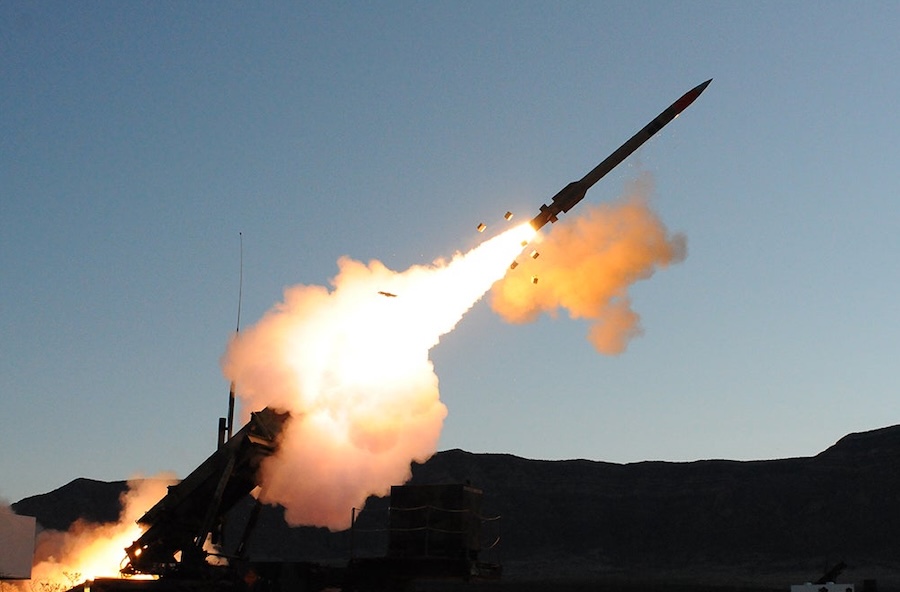
Patriot’s place in that structure is relatively clear. The mobile system can engage high-performance aircraft and tactical ballistic missiles, as well as cruise missiles and certain uncrewed aerial systems.
The Army already operates 15 active-component Patriot battalions and plans to add three more. One new battalion is scheduled to enter service in each fiscal year from 2029 through 2031.
The cost of expanding that force will be substantial. A four-battery Patriot battalion equipped with IBCS and LTAMDS is estimated at $1.792 billion, according to information the Army provided to CRS.
That figure offers an early benchmark for the cost of a fully networked Patriot formation. It does not account for missiles, long-term support or the wider infrastructure that would be needed if several battalions were assigned to Golden Dome.
IBCS would sit at the heart of the Army’s contribution. CRS described it as the “centerpiece” of the service’s Integrated Air and Missile Defense capabilities.
The system replaces older command-and-control equipment in Patriot and Terminal High Altitude Area Defense units and provides 360-degree protection coverage. Northrop Grumman, its developer, says IBCS “expands battlespace for longer range intercepts and defense depth.”
LTAMDS would provide the radar component. Designed to replace legacy Patriot radars, it offers greater detection range, improved target classification and coverage in all directions.
A prototype has already been tested, according to the report. Raytheon, the radar’s developer, has said LTAMDS is designed to counter advanced and next-generation threats, including hypersonic weapons.
Taken together, the three systems offer the Army a ready framework for its part of Golden Dome. Patriot provides the engagement capability, LTAMDS detects and tracks incoming threats, and IBCS ties the network together.
That combination would allow the Army to contribute more than a collection of stand-alone missile batteries. It would create a connected, land-based layer able to share information and coordinate engagements across a broader defended area.
The fiscal 2027 budget request gives an early sense of the potential scale of the investment. The Defense Department requested $17.5 billion for a Golden Dome for America Fund, including $434 million for Army operations, maintenance, research, development, testing and evaluation.
The Army separately requested $12.2 billion for Patriot Advanced Capability-3 Missile Segment Enhancement procurement. The Pentagon would be able to direct those missiles to either homeland or overseas missions, meaning the request is not dedicated solely to Golden Dome.
Most of the proposed spending would come outside the regular annual appropriations process. Mandatory funding accounts for 89% of the PAC-3 MSE request and $17.1 billion, or 98%, of the Golden Dome fund.
The administration has argued that the approach provides speed and flexibility. CRS said it may also leave Congress with less control over individual programs if lawmakers approve broad funding categories without detailed line items.
Missile supply is another open question. The Pentagon’s fiscal 2027 request would nearly triple overall missile procurement to $95 billion, reflecting a broader effort to rebuild inventories and meet operational demand.
Even so, building a layered Golden Dome network would require years of sustained investment in interceptors, factories and long-term support, CRS said. Production schedules are likely to shape how quickly the Army can field dedicated units because new systems and missiles may take several fiscal years to manufacture.
The Army is also reorganizing around the mission. Northern Command established Joint Task Force-Gold in January under Lieutenant General Sean Gainey, who also commands the Army Space and Missile Defense Command.
A battalion-sized formation has reportedly been selected from the existing force as the Army’s initial contribution. The service has not identified the unit or the equipment it will operate, saying only that it plans to use the formation for experimentation and testing.
The Pentagon established Golden Dome’s first operational site at Fort Story in August. The East Coast location is intended to support the defense of domestic airspace and eventually help protect population centers including New York and Washington from cruise missiles, hypersonic weapons and other advanced threats.
It remains unclear whether Patriot and IBCS will be among the first systems sent there. The Pentagon has not identified the units planned for Fort Story or disclosed how many additional sites will be needed across the country.
The demand for people may prove just as significant as the demand for hardware. The Army’s air and missile defense force relies heavily on specialized personnel who already face a high operational tempo and persistent demand for overseas deployments.
Golden Dome would add new requirements in air defense, space operations and command and control. Recruiting, training and retaining enough qualified personnel may limit how quickly the Army can expand its homeland mission.
The total cost of Golden Dome remains unsettled. General Michael Guetlein, who leads the Office of Golden Dome for America, has testified that the program will cost $185 billion through delivery in 2035, while the Congressional Budget Office has estimated $1.2 trillion to develop, deploy and operate it over 20 years.
Patriot and IBCS are among the most mature Army options available for the project, making them natural candidates for an early role. Whether they become the backbone of Golden Dome will depend on decisions that have yet to be made about funding, force structure, production capacity and deployment.
Source: The U.S. Army and the Golden Dome Program (report).