
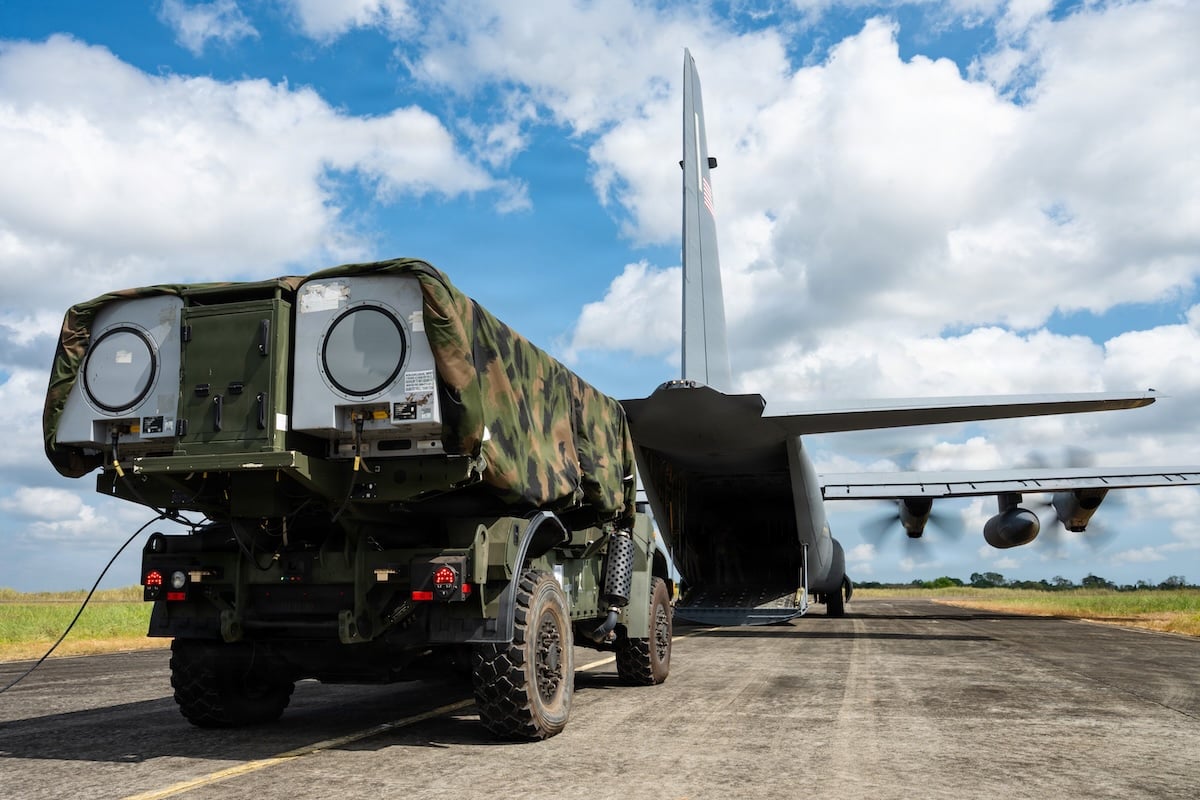
The drills centered on the Navy-Marine Expeditionary Ship Interdiction System, or NMESIS, which the battery uses to deliver what the Corps calls organic, precision maritime fires in support of combined and joint force operations. They also fed into the wider mission of the 3rd Marine Littoral Regiment (MLR): securing key maritime terrain, synchronizing combined-joint fires and protecting critical sea lanes across complex littoral environments.
“The NMESIS is a critical component of the Marine Corps’ Force Design initiatives to meet the needs of the modern battlespace,” said Capt. Daniel Cook, the MMSL Battery’s operations officer. “As a highly capable, mobile, and survivable system, it can effectively deny maritime threats access to critical waterways from distributed and austere sites.”
The training was split into two courses of instruction, both built around realistic, scenario-driven tasks. The first covered basic artillery tactics; the second turned to core field skills, including patrolling, fire team attacks, tactical combat casualty care and local security.
Command and control ran through both, exercised at battery and platoon level as Marines planned operations and set up operations centers. Those distributed nodes allowed leaders to coordinate movement, process targeting information and direct simulated firing missions through each phase of the training.
On the artillery side, Marines carried out reconnaissance, selected and occupied positions, established security and executed rapid displacements. They also practiced NMESIS fire mission processing and procedures, reinforcing the communication, coordination and technical proficiency needed to employ anti-ship capabilities.
“The training emphasized readiness through realistic scenarios that required Marines to execute the same fundamental tasks they may be called upon to perform across demanding maritime terrain,” said Cook. “By rehearsing command and control, position occupation, fire mission processing, and field skills, we strengthened the battery’s ability to operate as a team and provide a flexible maritime fires option to the combined or joint force.”
The Corps said pairing artillery-specific training with basic fieldcraft continued to develop disciplined and adaptable Marines. That, it said, prepares the battery to support the regiment’s ability to operate across littoral terrain and to contribute to maritime security and coastal defense.
NMESIS was first fielded to 3rd MLR in 2024 and is regarded by the Corps as a cornerstone of its Force Design initiative. It gives joint force commanders an expeditionary and survivable ground-based anti-ship platform at extended ranges.
Since receiving the system, the regiment has deployed it to the Philippines for multilateral exercises such as Balikatan and KAMANDAG. Those deployments were aimed at enhancing interoperability while training alongside regional allies and partners.
3rd MLR is a subordinate unit of the 3rd Marine Division, based at Marine Corps Base Hawaii and purpose-built for operations across complex littoral terrain. It integrates advanced sensing, survivable command and control, littoral maneuver and modern maritime fires alongside combined and joint partners in support of a free and open Indo-Pacific.