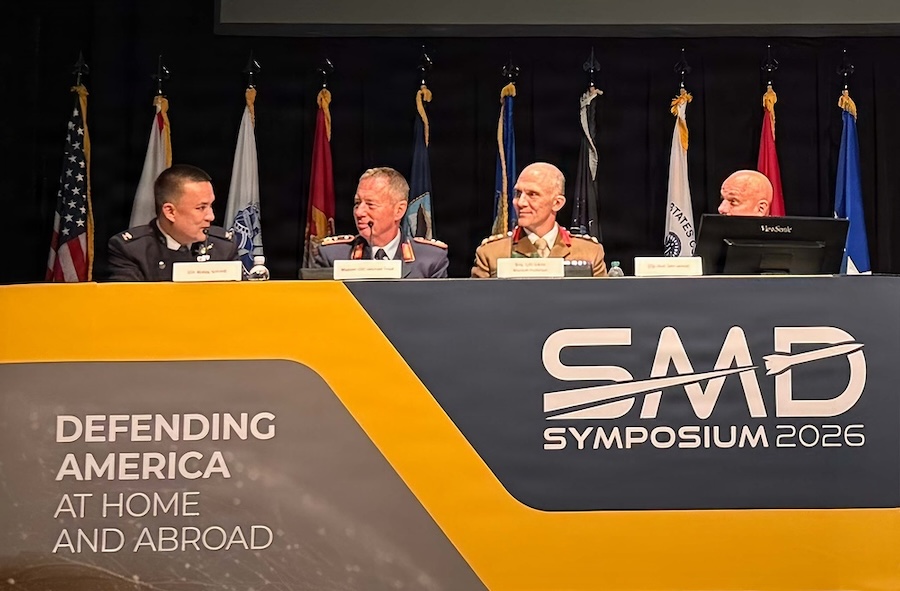
Schmitt said closer coordination across military services, combatant commands, allies and commercial partners had become necessary as the space domain grew more contested. S4S, the Space Force component of U.S. Space Command, commands forces conducting space superiority operations and delivers space-enabled effects to the Joint Force.
The command organizes its mission around four priorities: protect, defend, connect and deliver. Those priorities cover the protection of space capabilities, coordination among combat forces and delivery of space-derived data to warfighters.
“We work with allies and partners to command U.S. Space Force systems, protect and defend U.S. Space Command’s area of responsibility, and deliver critical capabilities to the Joint Force around the globe,” Schmitt said. “The bottom line is our mission at S4S is to enhance blue kill chains, make them more effective, and to break red kill chains – to keep the enemy from using their space capabilities against us.”
“I think when I joined the U.S. Air Force doing space operations, we assumed it was a benign domain and that our satellites were completely protected and that we could use them at will to do what we want to do across the Joint Force,” Schmitt said. “I think those assumptions are no longer valid – the space domain is under threat.”
Schmitt said the domain had become increasingly congested as adversaries deployed more satellites and sought to contest U.S. access to space capabilities. Gen. Stephen Whiting, commander of U.S. Space Command, designated 2026 as the command’s “Year of Integration” to build a synchronized and combat-ready space enterprise.
That approach places allied exchange and liaison officers directly within S4S operational planning teams. The officers participate from the start of the planning process instead of being added at a later stage.
“The way we work with allies and partners is really integrated into the fabric of S4S,” Schmitt said. “In any kind of planning that we do, we’ve got representatives from all the partner nations that are part of the team.”
S4S also serves as the operational execution arm for Multinational Force–Operation Olympic Defender. The coalition comprises the Five Eyes nations, Germany and France.
“I remember years ago when MNF-OOD was first stood up, and back then it was more of an idea focused on information and awareness,” Schmitt said. “To see how much progress we’ve made just in the last few years, bringing that from information sharing to really combined operations, has been remarkable.”
The coalition is developing shared operational concepts for steady-state campaigning, crises and conflict. Its recent activity included Operation Selene, a Canadian-led mission that combined the space domain awareness capabilities of all seven nations to maintain custody of a high-interest object in orbit.
Whiting described Selene as the coalition’s “most focused, combined space domain awareness operation to date” and said it would become an enduring mission. Schmitt said information-sharing and classification restrictions remained obstacles, but the coalition was working to reduce those barriers.
“We have spent a significant amount of time working through the capabilities that the alliance brings,” Schmitt said. “What I see in Multinational Force–Operation Olympic Defender is a common strategy, a common vision across the nations.”
Lt. Gen. Dennis Bythewood, the S4S commander, has said allied integration is central to maintaining space superiority and delivering combat effects across the Joint Force. “I think it’s important that we highlight just how working together definitely makes us more capable,” Schmitt said.