

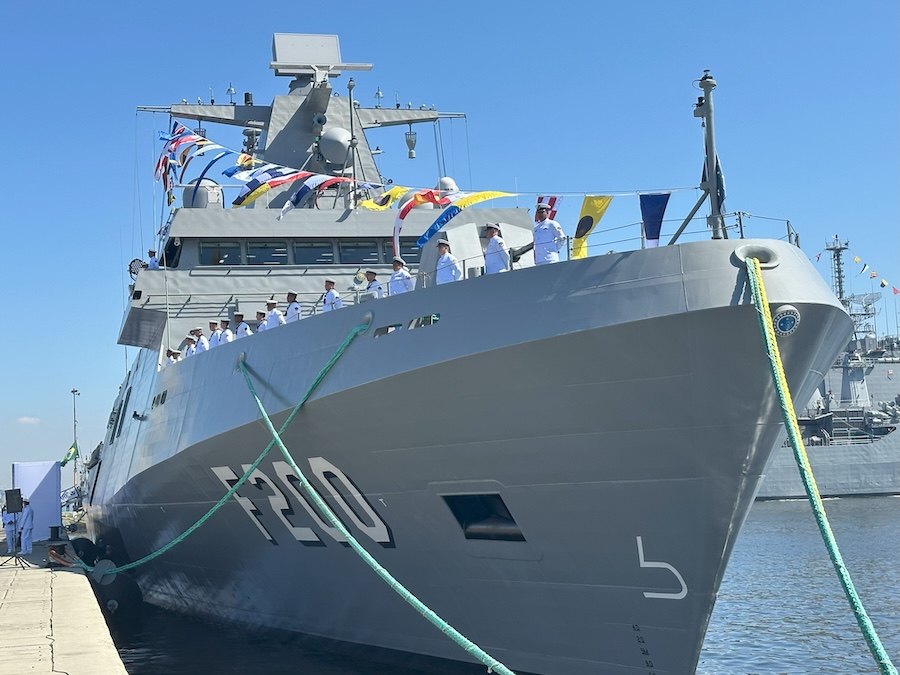
The vessel was built at TKMS’ shipyard in Itajaí in less than four years. It is the first ship delivered under Brazil’s Tamandaré Class Frigates Programme, which the company described as the most advanced naval project ever developed in the country.
The programme is led by the Brazilian Navy and managed by EMGEPRON. Construction is being carried out by Águas Azuis, a joint venture formed by TKMS, Embraer and Atech.
Senior representatives from TKMS, partner companies, the Brazilian government and the navy attended the ceremony. Among them was Admiral Marcos Sampaio Olsen.
“We have been partners of the Brazilian Navy since the 1980s, when we jointly developed the successful Tupi-class submarines,” said Oliver Burkhard. “The commissioning of the Tamandaré frigate now represents a new milestone in this journey, and TKMS stands ready to continue it with a second batch of four additional ships.”
“The signing of a Memorandum of Understanding in this regard is a strong sign of the deep trust between us and Brazil,” Burkhard added. “The project demonstrates how structured international cooperation can enhance strategic capabilities while strengthening the local industrial base.”
The Tamandaré-class frigates are based on TKMS’ MEKO A-100 platform. The design is intended to provide modularity, operational flexibility and adaptability for different missions.
The F200 is equipped with advanced combat systems, sensors and weapons systems. TKMS said the ship establishes a new technological benchmark for the Brazilian Navy.
Brazil joins 18 navies worldwide that operate surface vessels supplied by TKMS. The company said three additional frigates are scheduled for delivery by 2029.
Paulo Alvarenga said: “The Tamandaré Class Frigates Program is a concrete example of technology transfer, strengthening of the defense industrial base, and value creation for the country.”
“We are proud to contribute to enhancing the operational capabilities of the Brazilian Navy,” he added.
TKMS said the wider programme also supports Brazil’s domestic economy. Around 1,000 Brazilian companies are involved in the supply chain, while the project is expected to support roughly 23,000 jobs through direct, indirect and induced employment.