
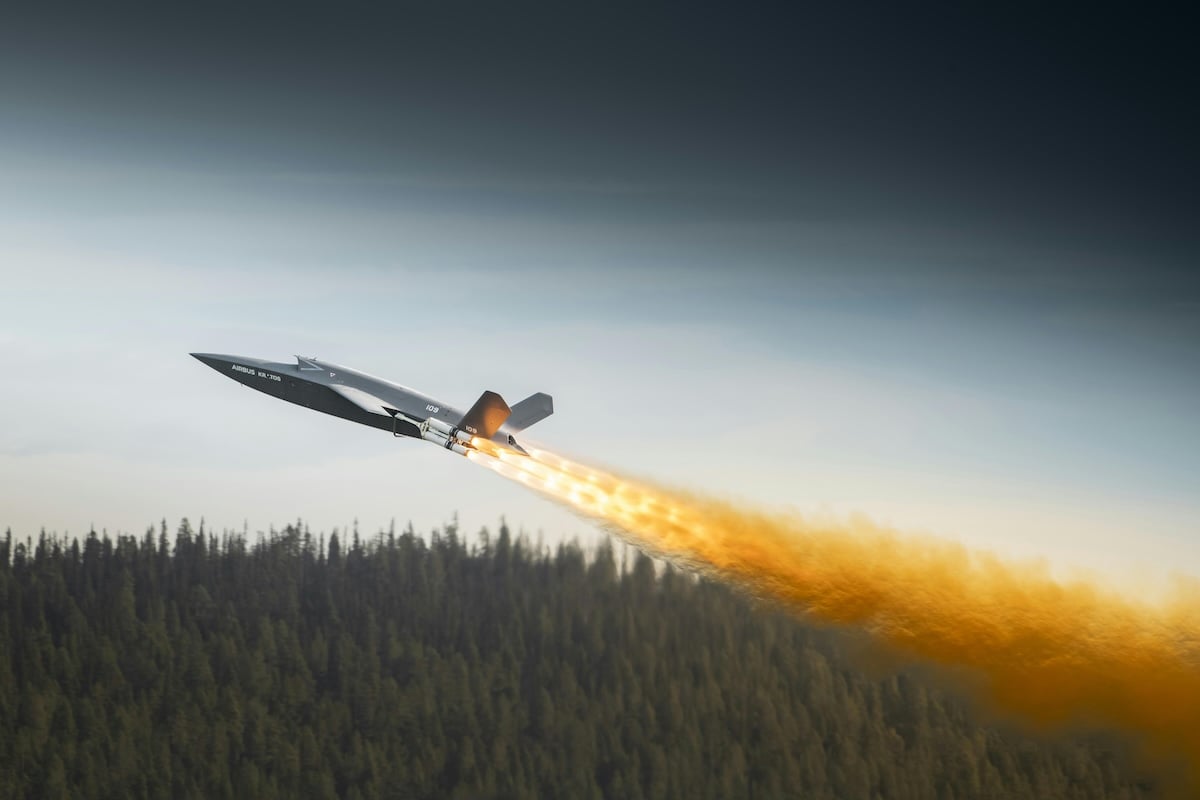
The aircraft took off from a test facility in Northern Europe using a runway-independent, rocket-assisted launch. It completed maneuvers at different altitudes and speeds up to Mach 0.8, as well as in-flight mission adjustments.
All test objectives were met, according to the companies. Subsequent flights will involve Airbus’ Multi-platform Autonomous Reconfigurable and Secure, or MARS, mission system.
The partnership, announced in July, pairs Kratos’ XQ-58A Valkyrie airframe with Airbus-developed mission technology. MARS is intended to give German or other European operators control over software, mission applications, data and system hardware.
The system uses AI-enhanced software to conduct autonomous missions and coordinate groups of aircraft. The companies said its control hierarchy retains human oversight and ensures critical decisions comply with rules of engagement and legal and ethical standards.
“In an increasingly complex and contested threat environment, air forces require affordable combat mass,” said Mike Schoellhorn, chief executive of Airbus Defence and Space. “By pairing Kratos’ proven airframe as a ‘program of record’ with Airbus’ sovereign European mission system, we are able to offer a robust, sovereign, affordable, and combat-ready CCA system by the end of the decade.”
“The Valkyrie will also play a critical role in enhancing crewed combat aircraft such as the Eurofighter with extended range, firepower, and survivability,” Schoellhorn said. “The aircraft design enables operational resilience through its rail launch capability, while offering conventional, runway based, take-off and landing as an option.”
Valkyrie has been flying since 2019 and is already in production, according to Kratos. The company said the platform has flown alongside and teamed with F-35s, F-22s, F-15EXs and F-18s operated by the U.S. Air Force and Marine Corps.
Kratos describes Valkyrie as a stealthy collaborative combat aircraft, also designated an autonomous collaborative platform, developed for joint and allied forces. It supports runway-independent operations as well as flights from austere and improved airfields.
The U740 is designed to operate autonomously or under the command of crewed fighters, including the Eurofighter. Its intended roles include carrying out high-risk missions and protecting crewed aircraft.
Airbus lists the U740 at 9.1 meters long, with an 8.2-meter wingspan and a maximum takeoff weight of approximately three metric tons. It has an internal weapons bay and external payload stations beneath its wings.
Kratos states that the broader Valkyrie platform can travel more than 3,000 nautical miles, reach Mach 0.86 and operate at altitudes up to 45,000 feet. These are platform specifications, rather than performance figures demonstrated during the European flight.
The aircraft can carry kinetic and non-kinetic effectors in its internal bay and on wing stations, according to Kratos. The company also identified air-to-air and air-to-ground munitions as payload options for the U740’s internal bay.
“First flights typically include plenty of learning opportunities, but with the maturity of the Valkyrie system and the well-integrated Airbus and Kratos team, this flight was an amazing success,” said Eric DeMarco, Kratos’ president and chief executive. “We’re proud to be partnering with Airbus on the CCA opportunities in Germany and other parts of the world.”
“Combining the strengths of Kratos and Airbus enables the affordable Valkyrie system and Kratos’ CCA and drone manufacturing legacy to evolve with MARS and Airbus’ other high-capability subsystems, experience, and extensive knowledge across the full aerospace spectrum,” DeMarco said. Airbus has designed MARS for use across multiple platforms, extending its intended application beyond the European Valkyrie variant.