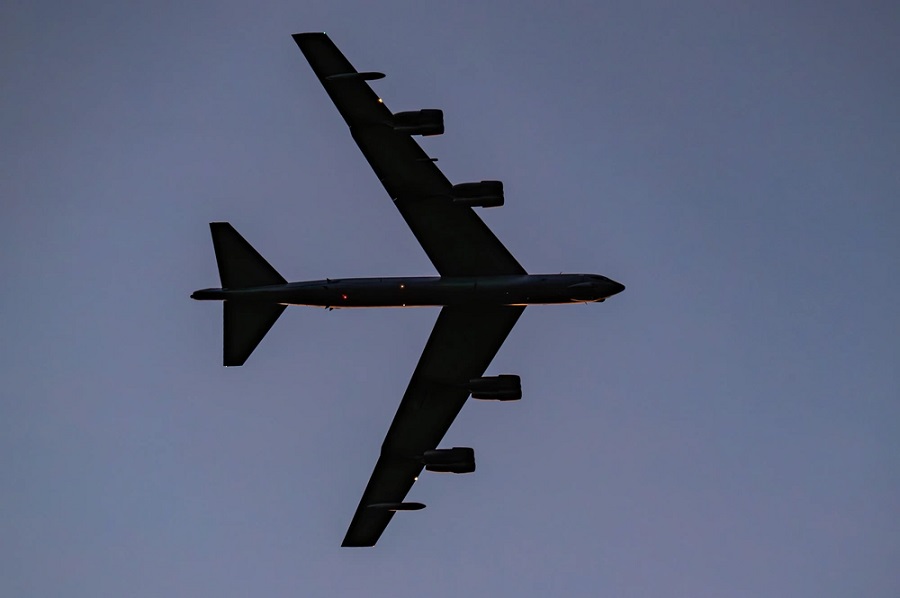
The Air Force has flown the B-52H since the early 1960s and plans to keep the bomber in service into the 2050s. The service wants the aircraft to operate alongside the B-21 Raider stealth bomber, which is still in testing.
The B-52 modernization effort includes the new radar, Rolls-Royce engines, improved avionics, digital cockpit displays, new weapons, upgraded communications systems and other changes. Once the fleet is fully modified in the 2030s, the aircraft will be redesignated the B-52J.
The crash occurred late in the morning local time shortly after takeoff. Eight people were on board, including service members, government civilians and contractors supporting the test mission.
The aircraft erupted into flames that consumed almost the entire bomber. Col. James Hayes, deputy commander of the 412th Test Wing at Edwards, called the event a “tragedy” during a June 15 news conference and said it was clear no one could have survived.
Senior Pentagon officials, including Defense Secretary Pete Hegseth, Air Force Secretary Troy Meink and Air Force Chief of Staff Gen. Kenneth Wilsbach, posted messages on social media mourning those killed. Boeing, the original builder of the B-52 and lead contractor for integrating the modernized systems, later confirmed that two of its employees died in the crash.
Hayes said the B-52 had just taken off for a test sortie. He said the mission was supporting the Radar Modernization Program.
A B-52 fitted with the new APQ-188 radar flew from Boeing’s San Antonio facility to Edwards in December 2025. The radar, developed by Raytheon Technologies, is intended to improve navigation and targeting in all weather conditions.
An Edwards spokesperson was not immediately able to confirm whether the B-52 that arrived in December was the aircraft that crashed. It is also unclear what effect, if any, the crash will have on the radar program or the wider B-52 modernization effort.
The radar program has faced difficulties in recent years. These have included technical integration challenges and cost growth that triggered a law in spring 2025 requiring congressional notification.
Delays in the radar program also contributed to the projected initial operational capability of the B-52J slipping by three years. A Pentagon report in March said the Air Force had scaled back the radar program’s scope because of those problems.
After the crash at Edwards, the Air Force has 75 B-52s remaining in its fleet. The aircraft was originally expected to fly for only 20 years, but its ability to carry large quantities of weapons has kept it in regular use.
The B-52 can carry as much as 70,000 pounds of ordnance. It has been used in the Gulf War, the wars in Iraq and Afghanistan, the campaign against the Islamic State and most recently Operation Epic Fury against Iran.
The aircraft can carry precision-guided weapons, gravity bombs, cluster bombs, mines, cruise missiles and nuclear weapons. Its role as a heavy weapons carrier has remained central to its value for the Air Force.
Keeping the B-52 airworthy has become more difficult as spare parts become harder to find and aging systems break more often. Many companies that originally produced B-52 parts more than 50 years ago are no longer operating, forcing the Air Force to seek alternative sources.
Those efforts are not always successful. Maintainers increasingly have to cannibalize spare parts from one bomber to repair another.
The difficulty of sustaining B-52 engines and other systems helped drive the Air Force’s decision to modernize the aircraft into the B-52J. The Commercial Engine Replacement Program is the largest part of that effort.
The program will replace the original Pratt & Whitney TF33 engines with Rolls-Royce F130 engines. No new F130 engines have yet been installed on B-52s, and the main engine replacement work remains ahead.
The Air Force said in May that the engine replacement program had passed its critical design review. Boeing will next modify the first two B-52s with new engines and other upgrades at its San Antonio facility, with the first aircraft expected to arrive there later in 2026.
After those two aircraft are upgraded, the plan is to fly them to Edwards for extensive testing. The crash raises new attention on the broader modernization program, though its effect on future testing is not yet clear.
Doug Birkey, executive director of AFA’s Mitchell Institute for Aerospace Studies, said the B-52H still has a strong record and remaining service life. He said the H-model spent much of its early years on nuclear alert while older B-52 variants were flown heavily during the Vietnam War, meaning the H fleet did not accumulate as many Cold War flight hours.
Birkey said investigators will likely rely on witness testimony and possible video evidence because the crash occurred near the base’s air traffic control tower. He also said the intensity of the fire means there will likely be limited physical evidence to examine.
The Edwards crash was the first loss of a B-52 in a decade. In May 2016, a B-52 skidded off a runway during an aborted takeoff at Andersen Air Force Base in Guam after the crew suspected a bird strike when several engines lost thrust.
The crew safely evacuated that aircraft, but the bomber caught fire and was declared a total loss. Another B-52 crashed into the ocean northwest of Guam in 2008 after takeoff, killing all six crew members.
The investigation into the 2008 crash concluded that the aircraft’s rear stabilizers malfunctioned and caused the accident. Those were the only two previous B-52 losses in the 21st century.
In 1994, a B-52 crashed at Fairchild Air Force Base in Washington during a practice flight for an air show. The aircraft stalled after a steep low-altitude turn and hit the ground, causing an explosion that killed all four people aboard.
Source: Air & Space Forces Magazine.