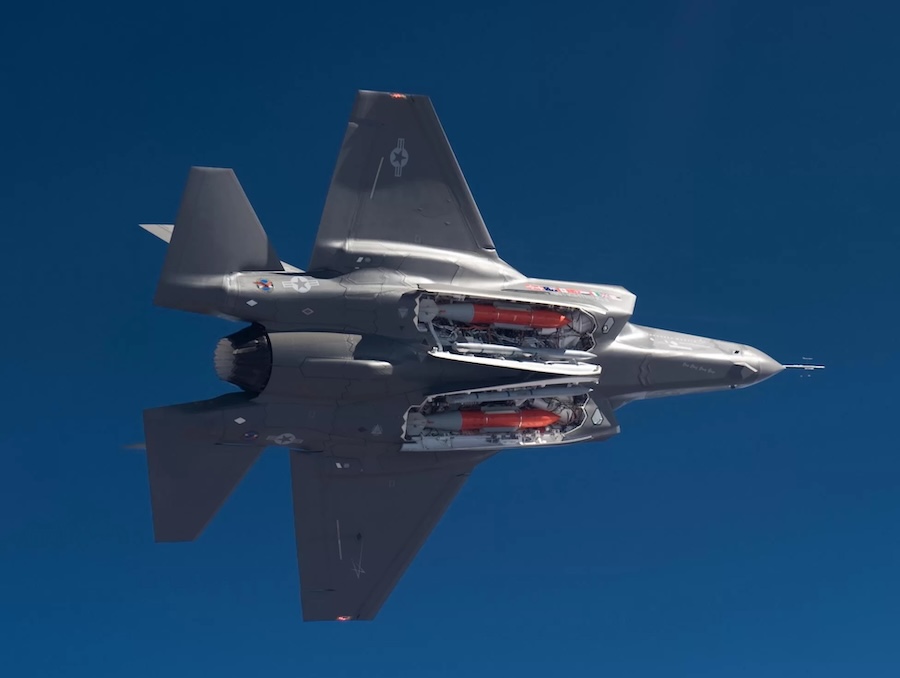
The aircraft will be based at RAF Marham and made available for the alliance’s nuclear mission. The F-35As will be dual-capable, meaning they can be equipped to carry nuclear weapons during a conflict.
The government announced the purchase in June 2025 after the Strategic Defence Review recommended a renewed British contribution to NATO’s nuclear posture. Several NATO countries already provide dual-capable aircraft to the alliance.
Britain has long supported NATO’s nuclear mission through conventional capabilities and other resources. The F-35A commitment will extend that contribution by restoring a direct nuclear role to the RAF under the government’s “NATO First” approach.
The new role will complement, but remain separate from, Britain’s independent submarine-based nuclear deterrent. The distinction means the UK will contribute British aircraft and pilots to NATO’s mission while any US nuclear weapons carried by them remain under US control.
The decision marks the RAF’s return to a nuclear mission for the first time since Britain withdrew its sovereign air-launched nuclear weapons after the Cold War. The WE177, the country’s final air-launched nuclear weapon, entered service in 1966 and was retired in 1998.
Britain’s nuclear weapons programme began during the Second World War, and its first operational nuclear weapon, Blue Danube, was carried by RAF V-bombers from 1956. Since the withdrawal of the WE177, submarine-launched Trident missiles fitted with British sovereign-designed warheads have served as the country’s only nuclear delivery system.
NATO’s wider deterrence posture relies on US nuclear weapons deployed in Europe and supporting infrastructure and capabilities supplied by allied countries. It also includes the strategic nuclear forces of the US and UK assigned to NATO, alongside those of France.
Britain has assigned its nuclear capability to NATO’s defence since 1962, but its sovereign deterrent remains fully operationally independent. Only the prime minister can authorise the use of UK nuclear weapons.
The government describes its policy as maintaining an independent, minimum and credible deterrent designed to prevent coercion and deter aggression. It retains deliberate ambiguity over when, how and at what scale it might contemplate nuclear use, while stating that such weapons would be considered only in extreme circumstances of self-defence, including the defence of NATO allies.
The Ministry of Defence linked its nuclear modernisation plans to a deteriorating security environment and the expansion of other states’ arsenals. It said Russia had more than 4,000 nuclear warheads available for use, while China possessed around 600 and was expected to more than double that number by 2035.
Britain’s nuclear relationship with the US is underpinned by the 1958 Mutual Defense Agreement and the 1963 Polaris Sales Agreement. The former allows the two countries to exchange nuclear materials, technology and information for mutual defence purposes and provides for the transfer of non-nuclear components.
The UK’s independent deterrent is currently maintained by four Vanguard-class ballistic missile submarines based at HMNB Clyde. Armed with Trident II D5 missiles, the boats conduct continuous deterrence patrols supported by other Royal Navy capabilities.
Four Dreadnought-class submarines are due to replace the Vanguard fleet from the early 2030s. The government’s nuclear “triple-lock” also commits Britain to maintaining Continuous At Sea Deterrence and delivering future upgrades, while the planned F-35A force provides a separate contribution to NATO’s nuclear mission.