
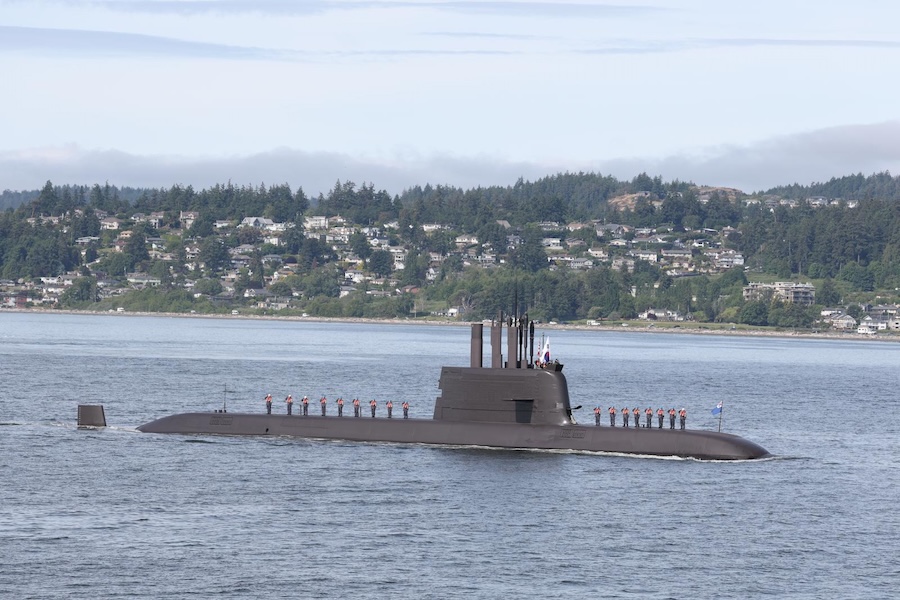
The voyage took about two months and included logistical stops in Guam and Hawaii. In Hawaii, two Royal Canadian Navy submariners joined the Republic of Korea Navy crew for the onward passage to Victoria.
Hanwha Ocean said the deployment demonstrates the range and capability of the KSS-III submarine it is proposing for Canada’s Canadian Patrol Submarine Project. The company said the submarine is proven, in service and in active production at its Geoje shipyard in South Korea.
The company said the KSS-III meets and exceeds Royal Canadian Navy requirements for the programme. These include underwater surveillance capability, Arctic deployability, extended range and endurance, stealth, persistence and lethality across Canada’s three oceans.
Dosan Ahn Changho arrived in Canada together with the Republic of Korea Navy frigate Daejeon, which also made the voyage. Both vessels are due to participate in joint exercises with the Royal Canadian Navy to demonstrate interoperability with NATO allies.
Hanwha Ocean said it has the fastest delivery schedule for the Canadian submarine project. If contracted in 2026, the company said it could deliver four KSS-III submarines before 2035 to fully replace Canada’s current Victoria-class fleet.
The company said earlier retirement of the Victoria-class submarines would generate estimated savings of about C$1 billion in maintenance and support costs. It said the remaining eight submarines would be delivered at a rate of one per year, allowing a full 12-submarine fleet to be delivered to Canada by 2043.
Hanwha Ocean said no other option can come close to that delivery schedule. It also said its accelerated plan would allow job creation, trade and investment in Canada to begin immediately.
The company’s proposal includes construction of maintenance, repair and overhaul facilities on both Canadian coasts. It also includes training facilities, technology transfer, localisation of production, supply chain integration and other partnerships.
Hanwha said one planned partnership with Canada’s Automotive Parts Manufacturers’ Association would establish a new Canadian entity to produce military and industrial vehicles in Canada. The venture is contingent on Hanwha being selected for the Canadian Patrol Submarine Project and would use “Made in Canada” parts and materials, including Canadian steel and aluminium.
Hanwha said its economic proposal has increasingly focused on localising underwater warfare and sustainment capabilities in Canada. The company has expanded partnerships with Canadian firms including Geospectrum Technologies, Ultra Maritime, OSI Maritime Systems and Curtiss-Wright INDAL Technologies.
Those partnerships are intended to support Canadian-based capability in sonar systems, underwater surveillance technologies, torpedo-related support infrastructure, integration, maintenance, repair and long-term fleet sustainment. Hanwha also plans to establish the Hanwha Arctic and Defence Innovation Centre in Canada.
The centre is intended to support defence research and development in areas such as AI-enabled systems, autonomy, digital engineering, advanced manufacturing, simulation, naval systems, aerospace technologies and next-generation defence applications. Hanwha said it reflects a longer-term vision for cooperation with Canadian universities, research institutions, technology companies and industrial partners.
Hanwha said an analysis by KPMG of its proposal submitted on 27 February found that, from 2026 to 2044, it represented C$60 billion in economic opportunities for Canada. The analysis also found it would support an average of 22,500 full-time equivalents annually and generate C$94 billion in GDP across Canada.
The company said it has teaming agreements, memoranda of understanding and contracts with more than 70 Canadian companies and institutions. These include Algoma Steel, AtkinsRéalis, Cohere, CAE, MDA Space, Ontario Shipyards, PCL Construction, Telesat, Dalhousie University, Mohawk College, the University of New Brunswick and the University of Toronto.
“Canada has been looking for different friends and allies, other ‘middle-powers’, to diversify investment, trade and defence capabilities,” said Lim Ki-mo, Ambassador of the Republic of Korea to Canada.
“South Korea has opened its arms to Canada and is taking every step possible to enhance and expand a relationship that started 75 years ago when Canada sent more than 26,000 troops to help defend our nation,” Lim said. “The Canadian Patrol Submarine Project represents a new platform for Canada and South Korea to build from together – linking our Governments, Armed Forces, Navies and defence sectors closely together for decades.”
Hanwha Ocean President Charlie SC Eoh said the programme should be viewed as a long-term industrial partnership as well as a defence acquisition. “The future of Canada’s defence industrial strategy is not simply about acquiring military platforms — it is about building trusted, long-term industrial partnerships that strengthen sovereign capability, create high-quality jobs, and support Canadian industry across the country,” he said.
“Hanwha Ocean is committed to becoming a trusted long-term partner for Canada through local investment, industrial cooperation, workforce development, and sustained economic engagement that supports Canada’s ‘Buy Canadian’ approach,” Eoh said.
Hanwha said the KSS-III is the world’s first diesel-electric submarine class to integrate both air-independent propulsion and lithium-ion battery systems. The company said the combination provides exceptional submerged endurance and operational flexibility.
The submarine also incorporates acoustic quieting technologies designed to minimise underwater radiated noise. Its combat system architecture can employ a broad range of weapons, including torpedoes and cruise missiles.