The European Commission approved the financing agreement for Romania under SAFE, a temporary emergency instrument worth €150 billion that is intended to support rapid defence industry and technology investments by EU member states. Romania received the second-largest allocation under the facility after Poland, which was granted €43.73 billion.
About €4.2 billion of Romania’s allocation is due to support road transport infrastructure of national interest. The remaining funding is earmarked for defence and security acquisitions, related infrastructure projects and military capability development.
Romania may request its first disbursement in October 2026, and the funds will remain available until 31 December 2030. After the agreement enters into force, the European Commission may provide pre-financing of up to 15%, or about €2.5 billion, while each tranche will have a 45-year maturity and a 10-year grace period.
Romanian Finance Minister Alexandru Nazare said the programme would support both national security and infrastructure links with Moldova. “Through SAFE, Romania is not only investing in defence and security, but is also creating perhaps the most important opportunity in recent decades to connect Moldova to the major European infrastructure,” Nazare said.
“In recent months, concrete mechanisms have been created through which strategic projects in the region — Pascani–Suceava–Siret, Targu Neamt–Iasi–Ungheni and other essential investments for Moldova — will have a distinct and predictable funding track until 2031,” Nazare said.
“SAFE means security for Romania, but also one of the most important development opportunities for Moldova in recent decades,” Nazare added.
Digital media outlet defenseromania.ro reported that the Ministry of National Defence is awaiting ratification of the SAFE agreement by Parliament before signing procurement contracts. The outlet said the deadline for signing individual agreements is 31 May, creating pressure on the procurement timetable.
The ministry has indicated that possible delays should be viewed as part of a negotiation process rather than as a retreat from the programme. “Possible shifts in the contracting timetable must be seen as the result of a rigorous process of negotiation and protection of the national interest, not as an abandonment of the objectives of the SAFE programme,” the ministry said, according to defenseromania.ro.
The ministry said its priority is not simply to sign contracts by a fixed date, but to ensure that any agreements are sustainable and favourable to Romania. “The Ministry of National Defence considers that the main objective is not the signing of contracts by an arbitrary deadline, but the conclusion of sustainable, balanced and advantageous contracts for Romania,” it said.
It also warned that weak contractual protections or unsuitable technical solutions could create lasting problems for the armed forces and public finances. “Accepting insufficiently protected contractual conditions or technical solutions that do not fully meet operational needs could generate significant long-term risks both for defence capability and for the efficient use of public funds,” the ministry said.
The ministry said it would continue talks with industry while using legal mechanisms to seek the best outcome for the state. “The Ministry of National Defence will continue dialogue with interested industrial partners and will use all available legal mechanisms to identify the most efficient and advantageous solutions for Romania,” it said.
“Our responsibility is to deliver credible and sustainable military capabilities for the Romanian Army, which fully meet the technical requirements necessary to fulfil missions. A contract must be signed when it offers value, security and adequate guarantees for the Romanian state, not merely to meet a calendar deadline,” the ministry added.
Defenseromania.ro said the ministry did not identify which procurement programmes could be affected by possible timetable changes. That leaves uncertainty over which projects may be delayed, renegotiated or prioritised as Romania moves towards the May deadline.
The outlet said €8.33 billion from Romania’s SAFE allocation is intended for the equipment of the Romanian Army. It also said individual weapons, popularly known as assault rifles, were moved from the Ministry of National Defence to the Ministry of Internal Affairs within the SAFE programmes.
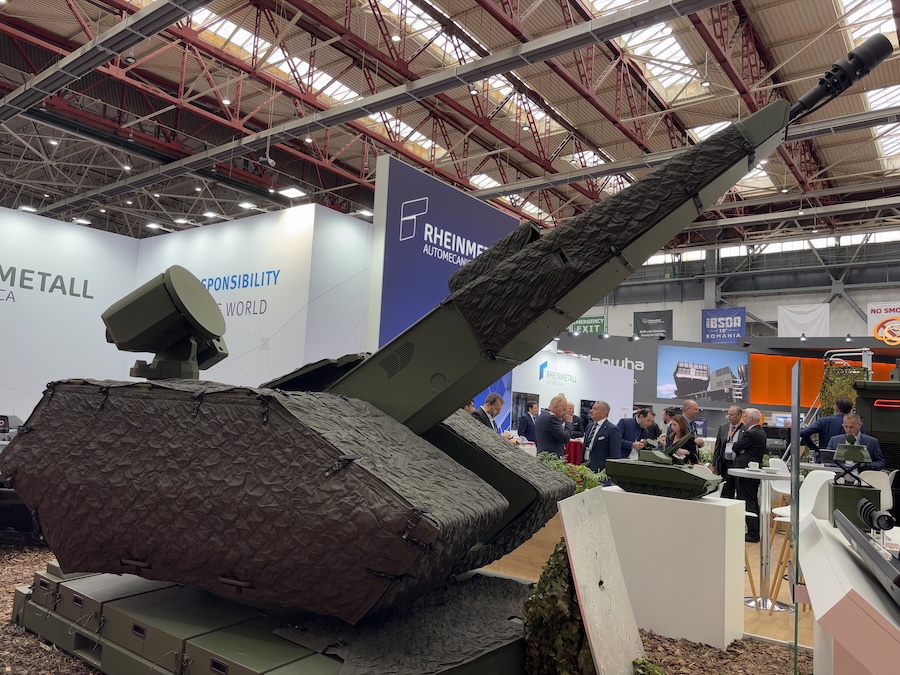
Germany’s Rheinmetall is expected to receive the largest share of the SAFE-funded defence package, according to defenseromania.ro. The outlet said the company is linked to €5.69 billion of the €8.33 billion total.
The 15 procurement projects approved for the Ministry of National Defence include Piranha 5 8×8 armoured personnel carriers and derivatives produced by GDELS Romania. They also include IVECO wheeled multifunctional vehicle transport platforms valued at €344.40 million.
The package includes a tactical operations centre for air and missile defence, known as SBAMD-TC, valued at €160 million. It also includes two diver intervention vessels worth €84 million and two offshore patrol vessels worth €836 million.
Romania also plans to acquire multi-mission helicopters valued at €852 million and a Naval Strike Missile launch system worth €207 million. The largest single listed programme is for infantry fighting vehicles from Rheinmetall Automecanica SRL, valued at €3.337 billion.
Other planned procurements include the SKYNEX ground-based air defence system with counter-UAS and C-RAM capabilities from Rheinmetall Italia, worth €476 million. A very short-range mobile air defence system, VSR-CUAS Skyranger 35, also from Rheinmetall Italia, is valued at €470 million.
The list also includes Gap Filler air surveillance radars worth €258 million and three medium-range surface-to-air missile systems worth €547.83 million. Loitering munition strike systems are valued at €147 million.
Romania also plans to buy very-short-range air defence systems with CIWS Millennium capabilities worth €36 million, including two systems from Rheinmetall Italia. The package includes 35 mm ammunition for C-RAM, Oerlikon and Skyranger systems, including AHEAD rounds, worth €450 million from Rheinmetall Waffe Munition GmbH.
The procurement package is part of a broader set of 21 military projects worth more than €9.5 billion. The ministry’s comments indicate that Romania intends to continue the SAFE programme, but may resist signing contracts that do not meet its requirements even if that creates delays.