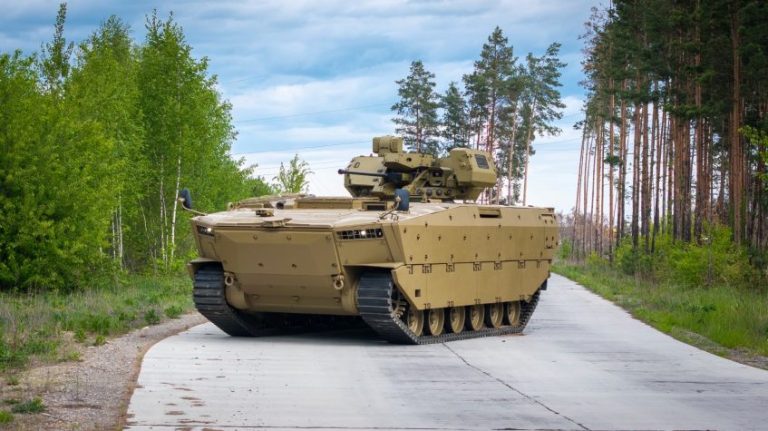

The two designs shown were Wolf, offered by General Dynamics Land Systems, and Lynx, offered by American Rheinmetall Defense. American Rheinmetall Defense is working with several other companies under Team Lynx.
Wolf is a new design, although earlier information indicates it may be derived in part from existing solutions in General Dynamics Land Systems’ global production network. These may include systems such as the European ASCOD from General Dynamics European Land Systems.
Lynx is derived from the KF41 Lynx, produced by Rheinmetall Landsysteme with partners from Hungary and Italy for the Hungarian, Italian and Ukrainian markets. In this case, the connection with the existing design also appears to be relatively loose.

Both vehicles follow a conventional layout for infantry fighting vehicles. Based on the drawings, it is difficult to determine their external dimensions or weight, although the latter is likely to exceed 40 tonnes.
The vehicles have two-person crews seated side by side behind the engine compartment. A troop compartment in the rear of the hull is designed to carry six infantry soldiers.
Other configurations of the troop compartment may eventually be developed if the XM30 enters service. Both vehicles have a large, nearly tank-sized turret mounted on the roof.
The turret is unmanned and does not penetrate the hull. It is armed with the Northrop Grumman XM913 50 mm chain gun, which uses 50×228 mm ammunition.
The ammunition load was not disclosed. The cannon is paired with a standard 7.62 mm M240 machine gun.
The vehicles may also be fitted with an additional 12.7 mm Browning M2A1 heavy machine gun in a remotely operated weapon station on the turret roof. Tube armament is supplemented by a universal launcher for anti-tank guided missiles from the TOW or CCMS-H families, or for loitering munitions.
The turrets shown in the drawings carry extensive sensor suites and communications antennas. Both vehicles appear to use similar suspension systems, with InArm hydropneumatic suspension, six pairs of road wheels and composite tracks.
The Rheinmetall design appears to use the company’s own track solution, while the General Dynamics vehicle may use tracks from Soucy. In both cases, the drive system is likely to be hybrid, or the vehicles may be designed for possible hybridisation in the future.
The level of armour protection was not disclosed, but it is expected to be strong and modular. The protection package is supplemented by Elbit’s Iron Fist active protection system, which was also selected for the M2A4ED1 Bradley.
The system is expected to undergo some form of Americanisation for U.S. Army use. Its final designation in the Army is expected to be M251, while the current XM251 version is planned for the XM30 and M1E3 tank and later for the Stryker and Bradley.
The main differences visible from the side-view drawings are limited. The GDLS Wolf may have a slightly longer hull, while the American Rheinmetall Defense Lynx may be somewhat taller.
The Bradley successor is expected to enter service around 2028 to 2030. Under current budget forecasts, the U.S. Army plans to buy 108 vehicles by 2031.
The final requirement could reach several thousand vehicles. However, changes in the global security environment and in the United States could still affect the programme.
The XM30, or MICV, is the sixth U.S. Army programme since the 1980s aimed at replacing the Bradley. All previous efforts to field a successor were unsuccessful.