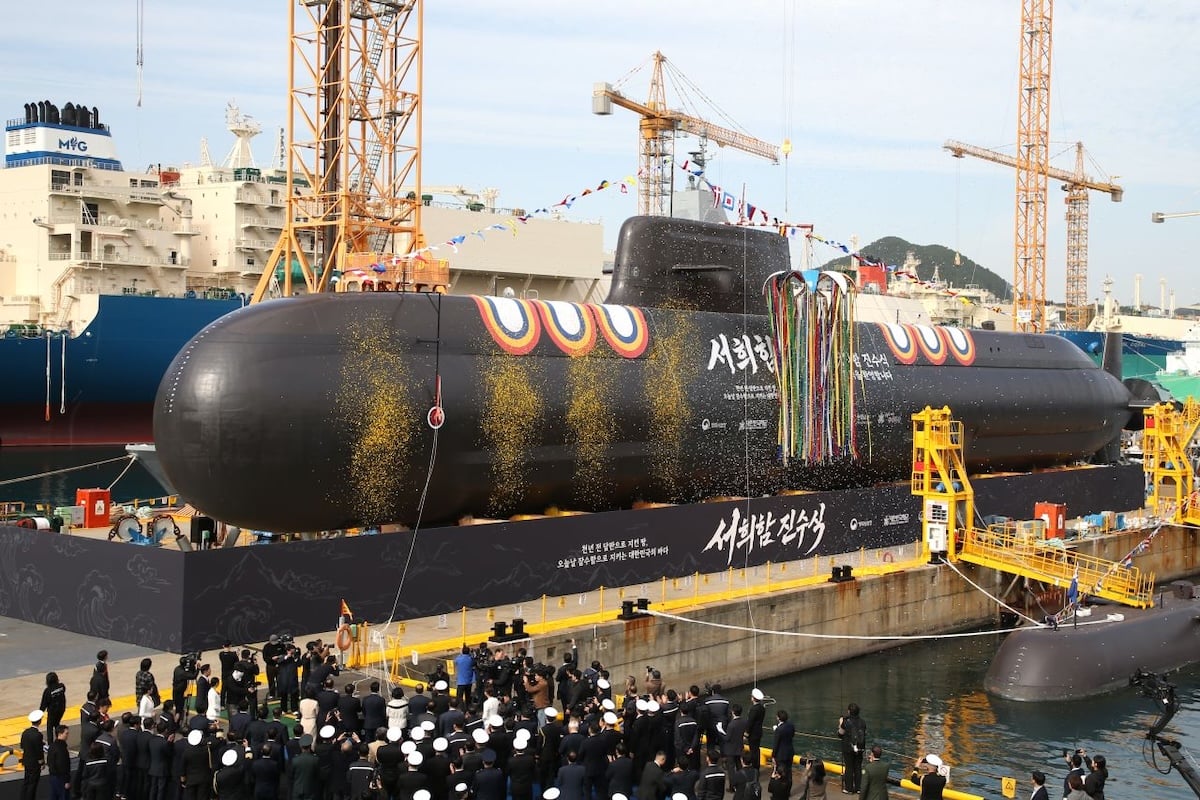
South Korea’s Defense Acquisition Program Administration announced the launch on 3 November at Hanwha Ocean’s Okpo shipyard on Geoje Island. The construction contract was signed in September 2021.
The approximately 3,600-tonne, 89-metre submarine has 10 vertical launchers, four more than the preceding Batch-I design. Its larger hull provides room for a broader range of weapons and equipment, while upgraded combat and sonar systems support long-range identification of multiple targets and precision strikes.
Propulsion improvements include lithium-ion batteries, modified electric motors and a retractable auxiliary azimuth thruster. Hanwha Ocean says the revised design offers longer submerged endurance, longer operation at maximum speed and reduced noise compared with Batch I.
The sensor changes include a passive sonar with a conformal array replacing the earlier ring-shaped array, and larger-aperture flank sonar arrays. The submarine also incorporates a Hensoldt SERO 400 optronic mast.
An auxiliary propulsion system provides a backup in the event of a propulsion failure. A separate hull-penetrating attack periscope enables direct observation when electro-optical sensing is limited, forming part of the design’s survivability improvements.
Domestic equipment accounts for a growing share of the programme, with another 12 equipment types localised, including the lithium-ion battery system. That brings the total to 70, which Hanwha Ocean says will support more reliable and responsive logistics.
Hanwha Ocean is building all three vessels in the KSS-III Batch-II programme, also known as the Jang Yeong-sil class. The lead submarine, Jang Yeong-sil, is due for delivery by the end of 2027.
Seo Hui takes its name from a military strategist and diplomat of the Goryeo Dynasty. Around 200 government, parliamentary and defence representatives attended the launch, with the Speaker of the National Assembly serving as guest of honour for the first time at a submarine launch.