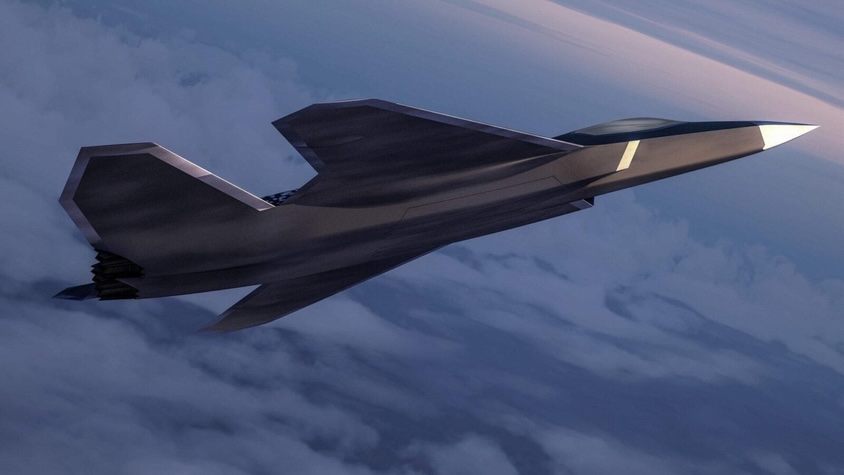
The move was disclosed in a report by India’s Standing Committee on Defence presented to parliament on 7 August 2026. The Ministry of Defence told the committee that it had started efforts to join the FCAS sixth-generation aircraft development programme currently led by the French government.
The parliamentary committee also asked the ministry to prepare a detailed action plan and timetable for India’s acquisition of sixth-generation combat aircraft. The announcement formalises a process that had already become visible earlier this year.
India and France were reported in February to have held preliminary discussions on possible Indian participation in FCAS, including development and production of the future aircraft. In March, the Indian defence ministry told parliament that the air force was considering either FCAS or the British-Italian-Japanese Global Combat Air Programme.
The strategic context changed after the original Franco-German aircraft partnership broke down. France and Germany acknowledged on 8 June that they could not continue the joint combat-aircraft project following unresolved disputes between Dassault Aviation and Airbus.
The disagreements centred on leadership of the aircraft design, the division of industrial work and technical requirements. France wants a successor to the Rafale that can also operate from an aircraft carrier, while Germany has different requirements.
The breakdown does not automatically end all work on technologies being developed under the wider FCAS framework. It does, however, create a potential opening for India that was more difficult under the original multinational structure involving France, Germany and Spain.
Paris is now open to a new partner able to share the high cost of development and provide a large future market for the aircraft. India could meet both requirements while also bringing a substantial domestic aerospace and defence-industrial base.
New Delhi’s objective goes beyond buying another French aircraft. India is seeking a meaningful role in the design, development and production of future combat-air technologies.
French President Emmanuel Macron and Indian Prime Minister Narendra Modi agreed in February to deepen cooperation on advanced military systems. The two countries also plan to establish a joint group to coordinate development of selected technologies.
That cooperation was given a technical framework through an arrangement between France’s defence procurement agency, the DGA, and India’s Defence Research and Development Organisation. FCAS participation could extend that relationship into technologies central to future air combat.
India is particularly interested in very-low-observability technologies, advanced sensors, data fusion and artificial intelligence. Other priorities include manned-unmanned teaming, communications systems and next-generation propulsion.
Access to those capabilities could be more important for India than the aircraft itself. New Delhi is seeking the engineering expertise needed to design and integrate a complete future air-combat system.
Propulsion remains a major priority for India after decades of efforts to establish an indigenous jet-engine capability. The Kaveri engine, originally intended for the Tejas fighter, has failed to meet the programme’s initial ambitions.
Defence Minister Rajnath Singh said in February that India needed to develop the ability to produce its own combat-aircraft engines within the next several years. Participation in FCAS could support that broader effort to strengthen domestic aerospace technology.
India is already pursuing a similar approach in other defence projects with France. The two countries signed an agreement in February covering production of Hammer missiles in India, while New Delhi is also seeking extensive local manufacturing in a planned purchase of another 114 Rafale fighters.
Under that proposed Rafale programme, 92 of the 114 aircraft would be produced in India. Local content is expected to reach between 55% and 60%.
FCAS would be a substantially larger industrial and technological undertaking. For France, Indian participation could spread development costs across a broader user base and reduce the burden of pursuing a national Rafale successor alone.
For India, the programme could provide a faster route to technologies that would otherwise require lengthy and expensive domestic development. It could also help establish production, maintenance and engineering capabilities for future combat-air systems.
The potential partnership also fits the two countries’ emphasis on strategic autonomy. France has maintained defence cooperation with India without requiring New Delhi to align with a specific political bloc, while India is seeking to reduce technological dependence on both the United States and Russia.
Major issues would still have to be resolved before India could formally join the programme. Intellectual-property rights, access to sensitive technologies and the division of industrial responsibilities are likely to be central to any negotiations.
Those issues carry added weight because disagreements over industrial leadership and workshare contributed to the breakdown of the original FCAS aircraft partnership. France would have to decide how much access Indian industry could receive to the programme’s most sensitive technologies.
India must also balance any FCAS role with its domestic Advanced Medium Combat Aircraft programme. New Delhi intends to develop the AMCA independently as its own fifth-generation fighter.
The two projects would not necessarily compete. AMCA could provide India with experience in developing an indigenous stealth fighter, while FCAS could offer access to technologies beyond the scope of the current domestic programme.
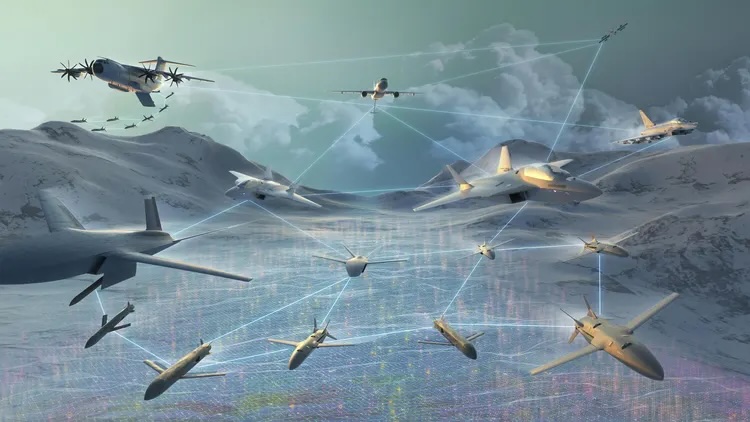
A sixth-generation combat aircraft is also expected to operate as part of a wider system rather than as a standalone platform. That system would include unmanned aircraft, weapons, remote sensors and data networks.
India’s formal move towards FCAS therefore represents a potential industrial partnership rather than another fighter acquisition. Whether it progresses will depend on negotiations over technology access, intellectual property and the role Indian companies would receive in designing and producing the future system.